Call or Text Now
When you look at a rebrand, you might think in the direction of a new name, refreshed label, or updated claim.
But what happens to the cases of product carrying the old branding? Overnight, that inventory shifts from asset to liability.
This is the piece of a rebrand that rarely makes it into the marketing timeline. Once you have obsolete beverage packaging and inventory that can no longer be sold under its old identity, you can’t just send it to the back corner of the warehouse. Instead, you need an actionable, documented plan to take care of it.
This guide walks through what actually makes beverage packaging obsolete, what happens to the inventory once it can no longer be sold, what retailers and documentation typically require during the transition, and where packaging recycling fits into the bigger picture.
What Makes Beverage Packaging Obsolete? Rebrands, Label Changes, and UPC Updates
Not every packaging update creates obsolete inventory, but most that touch the label, the name, or the product’s underlying formula do to some degree. Three triggers show up most often in a beverage rebrand inventory situation.
- A full rebrand replaces a product’s name, logo, or overall look. Even when the beverage inside has not changed at all, packaging carrying the old identity no longer represents the brand accurately on shelf, and in most cases cannot legally continue selling once the new identity launches.
- A label or claims update covers changes like an ingredient swap, a nutrition panel correction, a new certification (such as organic or non-GMO), or the addition of a health claim. These changes are smaller in scope than a full rebrand, but they carry the same consequence for old product labels still sitting in inventory.
- UPC changes are where a lot of brand teams get caught off guard. A barcode is meant to identify a specific product exactly as it currently exists, so the deciding factor isn’t whether packaging changed at all, but whether the change is significant enough to affect how the product is identified, sold, or tracked.
GS1 US, Navigating GTIN Changes lays out three guiding principles you can use to decide when a new GTIN is required: consumer perception, regulatory compliance, and supply chain impact. A rebrand or label change typically checks more than one of those boxes, which is why a UPC change often rides along with a packaging update, and why old product label inventory becomes obsolete right alongside it.
What Happens to Old-Label and Obsolete Packaging Inventory
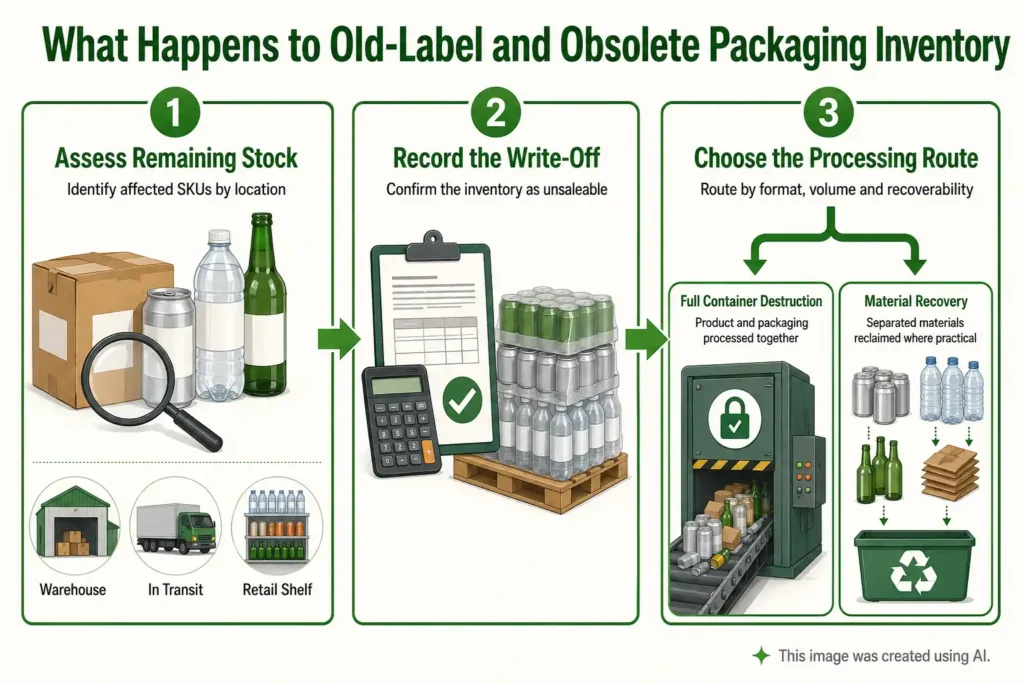
Once a product can no longer be sold under its old branding, it quickly becomes obsolete. Working through this kind of unsaleable beverage inventory (sometimes handled as a straightforward branded inventory disposal project) generally comes down to three steps.
1. Assessing What’s Left in Stock
Before anything gets written off or routed anywhere, you have to understand identifying exactly which SKUs are still carrying the old label, claim, or UPC, and where that stock physically sits:
- Company-owned warehouses
- Product already in transit to distributors or retailers
- Physically on shelf under the old identity
That breakdown, by location and by SKU, is what determines the scale of everything that follows
2. The Write-Off Decision
Once old-label stock is identified and confirmed unsaleable, it typically moves onto the books as a write-off, a straightforward accounting step that comes before any product leaves the warehouse.
3. Routing to Destruction or Material Recovery
From there, written-off stock gets routed one of two ways: full container destruction or material recovery. The right path depends on the format, the volume, and whether the packaging materials themselves can realistically be reclaimed once separated.
Most of that written-off volume moves through full container destruction, where the product and its packaging are processed together and verified as unsellable before material recovery begins.
Retailer Requirements and Documentation for Packaging Transitions
Because UPC changes often accompany a rebrand, most of the friction with retailers shows up around barcode timing rather than the packaging itself.
1. What Retailers Typically Expect During a Packaging Transition
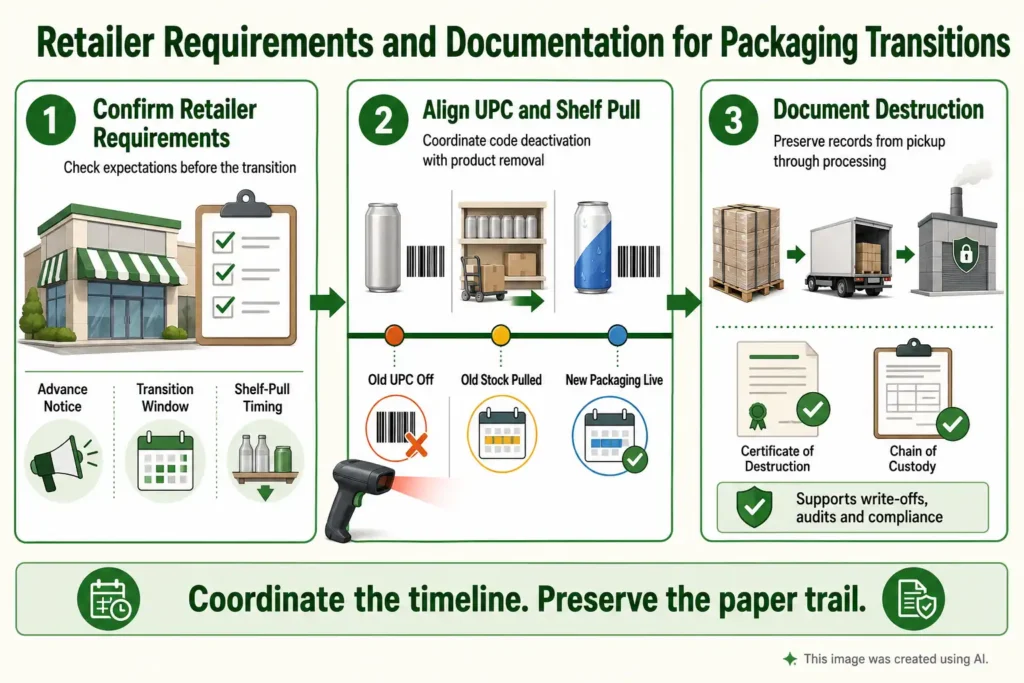
Exact requirements vary by retailer. However, many major retailers share a similar general expectation: once a new UPC and label go live, the old code needs to stop scanning and old-label product needs to come off shelf within a defined window.
Some retailers ask for advance notice before the transition; others expect the brand to manage shelf-pull timing on its own and flag any issues after the fact. Confirming expectations with each retail partner directly is worth doing early in the transition.
2. Old-Code Deactivation and Shelf-Pull Timing
If old UPC deactivation and pulling the physical old-label product do not line up, stores can end up with product that will not scan, or with old and new packaging sitting side by side longer than intended. This creates its own confusion for shoppers and store staff. If a retailer pulls the old-label product before it sells through, you may also be left with unsold beverage inventory to manage.
To avoid most of this friction, aim to plan the deactivation date and the shelf-pull date together, rather than treating them as separate workstreams.
3. Documentation: Certificate of Destruction and Chain of Custody
Once obsolete inventory is routed for destruction, documentation matters just as much as the retailer-facing timeline. A certificate of destruction and a clear chain of custody record give your finance and compliance teams what they need to support the write-off, close out the audit trail, and demonstrate, if ever asked, exactly what happened to product that is no longer on the books.
That paper trail is really what beverage disposal compliance comes down to: not paperwork for its own sake, but the record that stands behind the accounting decision made earlier in the process.
Can Obsolete Beverage Packaging Be Recycled?
Destruction handles the branding and product side of obsolete inventory, but the packaging materials themselves do not have to follow the same path once they have been separated out.
1. Glass
Glass separates from labels easily and holds its recovery value once removed, moving through the standard glass bottle recycling process like any other bottle leaving a beverage facility.
2. PET Plastic
PET follows the same logic, with one added step: printed sleeves, glued labels, and shrink wrap need to come off cleanly before the resin underneath is worth reclaiming through standard PET bottle recycling.
3. Labels and Other Packaging
Secondary packaging, cartons, sleeves, and shrink wrap, is harder to standardize than glass or PET, since it often mixes materials that need to be pulled apart before recovery is even possible. The rebrand-specific piece is straightforward: old branding and printed labels need to come off cleanly, since adhesive residue and mixed materials left behind can lower what’s recoverable underneath. That’s why label and wrap removal, alongside these broader beverage packaging considerations, is usually planned as its own step.
Working With a Partner for Obsolete Packaging and Rebrand Transitions
A rebrand is, at its core, a business and compliance event, not a safety recall. The inventory is not dangerous, contaminated, or defective. It is simply carrying an identity the brand has moved past. That distinction matters for how the transition gets handled, and it is part of why documentation and routing look different from what a recall requires.
Shapiro coordinates the collection, sorting, and routing of obsolete beverage inventory from non-alcoholic beverage industry brands to the specialized processors equipped to handle destruction and material recovery, without operating that equipment itself. For brand, packaging, and compliance teams working through a rebrand, a label change, or a UPC change, that means one point of contact for old-label product instead of separate vendor relationships for destruction, documentation, and recycling.
If your team is dealing with obsolete beverage packaging, our beverage destruction services can help you navigate the process. Contact us to talk through the volume, timeline, and documentation your rebrand needs.
FAQ
1. What counts as obsolete beverage packaging?
Obsolete beverage packaging is any inventory, cans, bottles, labels, or secondary packaging, that can no longer be legally or commercially sold because the branding, label, formula, or UPC it was produced under has changed. It typically includes warehouse stock, in-transit product, and anything still sitting on shelf under the old identity at the time of a rebrand or label update.
2. Do I need a new UPC every time I update my label or packaging?
Not always. Minor cosmetic changes generally do not require a new GTIN, but changes that affect consumer perception, regulatory compliance, or supply chain handling typically do. GS1’s guidance frames the decision around those three principles rather than a single fixed rule, so it is worth confirming against the specific change being made.
3. What happens to old-label inventory after a rebrand?
It is typically assessed for volume across warehouse, in-transit, and shelf stock, written off once it can no longer be sold under the old branding, and routed to destruction or, where the packaging can be cleanly separated, material recovery.
4. Do retailers require proof of destruction for discontinued packaging?
Many retailers and internal audit or finance teams expect documentation, such as a certificate of destruction, when old-label inventory is written off, though exact requirements vary by retailer. Even where it is not strictly required, that documentation supports a brand’s own accounting and compliance records.
5. Can obsolete packaging inventory be resold or discounted instead of destroyed?
It depends on why the inventory became obsolete. A purely visual rebrand, where the name, logo, or design changed but the product, claims, and approved label content underneath are still accurate, sometimes leaves room to sell through existing stock via discount or clearance channels, if the retailer agrees to it.
The picture changes once the packaging itself is no longer compliant. At that point, the product typically can’t be legally sold, discounted, or diverted through secondary retail channels, regardless of the condition of what’s inside, and destruction or material recovery becomes the compliant path.
6. How is this different from a product recall?
A recall is triggered by a safety, quality, or contamination issue and usually involves regulatory notification and a defined public response. Obsolete packaging from a planned rebrand or label update is a business event: the product itself is not unsafe, it simply cannot be sold under packaging that no longer matches its approved identity.
our expert

Peter W. Klaich Director, Agriculture/Animal Health
Peter Klaich is a leading expert within the agricultural recycling and animal health market arena, known for leading National Sales at Skip Shapiro Enterprises since June 2016. He focuses on advancing sustainable recycling solutions and waste management practices across the agricultural industry.