Call or Text Now
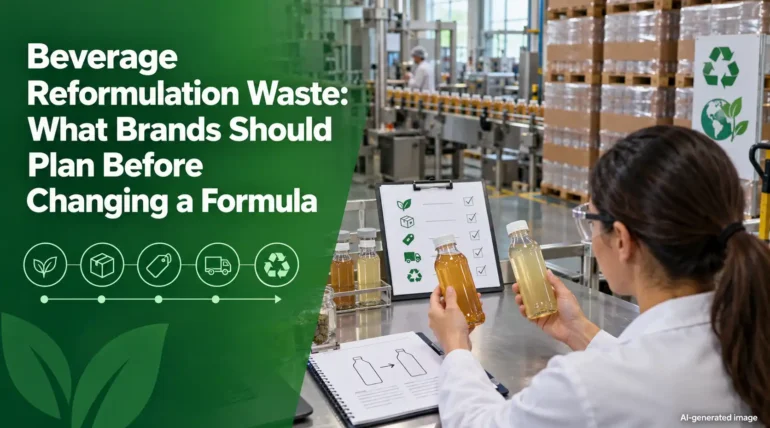
Your team just approved a reformulation, maybe a new sweetener or a cleaner label claim, and launch day is on the calendar.
What’s easy to miss is everything the old formula leaves behind once that date hits. Pallets of previous-recipe stock are still sitting in the warehouse, correctly labeled but with no real plan for selling through or disposing of them.
Left unplanned, that leftover inventory has a way of piling up until someone has to deal with it all at once.
This guide covers the operations side of a beverage reformulation including what it leaves behind, how to plan segregation and storage before launch, how to coordinate shelf and retailer transitions, and how to route old-formula stock through responsible disposal and recovery once its time is up.
What Is Beverage Reformulation, and Why Does It Create Inventory Waste?
Beverage reformulation is any change to a product’s recipe, whether that’s a full ingredient overhaul or a much smaller adjustment. Old-formula inventory stays in the warehouse until it’s sold through or otherwise resolved. Additionally, any pre-printed packaging or labels still tied to the old recipe become their own waste stream, since they’re no longer usable once the new formula is on shelf.
For most beverage teams, this kind of planning gap ends up being one piece of a much larger question around beverage industry waste management, and getting ahead of it here saves a bigger headache later.
Old-Formula Inventory and Failed Batches: What Reformulation Leaves Behind
Old-formula stock and off-spec products tend to get mixed up, and that mix-up is exactly how brands end up making the wrong call on both.
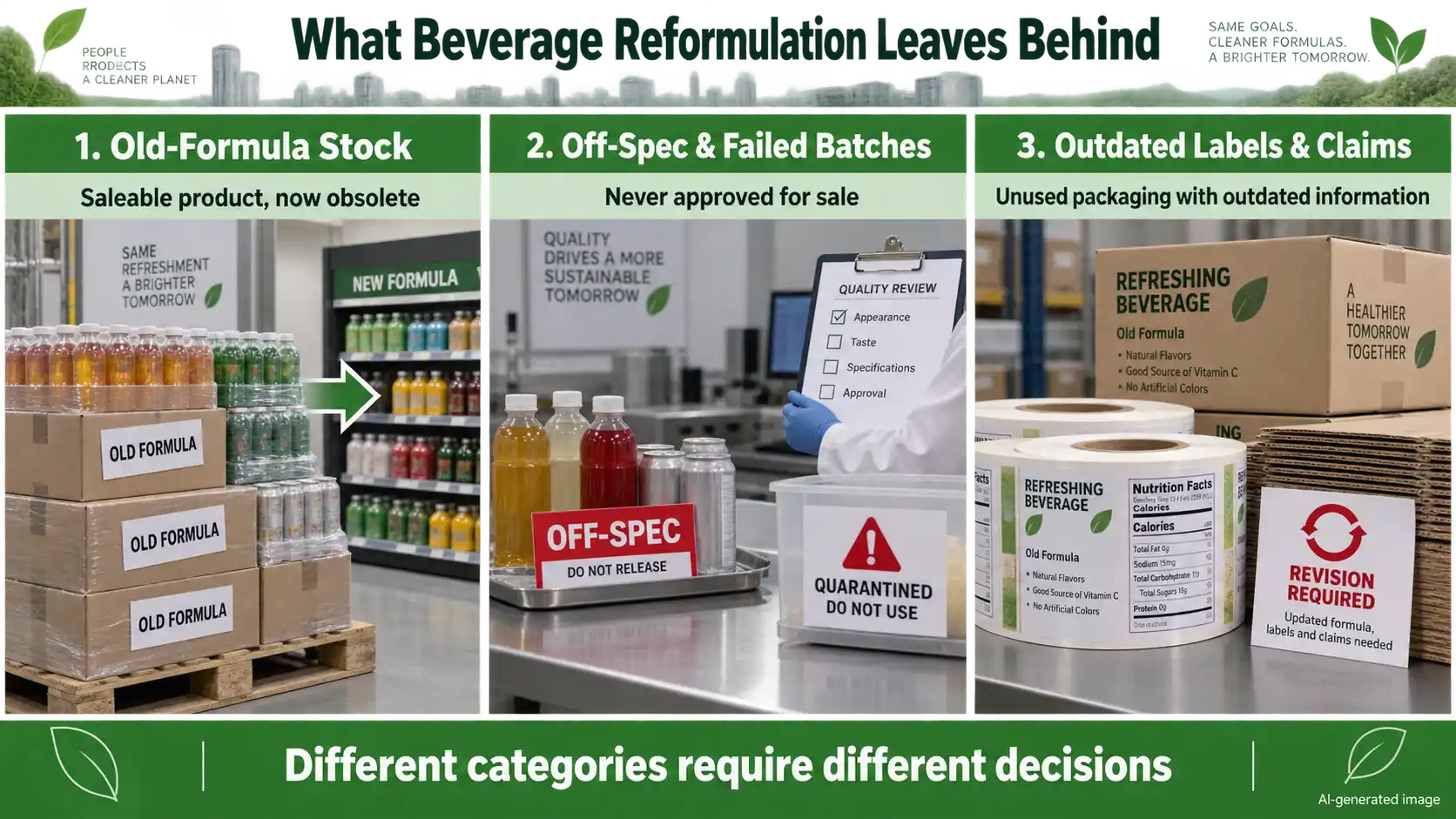
1. Remaining Old-Formula Stock
This is an obsolete formula inventory in the most literal sense. Cases built under the previous recipe that are still sitting in your warehouse or on a retail shelf once the new formula goes live.
The product itself may be perfectly fine to consume, but it no longer matches what the brand is telling the market, and it’s now competing for the same shelf space as the product replacing it.
A discontinued formula doesn’t stop being real inventory just because a new version exists, and it still needs a defined endpoint.
2. Off-Spec and Failed Batches
Off-spec batches are a different category. These runs are created during the product reformulation process itself, but they don’t meet the spec the brand approved for sale. An off-spec beverage product shouldn’t be treated the same as slow-moving old stock, since it was never sellable to begin with. This should feed directly into whatever quality review already exists on the production side, where food and beverage safety protocols already apply during a formula change.
3. Outdated Labels and Claims
This includes brand new, pre-printed packaging waiting for future production. While the labels are perfectly usable, they carry the old recipe’s ingredient list, nutrition information, or marketing claims that are no longer accurate. For more on what happens when packaging can no longer be used, see our guide to obsolete beverage packaging.
Planning Segregation and Storage Before Reformulation Launches
Most of this is avoidable with planning ahead. Keep old-formula and new-formula stock clearly separated for as long as both exist, and set in advance how long that overlap is allowed to last.
1. Why Mixing Old and New Formula Stock Is a Real Risk
A mislabeled or mixed pallet can cause a labeling and compliance problem that can follow you well past the shipping dock. One small handling error on the floor, during that overlap, is all it takes to turn into a much bigger problem.
2. Practical Segregation Approaches
The fix is mostly procedural. Give old-formula and new-formula stock their own physical zones or pallet locations, and back that up with lot coding and labeling clear enough that nobody has to guess which pallet is which. Treat formula change inventory as its own category for the length of the transition, not as an extension of general stock.
3. Setting a Hard Storage Timeline
Old-formula stock needs a shelf life of its own, not an open-ended “we might still need it” status. Setting a firm decision date, tied to the segregation plan above, gives the transition a real end point. Once that date passes, remaining stock moves straight into disposal and recovery paths.
Beverage Inventory Transition: Coordinating Shelf and Retailer Timing
A beverage inventory transition has to work on the retail side too. Getting the old formula off shelf at roughly the same time the new formula goes on takes coordination that’s easy to underestimate, especially across many retail points. If a retailer delists or pulls back the old formula before it sells through, see our guide to retail pullbacks, delistings, and unsold beverage inventory.
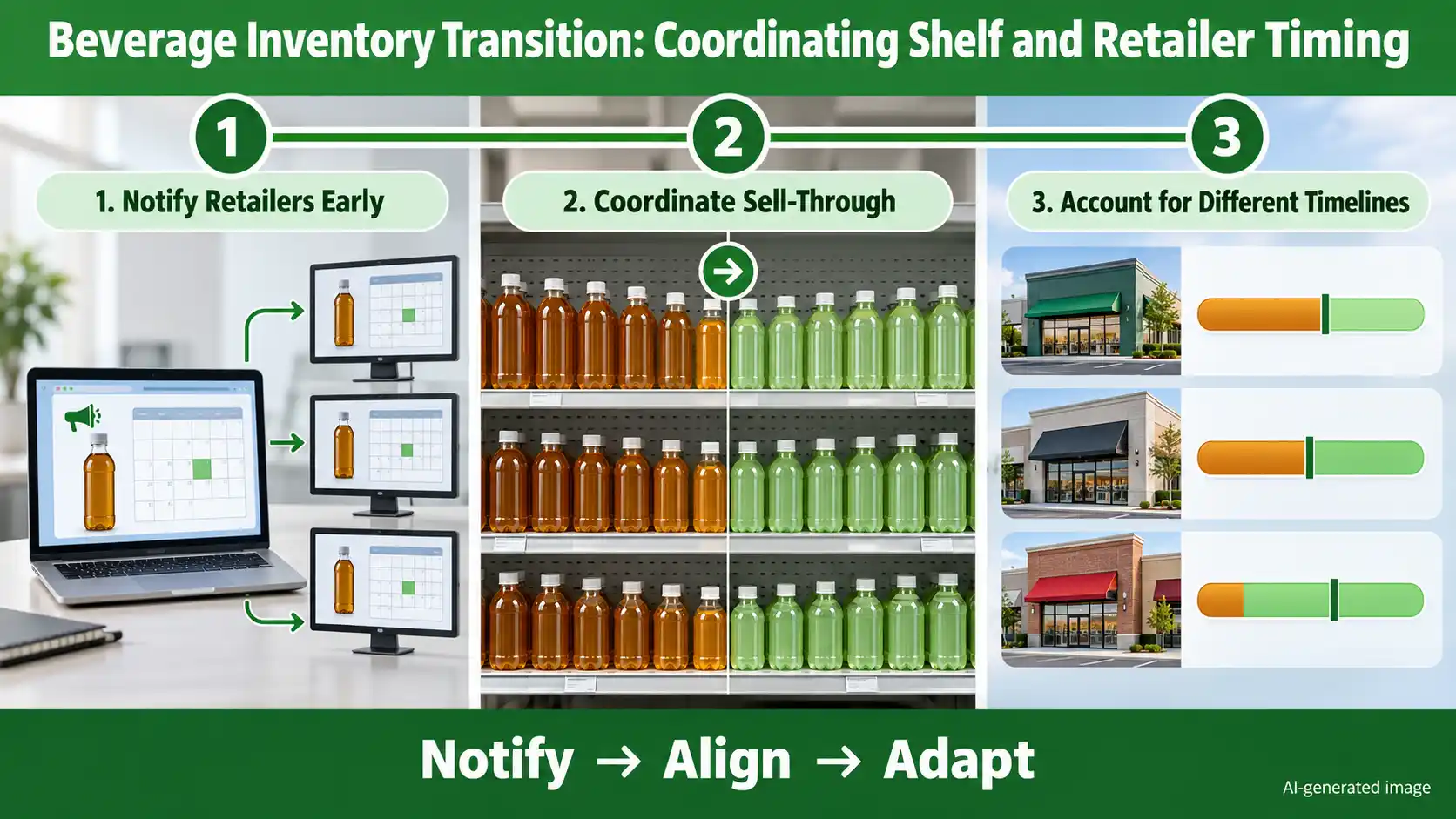
1. Notifying Retailers Ahead of the Change
A reformulation is a change, not a discontinuation, and the notice you send retailers should reflect that distinction. Giving buyers advance notice, along with a clear reason for the switch, helps them plan shelf resets on their own timeline and keeps them from pulling stock they didn’t realize was about to be replaced.
2. Coordinating Sell-Through with the New Formula’s Arrival
The old formula’s last sell-through date and the new formula’s on-shelf date need to land close together. Fall short on timing and retailers end up with a stockout while they wait on the new version. Run it too long the other way and you’ve got two versions of the same product fighting for the same shelf space.
3. Accounting for Different Retailer Timelines
Some accounts move fast once new product ships, others work through existing stock at their own pace no matter what the brand prefers. A realistic transition plan builds in room for that spread.
Destruction, Recovery, and Documentation for Old-Formula Inventory
Once the storage deadline passes, remaining discontinued formula stock needs a real next step. Some of it may still carry recovery value, but whatever can’t be resold has to leave circulation on the record.
That’s where Shapiro comes in. We work with food and beverage manufacturers to assess the product and packagin, then route it to a certified processor for secure, documented handling, the same beverage destruction services process already used for expired, damaged, and recalled inventory, backed by the kind of paper trail and chain of custody that beverage disposal compliance calls for. Leftover process water or rinse-outs from the same transition usually fall under liquid waste disposal instead.
If a reformulation is on your calendar and you’d rather plan this side of it now, contact us and we’ll help map out segregation, storage, and disposal around your launch.
Frequently Asked Questions
1. What counts as beverage reformulation?
Any recipe change counts as beverage reformulation, from a full ingredient swap to smaller changes in sweetness or acidity. The scale of the change varies, but the inventory planning it requires follows the same process. If a reformulation is on your calendar and you’d rather plan this side of it now, contact us and we’ll help brands in the non-alcoholic beverage industry map out segregation, storage, and disposal around your launch.
2. What happens to old-formula inventory after a reformulation?
It typically moves through a defined transition window, segregated from new-formula stock, until it either sells through, gets pulled for recovery where feasible, or reaches its storage deadline and moves to documented disposal.
3. What’s the difference between old-formula inventory and an off-spec batch?
Old-formula inventory was made correctly under the previous recipe and just hasn’t sold through yet. An off-spec beverage product is a batch from the transition itself that never met the new formula’s spec, so it was never sellable in the first place.
4. Do we need new packaging when we reformulate a beverage?
Sometimes. Whether packaging still works depends on what actually changes in the formula, pH, ingredients, the preservation system, processing conditions, and the packaging material. It’s worth reviewing packaging compatibility as a standard part of the reformulation process rather than assuming the current packaging will still hold up pH or preservation shift.
5. How should we plan retailer and shelf transitions during a reformulation?
Notify retailers ahead of the change, coordinate the old formula’s last sell-through date with the new formula’s on-shelf date, and build in room for the fact that many retailers won’t reset on the exact same schedule.
6. What documentation should we keep for discontinued formula inventory?
Keep a record of how old-formula and new-formula stock were segregated and lot-coded during the transition, along with the storage deadline you set. Once that stock is disposed of or recovered, hold onto confirmation of how it was handled, including any certificate of destruction or chain-of-custody paperwork for product that left commerce for good.
our expert

Peter W. Klaich Director, Agriculture/Animal Health
Peter Klaich is a leading expert within the agricultural recycling and animal health market arena, known for leading National Sales at Skip Shapiro Enterprises since June 2016. He focuses on advancing sustainable recycling solutions and waste management practices across the agricultural industry.