Call or Text Now
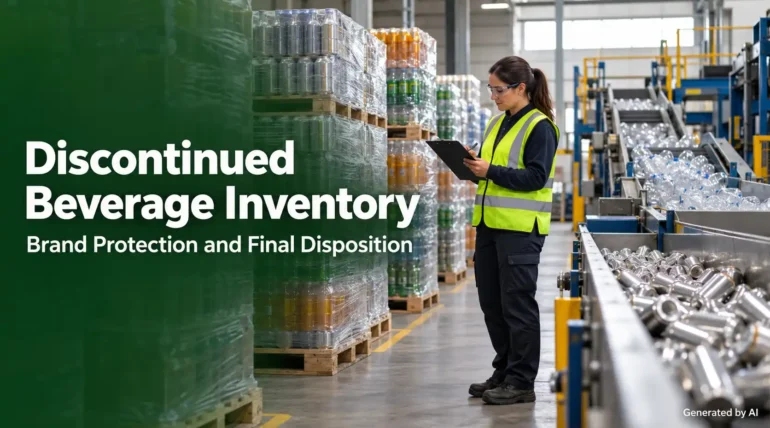
Pulling a SKU from the lineup is a merchandising call.
So, what happens to the discontinued beverage inventory after that? Until there’s a confirmed destination and a paper trail proving it got there, it’s still yours, whatever the sell sheet says.
For food and beverage manufacturers sunsetting a SKU, the hardest part of handling the process is proving where the discontinued product goes after the decision is made. The path from “no longer sold” to “fully and verifiably out of commerce” is the step that gets skipped, right up until someone asks where the inventory actually ended up.
In this blog, we’ll cover what is discontinued SKU, how to protect your brand during a market exit, and the documentation you’ll need for it.
What Counts as a Discontinued or Obsolete Beverage SKU?
A SKU becomes discontinued the moment a brand decides to stop producing or selling it. Obsolete SKUs, including obsolete beverage packaging replaced by a redesign but never fully cycled out of inventory, follow a similar pattern.
Most of these decisions trace back to SKU rationalization, the ongoing review brands run to see which products earn their place in a portfolio and which should get cut. What happens to the physical inventory afterward is a separate question.
Whatever the trigger, discontinued beverage products rarely disappear the moment a decision is made. Cases usually end up sitting in a warehouse or with a distributor, and someone eventually has to decide what happens to them.
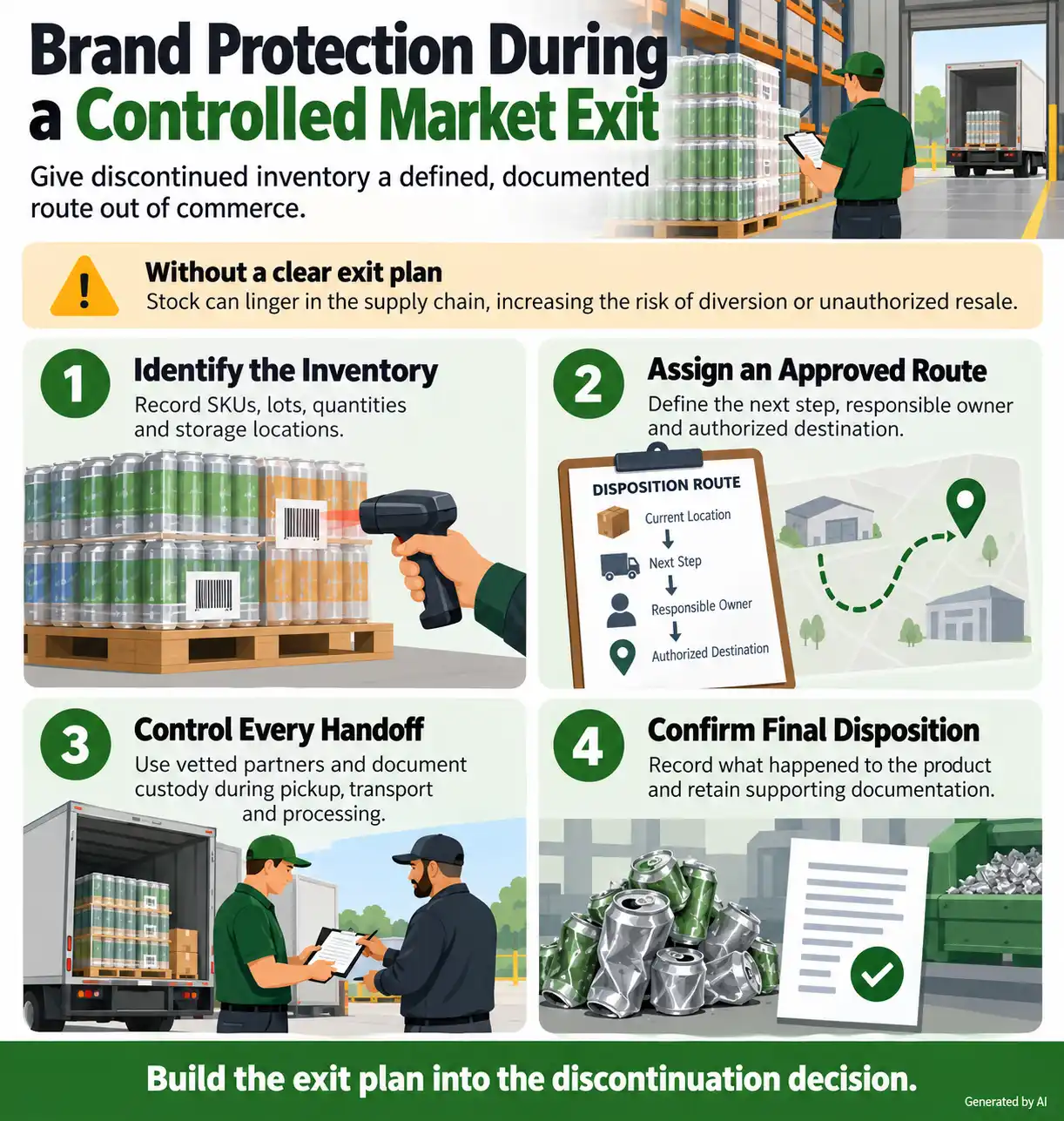
Brand Protection During a Controlled Market Exit
A controlled market exit means moving discontinued inventory out of commerce through a defined, documented process.
1. Why an Uncontrolled Exit Creates Brand Risk
Discontinued inventory with no assigned path doesn’t become neutral just because it’s no longer for sale. It becomes a liability with no clearly assigned disposition path or next step. The longer that goes on, the more decisions get made by default. A distributor holds onto product because nobody told them otherwise, and stock that should have exited the supply chain months earlier keeps floating through it.
None of this requires bad intent, just the absence of a plan, and that absence is exactly the condition that lets discontinued product drift toward outcomes a brand never authorized.
2. Grey-Market and Unauthorized Resale Risk
The risk of genuine, branded goods showing up in unapproved channels is very realistic. Overstocked distributors often offload unsold inventory instead of returning it to the manufacturer, which means inventory meant for destruction resurfaces instead of being retired. Discontinued beverage inventory sitting without a documented final destination carries that same diversion risk, even if it doesn’t always play out that way.
Gray market goods are genuine products bearing a valid trademark that were authorized for sale abroad and then imported into the United States without the trademark owner’s consent. For discontinued domestic inventory, the broader concern isn’t gray-market activity in that strict sense, it’s unauthorized resale or product diversion, the same concern that surfaces around retail pullbacks on unsold beverage inventory as much as anywhere else.
That doesn’t mean every discontinued SKU is destined for an unauthorized reseller’s listing but to avoid it from happening, you should build the exit plan into the discontinuation decision itself.
3. What “Controlled” Actually Means in Practice
In practice, a controlled exit rests on a few elements like:
- Inventory that’s identified down to the SKU and lot level
- Products are handled only by authorized, vetted partners
- Custody is documented at every handoff
- Final disposition is confirmed and recorded
A controlled exit also benefits from a clear decision plan. Once a SKU is formally discontinued, the brand should know what inventory remains, where it is located, who is responsible for it, and what approved route will take it out of commerce. That makes the disposition plan actionable. It also gives all parties involved a specific set of instructions instead of leaving them to decide whether to hold, return, discount, or move the product.
Contractual and enforcement measures matter too. Distribution agreements with clear, enforced resale restrictions are a practical way to keep control over product after it leaves a brand’s direct possession. The same logic applies to the discontinued beverage inventory scenario. Your control over the SKU should end only when you can verify it’s out of commerce.
Chain of Custody and Documentation for Discontinued Inventory
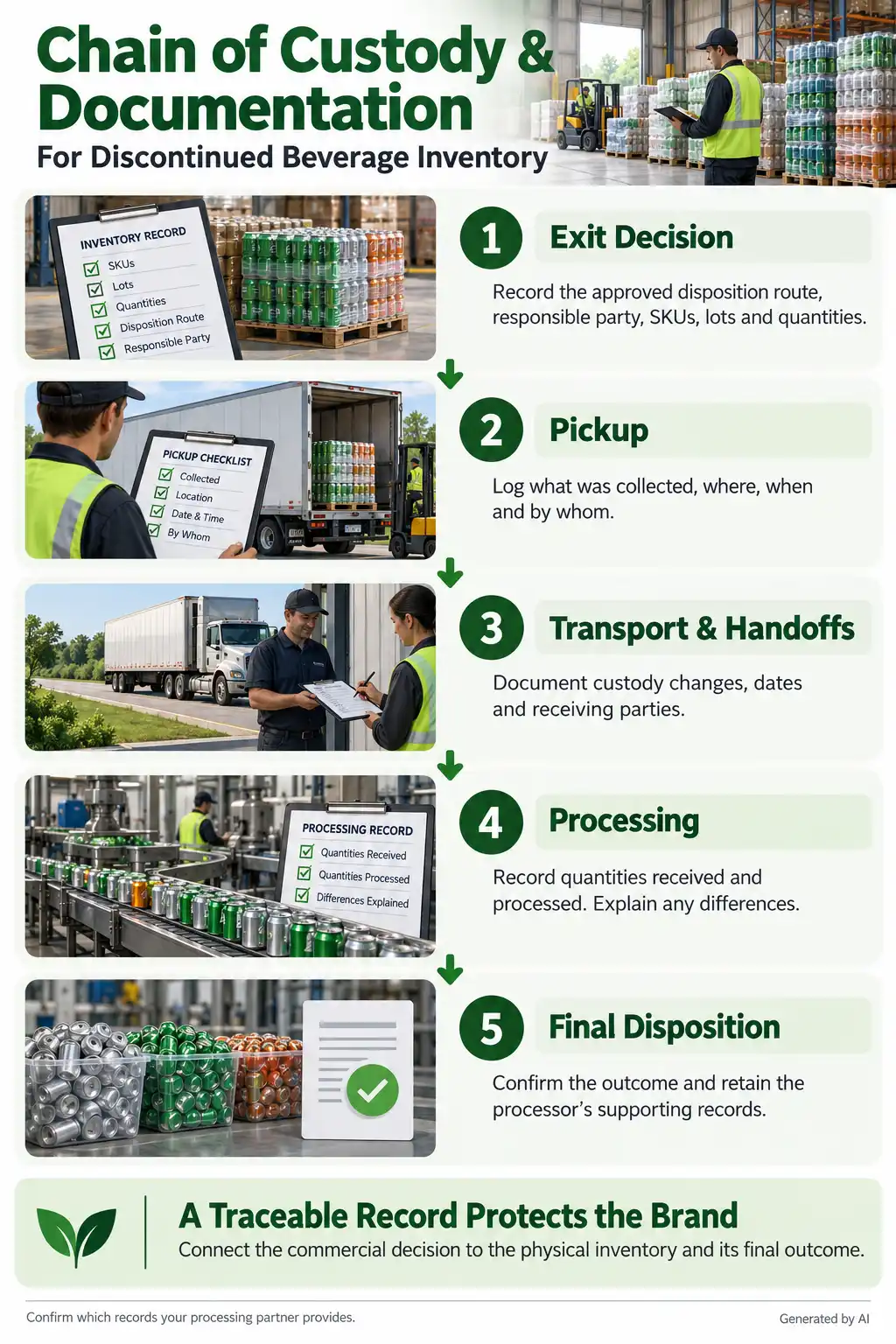
End-of-life inventory disposal without a paper trail is really just disposal with extra steps and no way to answer a question later. Documentation is the record showing how discontinued inventory moved from the exit decision to its final resting point, proving the product left commerce in a controlled way.
1. What Chain-of-Custody Documentation Should Include
Good documentation typically tracks inventory from the exit decision through pickup, transport, processing, and confirmed final disposition. What gets documented varies by product type and processor, so confirm what a given partner’s network actually captures.
2. Documentation as Brand Protection, Not Just Compliance
It’s tempting to file documentation under internal audit and move on, but that undersells what it does. Defensible records are what you can point to the moment a question comes up. Reviewing beverage disposal documentation requirements before a SKU is discontinued turns a compliance formality into a real brand-protection tool.
For a discontinued SKU, that record can also connect the commercial decision to the physical inventory. A disposition file can show what was authorized to leave the channel, what quantity was collected, when custody changed hands, and what happened at the end of the process. If quantities change between pickup and processing, the documentation should make that movement transparent and understandable.
Without that record, you’re left explaining why you can’t say where your own product went. With it, the answer is already on file.
Channel-Specific Packaging, Retailer Returns, and Working With a Partner
A few details make discontinued-SKU disposition more sensitive than routine inventory turnover. For example, if you’re handling private-label and co-branded packaging, you can’t just redirect it elsewhere even if it’s technically saleable, narrowing the options once that SKU is discontinued.
The same issue can arise when discontinued inventory is returned by retailers or distributors. Once the product can no longer remain in its intended channel, those returns still require clear custody, documentation, and a defined disposition path, as with retail pullbacks and delistings.
Additionally, product may move back to a warehouse or third-party facility before its final disposition is decided. That handoff is part of the exit process. Keeping the returned quantities tied to the affected SKU and lots help you account for inventory that has moved back into your control and avoid creating a new gap between the pullback and final disposition.
With so many details in the picture, controlled disposition becomes the option that actually protects the brand.
This is also where a partner earns its place. Shapiro works with beverage brands, distributors, and CPG teams to coordinate what happens next for discontinued inventory, arranging beverage destruction services, managing chain-of-custody documentation, and routing product to appropriate processors for full beverage container destruction or recovery.
If your team is sitting on a discontinued SKU without a documented plan, contact Shapiro to talk through the inventory and what a controlled exit would look like.
Frequently Asked Questions
1. What is a controlled market exit for a discontinued beverage SKU?
It’s a documented process for moving discontinued inventory out of commerce. This includes identifying, routing, tracking, and documenting all affected SKUs and lots.
2. Can discontinued beverage inventory end up on the grey market?
It can if it isn’t managed with a plan, though it isn’t guaranteed. Genuine, branded product can enter unauthorized resale channels through clearance sales, authorized-dealer returns, or bulk offloading when a line changes, exactly the scenario a discontinued SKU can create without documented routing. For more information on how to start building a plan, check out our beverage waste management guide.
3. What documentation should we keep when we discontinue a SKU?
You should keep records of affected SKUs and lot numbers, quantities, packaging format, the reason the product left circulation, and a chain of custody covering pickup through confirmed final disposition. Requirements vary by processor and product type, so confirm specifics with your disposition partner.
4. How is this different from a general SKU rationalization plan?
SKU rationalization is the broader process of deciding which products to keep, cut, or reformulate based on margin, velocity, and portfolio fit. This piece picks up after that decision is made, focusing on protecting the brand and documenting final disposition once a SKU is already headed off the shelf.
5. Do retailer-specific or private-label packaging SKUs need special handling when discontinued?
Generally yes. Packaging tied to a private-label or co-branded agreement often can’t be resold or redirected elsewhere, and contractual restrictions may limit resale options further. These SKUs typically call for documented, controlled disposition rather than a secondary sales channel.
our expert

Peter W. Klaich Director, Agriculture/Animal Health
Peter Klaich is a leading expert within the agricultural recycling and animal health market arena, known for leading National Sales at Skip Shapiro Enterprises since June 2016. He focuses on advancing sustainable recycling solutions and waste management practices across the agricultural industry.