Call or Text Now

Many people discuss food waste generated by restaurants and food manufacturers but often overlook the waste produced by the beverage industry.
With the beverage industry contributing to 26% of overall food waste, it’s no secret that more targeted reduction initiatives and effective waste management strategies are essential to addressing this issue.
Beyond environmental responsibility, the beverage industry is facing increasing pressure from both consumers and regulators. And while steps are being taken to improve waste management in the food and beverage industry, the problem persists.
In this guide, we explore the key challenges of managing beverage industry waste, outline ten strategies for more effective waste management, explain why non-alcoholic beverages require specialized destruction, and more.
Key Takeaways
- Beverage waste management involves handling complex waste streams, like liquids, packaging, and regulated substances, making compliance and sustainability essential for business success.
- Manufacturers face major challenges such as high-volume liquid waste, difficult-to-recycle packaging, strict regulations, and the need for proper handling of expired products.
- Effective waste reduction strategies include technologies like anaerobic digestion, improved recycling systems, reusable packaging, and strong waste segregation protocols.
- Partnering with a reliable beverage destruction provider helps businesses ensure compliance, maintain traceability, reduce operational disruption, and scale waste management efficiently.
Understanding Waste Management in the Beverage Industry
Waste management in the beverage industry refers to the processes and strategies used to reduce, reuse, recycle, and properly dispose of waste generated during the production, packaging, and distribution of beverages.
In other words, beverage waste is about more than just empty cans or bottles. Beverage manufacturing and distribution produce a huge variety of waste streams, including:
- Liquid waste, such as expired drinks and production byproducts
- Packaging materials like plastic bottles and aluminum cans
- Sensitive or hazardous substances like alcohol
Handling all this waste in an effective way isn’t just good practice; it’s crucial if you want to stay compliant and sustainable while running a successful operation.
The beverage industry produces waste that has particularly complex recycling or destruction methods. That’s why managing liquid food and beverage waste requires intricate beverage destruction strategies. stry produces waste that has particularly complex recycling or destruction methods.
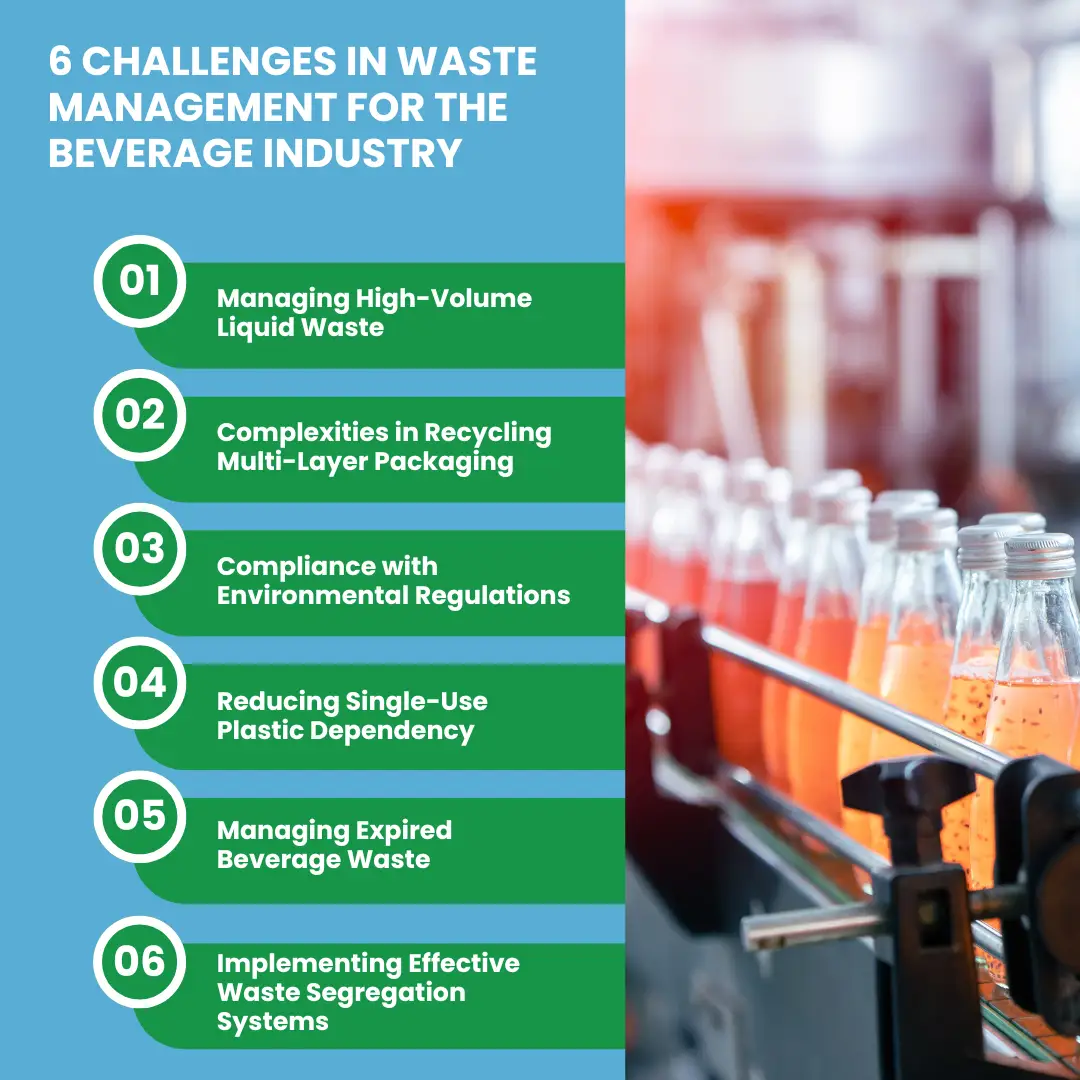
6 Key Challenges in Waste Management for the Beverage Industry
Waste management in the food and beverage industry is far from simple. Manufacturers and distributors face tons of issues, like having to manage massive volumes of liquid waste and staying compliant with complicated recycling processes.
We’ve identified the 6 biggest challenges that beverage manufacturers have to overcome to be able to effectively and sustainably manage beverage waste. Let’s talk about them.
1. Managing High-Volume Liquid Waste
One of the toughest challenges for beverage producers is the sheer amount of liquid waste they need to handle. Liquid waste disposal covers things like:
- Expired soda
- Contaminated juices
- Huge volumes of rinse water
- Spills
- Much more
Getting rid of such waste in an ethical and sustainable way takes meticulous planning. If you want to mitigate these challenges, avoid causing harm to the environment, and steer clear of regulatory headaches, you need to learn all about effective beverage destruction management.
2. Complexities in Recycling Multi-Layer Packaging
Beverage packaging often involves multi-layer materials like Tetra Paks. The combination of plastic, paper, and aluminum layers makes it notoriously hard to recycle packaging materials in the beverage industry.
Aside from being hard to deal with, these packaging materials are also expensive to recycle, which creates a challenge for businesses to find innovative, sustainable solutions.
Fun fact: Nestlé generated more than 1.5 million metric tons worth of waste in 2023.
3. Compliance with Environmental Regulations
Waste management in the beverage industry is super complicated in terms of compliance. Governments impose stringent environmental regulations upon beverage manufacturers, especially when it comes to potentially hazardous liquid waste like alcohol.
If you fail to follow beverage waste compliance standards, it won’t just cost you financially; it will cost you in terms of your brand reputation and more.
4. Reducing Single-Use Plastic Dependency
Plastic packaging dominates the beverage market, yet environmental backlash and regulatory bans on single-use plastics continue to rise higher and higher.
To meet the new demands of waste management in the beverage industry, manufacturers have to simply embrace alternatives or risk being sidelined by both consumers and regulators.
5. Managing Expired Beverage Waste
From chemical degradation and contamination risks to storage challenges and increased safety risks for workers handling these products, managing expired beverages adds an extra layer of complexity.
This is especially true because it often involves stricter regulatory requirements, including proper documentation, traceability, and verified destruction to ensure products cannot re-enter the market.
Without proper handling, expired beverages can lead to environmental issues, compliance violations, and potential brand damage, making it essential to follow structured disposal processes.
6. Implementing Effective Waste Segregation Systems
Last but not least, let’s talk about waste segregation systems. They have a huge impact on your recycling programs. So, manufacturers have to make sure to have:
- Clearly marked bins
- Regular staff training
- Strict operational guidelines
This is just the bare minimum in terms of handling hazardous materials and recyclables safely and effectively. It is the producer’s responsibility to properly separate recyclable materials from general waste, ultimately enhancing recycling rates and reducing landfill contributions.
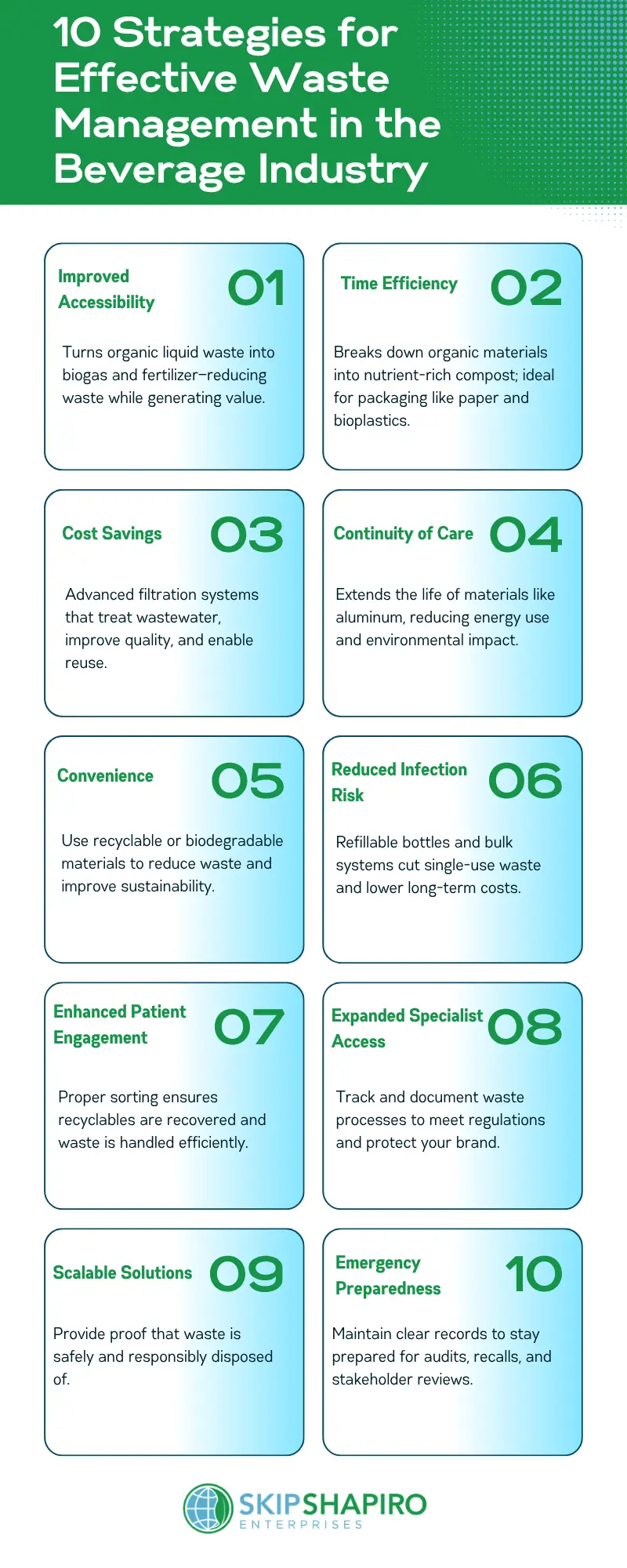
10 Strategies for Effective Waste Management in the Beverage Industry
When your waste management strategy is robust, compliance becomes effortless. Yes, you will need strategic thinking, innovative technology, and proactive planning, but it will all be worth it.
To make these strategies easier to evaluate, it helps to group them by the role they play in beverage waste management. Some methods, such as anaerobic digestion, composting, and membrane bioreactors, focus on processing liquid or organic waste in a way that supports compliance and, in some cases, resource recovery. Others, including recycling, packaging redesign, and reusable packaging, are aimed at reducing packaging waste and improving long-term sustainability from the source.
At the operational level, waste segregation, compliance controls, and proper destruction documentation help ensure that waste is handled safely, legally, and efficiently.
From anaerobic digestion to recycling and regulatory alignment, here’s what you need to know.
1. Anaerobic Digestion
One of the most impactful ways beverage producers can handle liquid waste is through advanced treatment technologies like anaerobic digestion.
Anaerobic digestion is a process that breaks down organic waste in the absence of oxygen to produce renewable biogas and nutrient-rich digestate that can be used as fertilizer.
Since it doesn’t just dispose of waste but also transforms it into valuable resources that support environmental initiatives, it’s considered a leading solution for managing beverage waste.
This is why many liquid waste disposal services use this technology.
2. Composting
Composting is a natural biodegradation process that uses microorganisms to decompose organic materials. The end result is compost, a nutrient-rich, soil-like fertilizer that improves plant growth, enhances soil structure, and supports sustainable agricultural practices.
While composting is not the best option for large-scale liquid beverage waste, it can be used to recycle some packaging materials such as paper, cardboard, and compostable bioplastics.
3. Membrane Bioreactors
Another strategy for waste management in the beverage industry is using membrane bioreactors. Membrane bioreactors (MBRs) are advanced wastewater treatment systems that combine biological processes with membrane filtration to remove contaminants from liquid waste.
This method helps your production stay compliant with environmental regulations. The cherry on top is that they also give you opportunities to improve water quality, enable water reuse, and reduce overall environmental impact.
4. Recycling
Multiple beverage packaging materials can be recycled to extend their lifecycle. For instance, aluminum is infinitely recyclable, meaning it can continually be recycled into new products. In fact, making recycled aluminum only takes around 5% of the energy needed to make new aluminum.
Companies must evaluate their unique packaging materials to determine which facilities can manage them and how to keep them in circulation.
That brings us to our next point.
5. Redesign Packaging for Enhanced Recyclability
Forward-thinking beverage companies are making a shift toward mono-material packaging and biodegradable materials to make recycling easier. They choose packaging that is easier to recycle from the get-go, thereby significantly decreasing their environmental impact and meeting the standards of consumers who demand sustainability.
With proactive packaging redesign, companies don’t just reduce waste – they take their brand perception to another level and bring in long-term customer loyalty.
6. Invest in Reusable Packaging Solutions
In addition to using recyclable materials, reusable packaging is also a valuable solution, as it minimizes waste at the source. This is why forward-thinking beverage companies are adopting solutions like refillable bottles, growlers, and bulk dispensers.
All of this drastically reduces reliance on single-use plastic while also helping companies optimize inventory and reduce waste associated with unsold prepackaged products in certain distribution models.
The benefits are immediate:
- Potentially lower long-term operational costs
- Reduced environmental footprint
- Increased consumer loyalty
Fun fact: Refillable beer kegs (15.5 gallons) can replace 165 (12-ounce) single-use bottles, helping brands save money and strengthen their sustainability narrative.
7. Develop Comprehensive Waste Segregation Protocols
Successful waste management starts on the facility floor. With clearly defined and enforced waste segregation guidelines, employee training, clear visual labeling, and proper beverage waste storage, manufacturers can ensure that recyclables end up recycled – not wasted.
Waste management in the beverage industry has distinct segregation protocols, which are especially important for things like expired beer recycling and proper wine disposal.
8. Beverage Waste Compliance, Traceability, and Regulatory Alignment
Regulations in the beverage industry aren’t getting any looser. If anything, the bar is rising. Staying compliant isn’t only about avoiding fines but also about building a traceable, trustworthy system that protects your brand and proves you’re doing things right.
Key strategies for compliant waste management in the food and beverage industry include:
- Traceability and documentation: Maintain accurate records, including Certificates of Destruction, to prove that waste is handled responsibly and cannot re-enter the marketplace.
- Compliance monitoring systems: Whether you’re a manufacturer, distributor, or otherwise involved in the beverage industry, it’s important to establish compliance teams and use smart software to stay ahead of ever-evolving environmental regulations. In an AI-driven world, this is easier than ever, with advanced tools capable of flagging issues early on and helping you prevent costly fines and legal risks.
- Regulatory alignment: Ensure your processes meet the requirements of agencies such as the FDA, TTB, and other government bodies, especially when handling alcohol or regulated products. We explore these requirements in more detail below.
Whether you’re dealing with packaging waste or the disposal of alcohol-based beverages, specialized waste partners can help you navigate and meet every requirement with confidence.
9. Certificates of Destruction and Documentation
Proof matters. In the world of waste management, formal documentation has tons of value. For example, Certificates of Destruction show verifiable records that you handle your waste responsibly both internally and externally.
Ultimately, this protects your brand and satisfies your regulators. If you’re still unsure how all of this works, partnering with a beverage destruction company can help.
10. Audit Readiness and Supply Chain Transparency
From recalled beverage disposal to non-alcoholic beverage destruction, traceable waste handling builds trust across your supply chain. With organized records and clear reports, you will always be prepared for audits, stakeholder reviews, and even product recalls.
Beverage Disposal Process & Chain of Custody
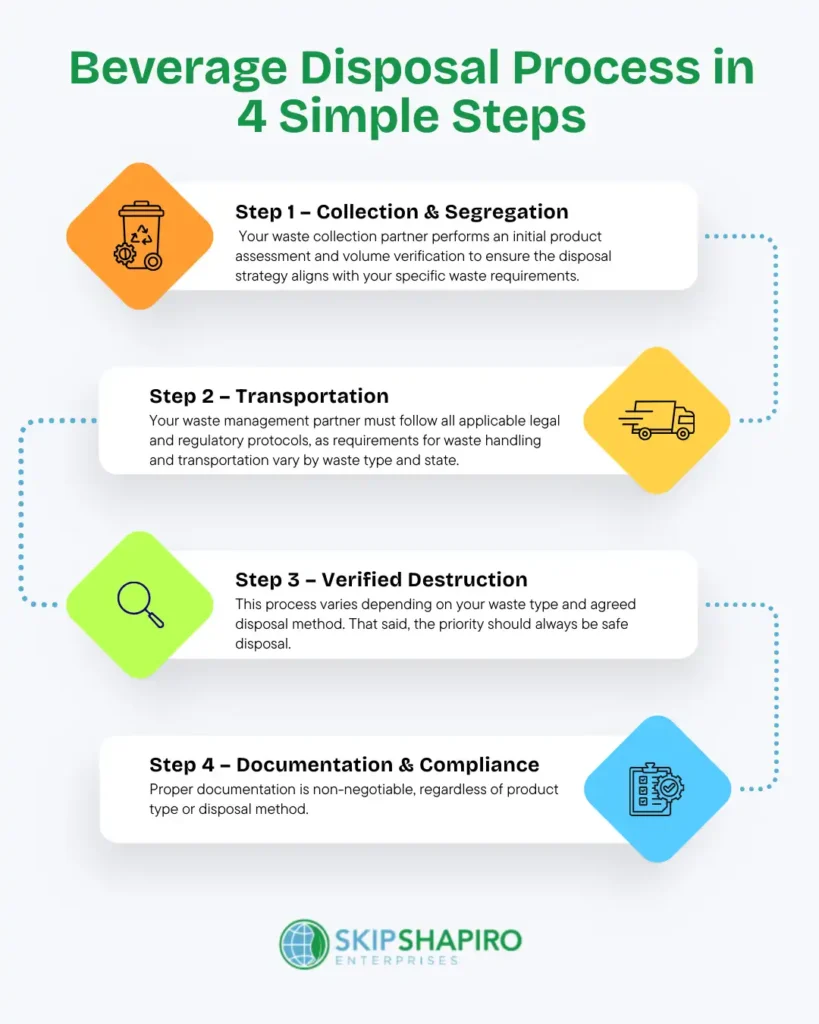
We’ve broken down the beverage disposal process into four key steps:
Step 1 – Collection & Segregation
The first step in beverage disposal is the collection and segregation of waste. Your waste collection partner performs an initial product assessment and volume verification to ensure the disposal strategy aligns with your specific waste requirements.
An important part of this process is product segregation to prevent cross-contamination, especially during recalled beverage disposal. Clear protocols should be implemented both at your facility and by the waste management partner during collection and transport.
For your company, this may involve training employees to properly handle and separate waste, providing clearly labeled bins for beverage waste storage, and maintaining accurate waste logs.
For an experienced beverage destruction company, this means following established chain-of-custody procedures, using dedicated collection methods, and ensuring materials remain properly identified, segregated, and documented throughout the disposal process.
Step 2 – Transportation
Next, the beverage waste must be transported to a processing facility. Your waste management partner must follow all applicable legal and regulatory protocols, as requirements for waste handling and transportation vary by waste type and state.
During transport, a Bill of Lading is used to document the shipment. This legal document records key details such as the type of waste, quantities transported, origin, destination, and chain-of-custody information, helping ensure traceability, compliance, and accountability throughout the disposal process.
Step 3 – Verified Destruction
The next step: destruction.
This process varies depending on your waste type and agreed disposal method. That said, the priority should always be safe disposal. By following EPA-compliant destruction methods, companies can reduce their environmental footprint and achieve their sustainability goals.
Verified destruction also includes documented proof, such as destruction reports or Certificates of Destruction, which confirm materials were permanently destroyed and removed from the supply chain.
Step 4 – Documentation & Compliance
Proper documentation is non-negotiable, regardless of product type or disposal method.
Comprehensive records help ensure beverage waste compliance and keep your organization inspection-ready. While documentation requirements can vary by product type, waste classification, and jurisdiction, maintaining a clear and complete audit trail is essential.
These records include beverage destruction metrics such as volume destroyed, destruction method used, and compliance verification status, all essential for audit readiness and regulatory reporting.
For example, non-alcoholic beverage destruction typically requires core chain-of-custody documentation, such as timestamped intake logs, weighbridge entries, and before-and-after photo evidence, to verify proper handling and final disposition.
Regulatory Compliance in Beverage Disposal
For U.S. beverage manufacturers, distributors, and operations teams, regulatory compliance in waste disposal is a critical part of staying audit-ready and avoiding costly penalties. Proper compliance reduces legal risk, supports environmental responsibility, and protects brand reputation in a highly regulated industry.
Because of this, compliance is non-negotiable. Partnering with a waste management provider that stays current with evolving U.S. regulations is essential to ensure your operations remain compliant and audit-ready.
Here’s a quick overview of what you need to know.
1. FDA Requirements
The U.S. Food and Drug Administration (FDA) enforces regulations aimed at protecting public health, including ensuring that beverages are safe, sanitary, and properly labeled.
While the FDA does not directly regulate beverage waste disposal, it plays a critical role in recalls, safety standards, and traceability requirements.
- Product recalls: The FDA requires proper documentation of recalled products to evaluate, classify, monitor, and audit product recalls. In many cases, this includes records showing that recalled beverages were properly disposed of or destroyed to ensure they cannot re-enter the marketplace.
- Juice safety: The FDA also regulates juice safety through the Juice HACCP rule, which applies to all juice sold as juice or used as an ingredient in other beverages, except juice produced at retail establishments. Under this regulation, juice processors must develop and implement HACCP plans to identify and control potential biological, chemical, and physical hazards.
Recordkeeping and traceability: Under sections 1.337 and 1.345, manufacturers and retailers must maintain records of food receipt and release to support traceability and accountability.
2. TTB Beverage & Alcohol Compliance
For alcoholic beverages, disposal and destruction are subject to oversight by the Alcohol and Tobacco Tax and Trade Bureau (TTB). When alcohol is destroyed rather than sold, TTB regulations may require documentation to verify the quantity destroyed and support compliance with federal alcohol laws and tax requirements.
Under the Code of Federal Regulations, an application may be required before destroying wine, beer, or spirits. This application typically includes:
- Alcohol type
- Alcohol content
- Approximate volume to be destroyed
- Where the alcohol will be destroyed
- Reason for destruction
Unless the TTB authorizes that inspection and supervision are not required, the alcohol must be inspected, the destruction must be supervised, and all records must be maintained.
It’s important to note that destruction must also comply with local environmental and waste disposal rules, not only federal alcohol laws.
Working with an alcohol destruction company that understands the regulations tied to your location and operations helps ensure alcohol is handled in accordance with TTB requirements while maintaining accurate records for beverage waste compliance, reporting, and potential audits. nce, reporting, and potential audits.
3. EPA Environmental Regulations
The United States Environmental Protection Agency (EPA) regulates solid and hazardous waste under the Resource Conservation and Recovery Act (RCRA) and sets wastewater discharge standards under the Clean Water Act. These regulations directly impact how beverage waste, especially liquids, is destroyed and discharged.
Key EPA considerations include:
- Solid and hazardous waste (RCRA): Beverage waste from manufacturing or recalls must be properly classified, handled, and disposed of to prevent environmental harm.
- Wastewater discharge (Clean Water Act): The EPA sets limits on what can be discharged into public water systems, requiring proper treatment of liquid waste before disposal.
- Packaging waste and recycling: Common recyclables such as plastics, glass, and aluminum must be properly separated and routed through the correct waste stream to support sustainability efforts. For example, since some plastics aren’t accepted in community recycling programs, it’s important to confirm what your local program allows.
With regulations spanning the FDA, TTB, and EPA, navigating beverage destruction without proper compliance can lead to penalties, environmental violations, failed audits, and reputational damage. That’s why it’s important to understand how to choose a beverage destruction company that truly supports your goals.
Non-Alcoholic Beverage Waste Management
While the disposal process and regulatory framework apply broadly across beverage types, non-alcoholic beverages present unique challenges that require specialized destruction approaches.
Let’s explore why.
1. Why Non-Alcoholic Beverages Require Specialized Destruction
Due to their unique product characteristics, non-alcoholic beverages fall under different regulations compared to alcoholic beverages. Why?
Because products like energy drinks, juice, and water all have different disposal triggers than alcohol. This includes:
- Sugar density → impacts effluent load limits
- Carbonation → affects rupture and pressure-release thresholds
- Vitamin/functional additives → influence disposal routing
- Shelf-life instability → requires faster liquidation windows
Understanding the differences between compliance requirements becomes even more complicated for companies that have multiple types of products and packaging. This is because it’s impossible to group all non-alcoholic beverages into a single category.
From aluminum cans to plastic bottles and sustainable beverage packaging, each material requires specialized handling to ensure compliance and maximize landfill diversion.
2. Technical Composition Factors
To truly understand non-alcoholic beverage destruction, we need to take a look at the technical composition of these products.
2.1 Composition Considerations
Non-alcoholic beverages typically carry destruction requirements tied to ingredient density rather than alcohol content. For instance, many include additives like taurine, vitamin blends, and caffeine concentrates. Others contain high-sugar formulations, electrolyte fortification, or flavor emulsions that increase the biochemical load and further narrow downstream routing options.
Because of these factors, their compositions often exceed anaerobic digestion thresholds and create effluent classification challenges. In other words, eligibility cannot be assumed based on liquid state alone, which directly influences the appropriate beverage destruction method.
2.2 Degradation Requirements
Because non-alcoholic products degrade faster and ferment differently than spirits, their recall windows and storage tolerances are significantly shorter. Certain product categories, like energy drinks, fortified juices, and vitamin waters, also need early-stage analytical screening to determine whether landfill diversion, aerobic digestion, or depackaging recovery is appropriate.
We provide certified recall, disposal & beverage destruction services that account for these faster degradation cycles, ensuring each product is routed to a compliant and suitable end-of-life solution.
2.3 Carbonation & Pressurization Handling
Carbonated drinks come with hazards that other beverages simply don’t, especially pressurization risks.
Because energy drinks and sparkling juices contain trapped CO₂, they’re more prone to rupturing under pallet compression, compaction, or during transport. To mitigate these risks, operations rely on depressurization sequencing, controlled venting, and proper shrink-wrap tension.
As a result, handling protocols prioritize failure prevention over recyclability. These safety measures can also slow throughput, since pressurized SKUs require longer clearance intervals during destruction.
3. High-Volume Disposal Challenges
Non-alcoholic beverages move quickly through the supply chain, creating disposal challenges such as:
- Perishability: Perishability is a huge issue in the beverage industry. Challenges include products expiring faster than anticipated, demand forecasts missing the mark, and sudden waves of unsellable beverage waste piling up in storage—all of which pose food and beverage safety concerns when not managed quickly.
- Cold-storage overload: Cold-storage overload can happen quickly in high-volume operations. Limited refrigeration space, unexpected inventory spikes, or cold-chain breakdowns can all lead to rapid spoilage and immediate disposal needs.
- Promotional overproduction & SKU churn: Promotional cycles often create more inventory than the market can absorb. Seasonal flavors, limited-time SKUs, and short-lived campaigns can leave companies with excess stock that must be sorted, stored, and destroyed.
- Labeling errors: Labeling mistakes are another common challenge in beverage production. Misprints related to caffeine content or ingredients can trigger recalls, regulatory intervention, and mandatory destruction of affected batches.
- Additive destabilization: Functional beverages are especially susceptible to ingredient instability. Temperature fluctuations, storage issues, or formulation changes can cause vitamins, electrolytes, or botanicals to degrade, forcing early disposal to maintain safety and quality.
All this to say, the beverage industry faces unique challenges that often lead to surplus products that must be destroyed. Because these excess volumes aren’t always accounted for in a company’s waste management plan, it’s critical to have a disposal partner capable of handling sudden surges in beverage destruction needscritical to have a disposal partner capable of handling sudden surges in beverage destruction needs.
4. Chain-of-Custody Documentation for Non-Alcoholic Beverages
Source: CRI
Curious about chain-of-custody documentation?
Here’s what you need to know:
4.1 What Chain-of-Custody Documentation Includes
So what can you expect to see in proper chain-of-custody records?
Here are the core documents typically involved:
- Sealed trailer identification numbers
- Pallets labeled with SKU codes
- Timestamped intake logs
- Weighbridge entries
- Before-and-after photo evidence
- A Certificate of Destruction
4.2 Documentation Timelines & Delivery
When dealing with beverage destruction, timing is critical due to the shelf-life instability and carbonation risk of many liquid products. Because these beverages can change rapidly in composition or stability, the certification process must move quickly to ensure documentation accurately reflects the product’s condition at the moment of destruction.
This expedited flow helps maintain compliance, supports brand protection, and ensures all stakeholders receive timely confirmation.
It also ensures beverage destruction documentation stays reliable, accurate, and aligned with the product’s short viability window.
4.3 Non-Alcoholic vs. Alcoholic Documentation Differences
Beverages such as juices, energy drinks, and vitamin water present unique challenges, including shorter shelf lives, carbonation instability, complex additive profiles, and warehouse space constraints. As a result, they typically require more frequent and precise documentation than spirits.
For companies focused on compliance, accurate and timely documentation shouldn’t be an afterthought. Instead, it should be a core component of an effective waste management strategy.
We understand the importance of staying up-to-date with documentation and implementing strategies that support both compliance and sustainability. With expert insight into beverage destruction, we help streamline the entire process.
Conclusion
Effective waste management in the beverage industry isn’t about avoiding fees or fulfilling your obligation; it’s an opportunity to strengthen compliance, become more sustainable, and boost your operational efficiency.
While challenges are inevitable, addressing them proactively helps beverage businesses protect their reputation, meet evolving consumer expectations, and stay compliant with changing regulations.
If you’re a beverage manufacturer, distributor, or sustainability leader, now is the time to evaluate your current processes and identify areas for improvement.
From maintaining proper disposal workflows and chain-of-custody documentation to managing non-alcoholic beverage waste and staying aligned with juice and spirits regulations, your approach should be tailored to your operations.
If you’re looking to streamline compliant beverage disposal and destruction, working with an experienced partner can make a measurable difference.
Explore Shapiro’s Beverage Destruction Services to see how your business can improve compliance, reduce risk, and scale disposal operations with confidence.
FAQs about Beverage Waste Management
Beverage waste refers to unsaleable, expired, contaminated, recalled, damaged, or excess beverage products and the related materials generated during production, packaging, storage, distribution, or recall. It can include liquids, partially filled containers, and secondary packaging that must be managed through compliant disposal or destruction processes.
Alcoholic beverages should be disposed of through controlled destruction methods that align with federal, state, and local requirements. Depending on the product type and volume, this may involve approved liquid processing, wastewater treatment, or other verified destruction methods, supported by documentation, traceability, and, where required, TTB oversight.
Waste management is important because it helps beverage manufacturers stay compliant, control disposal and storage costs, reduce environmental impact, and protect brand reputation. A structured approach also supports audit readiness, traceability, and safer handling of regulated or recalled products.
The beverage industry generates multiple waste streams, including expired or contaminated liquids, damaged or recalled products, off-spec inventory, bottles, cans, caps, labels, shrink wrap, cardboard, and other packaging materials. Some products, such as alcohol-containing beverages, may also require more specialized handling and documentation.
Common beverage waste management methods include anaerobic digestion, wastewater treatment, recycling, depackaging, composting for suitable materials, and verified product destruction. The right method depends on the beverage composition, packaging type, regulatory requirements, and whether the goal is disposal, diversion, or material recovery.
Beverage destruction management is the controlled process of collecting, transporting, destroying, and documenting unsaleable beverage products so they cannot re-enter commerce. It typically includes chain-of-custody controls, verified processing methods, and documentation that supports compliance, traceability, and audit readiness.
If beverage disposal is not properly documented, a company may be unable to prove that products were destroyed in a compliant manner. This can increase the risk of failed audits, regulatory penalties, recall-related exposure, and reputational damage.
our expert

Peter W. Klaich Director, Agriculture/Animal Health
Peter Klaich is a leading expert within the agricultural recycling and animal health market arena, known for leading National Sales at Skip Shapiro Enterprises since June 2016. He focuses on advancing sustainable recycling solutions and waste management practices across the agricultural industry.