Call or Text Now

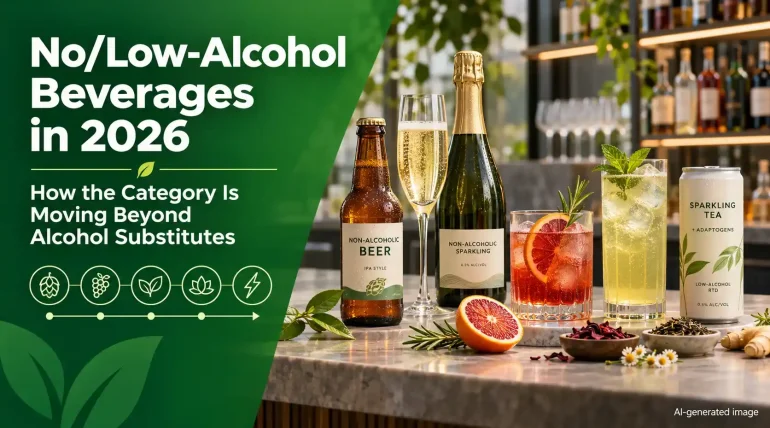
The no/low alcohol trends shaping 2026 look quite different from the ones we followed a few years ago. The category began as direct swaps for the drinks people already knew. Today it stretches into functional alcohol-free drinks and botanical alternatives built for adults, and mid-strength formats are starting to join in.
Let’s start with the people behind the numbers. Gallup’s 2026 consumption survey found that 54% of U.S. adults drink alcohol, which matches the 2025 record low. And NIQ data reported by The Spirits Business shows that U.S. off-premise sales of non-alcoholic drinks (meaning sales through stores) reached $1.08bn in the year to June 27, 2026. That is up 14.6% in sales value, yet it still equals only about 1% of alcohol dollars, so these non-alcoholic beverage trends have plenty of room to run.
Along the way, we call out what each number measures, because a sales figure and a survey answer tell very different stories.
No/Low Alcohol Trends and What Counts as No, Low and Mid-Strength
Before we get into the trends, here’s a breakdown of all the terms. People use these labels loosely, but the rules behind them are tighter than you might expect. The TTB rules on malt beverage alcohol content set the U.S. definitions, and they apply to malt beverages only.
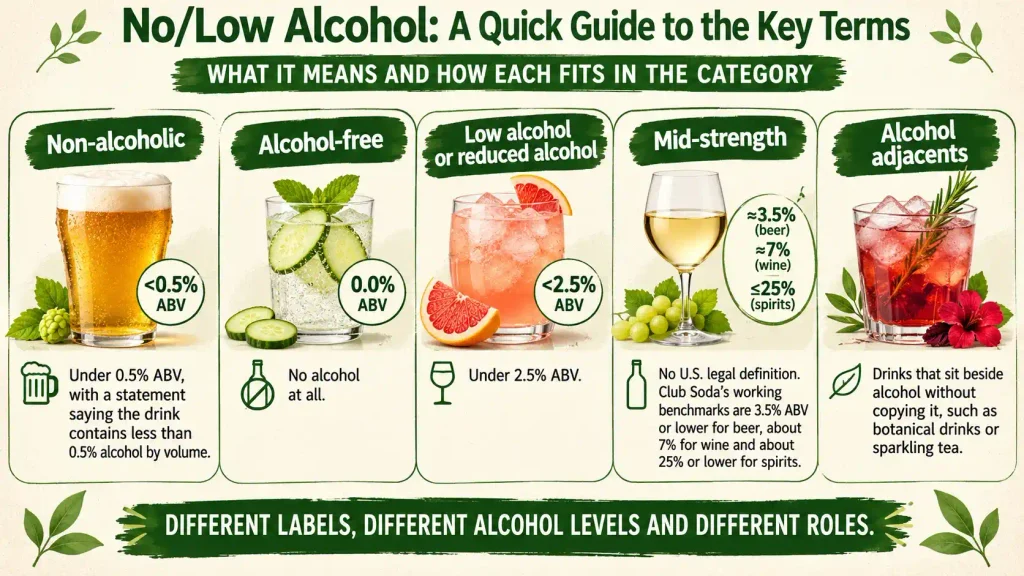
Wine and spirits follow other rules, and wines under 7% ABV fall under the FDA. Then why bother with the fine print? Because no- and low-alcohol trends play out differently in each tier, since every tier serves a different drinker and a different occasion.
Non-Alcoholic Beverage Trends and Why Demand Keeps Growing
The data points that demand for no- and low-alcohol drinks rises with the growing concern about health and a habit of mixing drinks by occasion.
Health Concerns Are Changing How Americans Drink
Let’s begin with what people say about health. In Gallup’s July 2026 poll, 51% of U.S. adults said one or two drinks a day is bad for health, down from 53% in 2025. The Surgeon General’s advisory on alcohol and cancer calls alcohol the third leading preventable cause of cancer in the U.S. and recommends a cancer warning on alcohol labels.
The 2025 to 2030 Dietary Guidelines urge “less alcohol for better health,” while they drop the earlier numeric daily limits. And IWSR’s August 2025 survey of 7,973 consumers across 10 markets adds a motive. Choosing a healthy lifestyle was the top reason for buying non-alcoholic beer, at 37%, and for non-alcoholic wine and spirits, at 40%.
Most No/Low Buyers Still Drink Alcohol
The real question is who actually buys these drinks. NIQ’s 2026 beverage alcohol analysis found that 93% of non-alcohol buyers also buy alcohol. It also found that 47% of bar and restaurant visitors mix alcoholic and non-alcoholic drinks on one occasion.
For a longer view, IWSR’s April 2025 analysis reports that 37 million Americans started drinking non-alcoholic products between 2022 and 2024, and 36 million started drinking low-alcohol ones. Put together, they tell us that most no/low buyers still drink alcohol, so the category grows through moderation, and abstinence plays a smaller part. That shapes every one of the moderation trend beverages we cover below.
Substitutes Still Lead the Category
Direct swaps for familiar drinks still make up most of the category, though growth rates differ quite a bit by type.
Non-Alcoholic Beer and Wine Hold Most Sales
In the NIQ data covering the year to June 27, 2026, zero ABV beer holds 80.8% of U.S. non-alcoholic sales value and grew 12.2%. Alcohol-free wine holds 11.7% and grew 17.8%. We use the term alcohol-free beverage trends only for products at 0.0%, which matches the TTB definition.
Wine follows the same direction, and the alcohol-free beverage trends we see in the U.S. show up in other markets too. IWSR’s no- and low-alcohol wine analysis found that non-alcoholic wine volume grew in all of the top eight wine markets from 2019 to 2024. In the U.S., the compound annual growth rate (CAGR) was 23%.
The Fastest Growth Is in Spirits and RTDs
Here the percentages get bigger. Non-alcoholic spirits, including ready-to-drink (RTD) products, hold only 7.5% of U.S. sales value in the NIQ data, yet they grew 40.7%. RTDs make up 75% of that segment and grew 61.5%. A small base makes big percentages easier to reach, so this could be interpreted as early momentum. Worldwide, IWSR’s January 2026 release forecasts non-alcoholic analogue volume to grow 36% from 2024 to 2029.
Who Buys Non-Alcoholic Drinks
NIQ data for the year to June 2026 gives Boomers 39.6% of U.S. non-alcoholic sales value and Gen X 30.4%. Millennials hold 25.2%, and legal age Gen Z holds 4.8%, though Gen Z is growing fastest.
That differs from the popular story that Gen Z drives no/low. And IWSR survey data from June 2026 finds that Millennials are the largest group of no/low wine buyers in six of the top eight wine markets. These two sources measure different things, since one tracks dollar share and the other tracks who buys, so both can hold true.
Functional Non-Alcoholic Drinks and Alcohol Adjacents
Now that we have the core of the category in view, let’s look at drinks that make no attempt to copy alcohol.
Why Alcohol Adjacents Attract Different Buyers
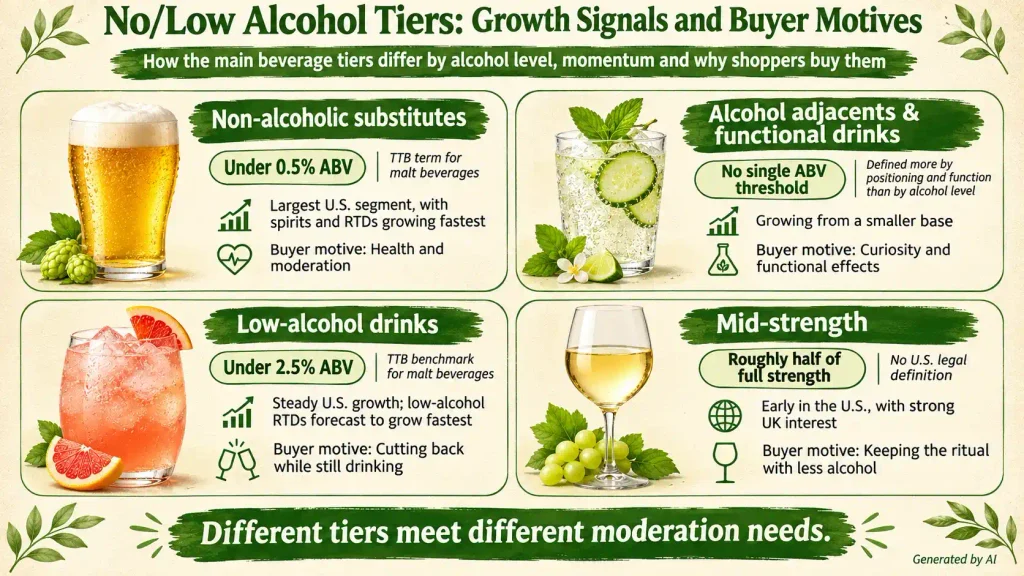
IWSR expects alcohol adjacent volume to have grown 11% in 2025, from a smaller base than non-alcoholic analogues. The buyers look different too. In its August 2025 survey, only 26% of adjacent buyers cited health. Curiosity came next at 20%, and 17% wanted effects similar to alcohol from functional ingredients.
Innova’s U.S. low and no alcohol research lists relaxation and stress relief among the leading claims. Focus claims show up as well. Innova also sees nootropic and adaptogenic ingredients gaining ground and expects evidence-backed benefits, such as sleep, to come next. That mix makes functional non-alcoholic drinks a group with its own audience, and it mirrors the wider functional beverage trends we see across the drinks market.
Botanical Drinks and Other Adult Alternatives
Not every adjacent copies a pint or a glass of wine. Aperitif-style botanical drinks and sparkling tea fit the adjacent definition, and they usually aim at flavor and a sense of occasion instead of imitation. For many buyers, they simply feel like a grown-up drink with its own identity.
A Moving Legal Line for Hemp Drinks
Congress enacted a new federal hemp definition in November 2025, and it includes a limit of 0.4 mg of total THC per container. A law signed on September 2, 2026, moved the effective date for that limit from November 12 to December 11, 2026, under Section 2019 of Public Law 119-103, so as of November 9, 2026, the limit is not yet in effect.
Mid-Strength Beverages and Low-Alcohol Drinks
Mid-strength beverages sit between full strength and alcohol-free. They let drinkers keep the ritual and some of the alcohol. In the U.S. the term has no legal definition, so brands set their own limits.
The strongest evidence comes from the UK. Club Soda’s mid-strength research found that 50% of UK consumers would rather have two mid-strength drinks than one at full strength. Another 13% “coast” on mid-strength all evening. And 42% are interested in mid-strength beer in supermarkets, but only 12% find it easy to locate.
U.S. data points the same way, although it does not measure mid-strength itself. IWSR shows that U.S. volume of low-alcohol drinks (under 2.5% ABV) grew at a 7% CAGR from 2019 to 2024. The same release forecasts low-alcohol RTDs to grow 17% a year from 2024 to 2028 across its top 10 markets. And NIQ’s 2026 analysis found that 47% of U.S. bar and restaurant consumers say ABV influences their choice.
So where does that leave us? In the U.S., mid-strength is an emerging area worth watching and not yet a proven market gap. UK research shows strong interest and a shelf visibility gap, and U.S. data shows growth in the wider low-alcohol category. However, no U.S. source yet measures demand for mid-strength itself, and we would not apply the UK shelf finding to American retail.
New Drinking Occasions Are Shaping the Category
Occasion matters more than most product teams assume. IWSR’s April 2025 research found that 30% of no/low consumers would previously have chosen full strength on the same occasion. And IWSR’s June 2026 wine analysis shows that wine drinkers switch between tiers depending on the moment.
The venue is shifting too. According to the NIQ data, non-alcoholic sales at bars and restaurants grew 44.2% in the past year, and that channel now holds 31.1% of sales. Depending on your portfolio, that makes bars and restaurants a growth channel worth planning around.
Then there are the moments themselves. Innova’s U.S. research says people reach for these drinks mostly with meals and when they want to relax. It expects aperitifs and recovery after a night out to come next.
And of course, taste still decides. Innova reports that “it tastes good” is the top reason people choose non-alcoholic wine. IWSR adds that 52% of no/low buyers chose a product because they knew the brand.
The No/Low Category at a Glance
If you want the whole picture in one place, this table sums up what we covered in the sections above.
What the Shift Means for Beverage Producers and Distributors
More tiers mean more products to manage, and that touches breweries and wineries as much as non-alcoholic beverage brands. You may see more SKUs and faster portfolio changes than your planning cycle used to allow. Some lines will get cut as demand moves, and the leftover discontinued beverage inventory deserves a plan before it piles up.
If you distribute, retail delistings can leave you holding stock your accounts no longer want. Categories that lose share leave slow stock behind too, such as wine that no longer sells. We handle that kind of product through alcohol disposal, and we rely on beverage destruction when a product must never re-enter the market.
Where the No/Low Category Goes From Here
No/low alcohol trends now run well past simple substitutes, into functional adjacents and mid-strength formats, and into occasions the category never reached before. Moderation drives most of it.
We support producers across the alcoholic beverage industry as their portfolios change, so if you would like to talk it through, feel free to contact us.
Frequently Asked Questions
What are the biggest no/low alcohol trends in 2026?
In 2026, the category is becoming more varied. Consumers are seeing more functional drinks, lighter-strength options, and products designed for specific occasions rather than as one-for-one replacements for beer, wine, or spirits. That reflects a wider shift toward flexible drinking habits, where people move between alcoholic, low-alcohol, and alcohol-free choices depending on the setting.
What is the difference between non-alcoholic, alcohol-free and low-alcohol drinks?
For beer, TTB defines non-alcoholic as under 0.5% ABV, alcohol-free as no alcohol at all, and low alcohol as under 2.5% ABV. Wine and spirits follow other rules, so these terms do not automatically apply to every no/low drink on the market.
What are mid-strength drinks?
Mid-strength drinks generally contain roughly half the alcohol of their versions at full strength. The U.S. has no legal definition for the term, so brands set their own limits, and Club Soda’s working benchmarks give the industry a common reference point.
Do people who buy non-alcoholic drinks stop drinking alcohol?
Mostly no. NIQ’s analysis found that 93% of non-alcohol buyers in the U.S. also buy alcohol, so most of these shoppers cut back or switch by occasion instead of quitting altogether.
our expert

Peter W. Klaich Director, Agriculture/Animal Health
Peter Klaich is a leading expert within the agricultural recycling and animal health market arena, known for leading National Sales at Skip Shapiro Enterprises since June 2016. He focuses on advancing sustainable recycling solutions and waste management practices across the agricultural industry.