Call or Text Now
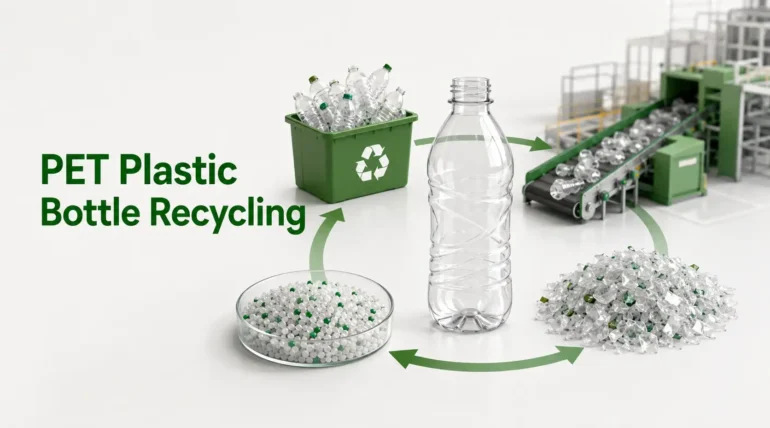
PET bottles have a strong reputation for recyclability, and for the most part, that reputation holds up.
What most recycling guides skip is what happens the moment PET-bottled inventory can’t follow that standard path: rejected loads, off-spec product, contamination, and still-full containers all fall outside the curbside-bin scenario, leaving beverage brands to work out the PET bottle waste pathway largely on their own.
This guide fills that gap, walking through how PET plastic bottle recycling actually works at commercial scale and what to do when a batch needs more than standard recycling.
What Is PET, and Why Do Beverage Brands Use It?
What does PET stand for in plastic? PET is polyethylene terephthalate, a lightweight, transparent thermoplastic made from petroleum-based raw materials.
It has dominated beverage packaging for decades because it checks nearly every box a bottler needs: lightweight enough to keep shipping costs down, clear enough to showcase the product inside, durable enough to survive a supply chain, and compliant with FDA standards for direct food contact under Title 21 of the Code of Federal Regulations.
Those properties explain why PET shows up across a long list of beverage categories, and why it carries one of the higher recycling rates among plastics. Bottlers understandably lean on that reputation when marketing packaging choices, which connects directly to the broader conversation around sustainable beverage packaging.
But the marketing shorthand of “infinitely recyclable” oversells what actually happens to the material. Unlike glass or aluminum, which can be melted down and reformed repeatedly without losing structural integrity, PET can be recycled 2 to 3 times before it starts degrading.
That is not a reason to write off PET recycling. It is a reason to be precise about what “recyclable” means when managing real inventory, not a single bottle headed to a curbside bin.
The PET Bottle Recycling Process for Commercial Beverage Loads
A single household bottle drops into a bin, gets picked up, and moves through a municipal materials recovery facility one container at a time. Commercial beverage inventory does not move that way.
Let’s take a closer look at the PET bottle recycling process for beverage brands and distributors:
1. Bottle Condition and Sorting
When it comes to commercial scale handling of PET plastic, the first question is what condition it is in:
- Full versus empty containers: This determines the whole downstream path, since liquid cannot travel through the same equipment as clean, empty plastic.
- Color and clarity: Clear PET commands more end markets than green or amber bottles, so sorting by color early protects the value of the load rather than narrowing it later.
- Intact vs crushed bottles: Intact bottles move through standard baling. Damaged or partially collapsed containers may still qualify, but often need separate evaluation before anyone commits them to a normal recycle PET plastic stream.
2. Caps, Labels, and Contamination Handling
Caps, labels, and shrink sleeves rarely share the same material as the bottle, and they need to come off before it can move cleanly through processing. Left in place, they introduce a second material into what should be a single-polymer stream and narrow what the reclaimed plastic can eventually become.
Residual liquid is its own contamination risk. Even a small amount of leftover product can affect an entire bale if it is not addressed beforehand, which is why full containers get pulled aside for separate handling rather than baled as-is.
3. Baled and Palletized Load Preparation
Once bottles are sorted, decapped, and cleared of residual liquid, commercial volumes get consolidated for pickup and transport. Baling density affects how efficiently a load ships, and palletization keeps material organized and traceable from the moment it leaves a facility.
This is the structural difference from a household’s curbside bin: everything here moves at pallet and truckload scale, under documentation, rather than one bottle at a time.
When PET Inventory Needs More Than Standard Recycling
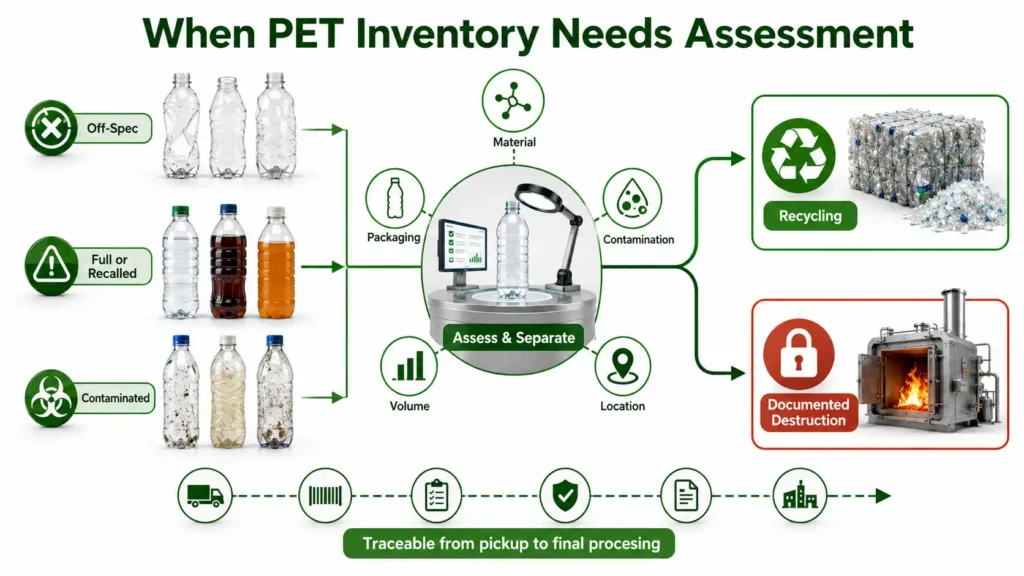
Not every batch of commercial PET bottle recycling inventory is ready for a standard recovery stream. Some of it needs assessment first, and occasionally destruction, before any material can re-enter a recycling pathway.
1. Rejected and Off-Spec Product Loads
A bottling run that fails quality control, whether from an underfill, a mislabeling error, or a packaging defect, produces intact PET that still cannot simply go into a recycling bin. The bottles themselves may be perfectly good plastic. The product inside, or the labeling outside, is the problem, and that means the load needs an intermediate assessment step before it moves anywhere.
2. Recalled or Still-Full Containers
Product under recall, or bottles that are still full or partially full, cannot go straight into a recycling program the way an empty consumer bottle can. Liquid has to be separated from the packaging first, and recalled product needs documentation confirming it has been removed from commercial channels for good.
3. Heavily Contaminated Batches
Residual product, mixed materials, or damage beyond what standard cleaning and sorting can handle sometimes puts a batch in a different category altogether. Rather than slowing down a normal recycling line, these batches often need a separate processing pathway from the start.
4. How the Assessment Decision Gets Made
The decision on any given load comes down to a handful of factors evaluated together:
- Material composition
- Packaging format
- Contamination level
- Volume
- Location
The outcome is not automatically destruction. Loads that look complicated on arrival can often still be recycled once properly separated and assessed, which is why that evaluation step matters more than skipping straight to disposal.
5. Documentation Through the Process
Whichever pathway a batch takes (recycling or destruction) it should stay traceable from pickup through final processing. That chain-of-custody expectation is not unique to PET. It runs through every material a beverage brand manages, and it matters just as much for a pallet of rejected bottles as it does for the processes of full beverage container destruction a brand relies on for liquid product itself.
What Happens to Recovered PET?
Once PET clears sorting, decontamination, and baling, it re-enters the supply chain through a handful of real end uses. Recycled PET gets reprocessed into new bottles at some percentage of recycled content, into polyester textile fiber, and into other plastic products. According to NAPCOR’s 2024 PET Recycling Report, the U.S. PET bottle collection rate stood at 30.2 percent, the broader North American rate reached 39.2 percent, and average recycled content in U.S. PET bottles reached 15.9 percent.
There’s also the question: What is recycled PET plastic actually worth to a beverage brand chasing sustainability goals? It is a documented offset against virgin resin use, and a data point brands can cite in packaging and sustainability reporting, provided the figures are current and correctly attributed.
The honest version of this story includes both sides: recycled PET plastic bottles are a real, functioning market, and that market still runs well below full material recovery, which is why upstream sorting and contamination control matter as much as the recycling step itself. Materials recovery for beverage packaging does not stop at PET either. Brands managing mixed packaging streams often ask the same questions about recycling PET plastic bottles that they ask about recycling aluminum beverage cans, since sorting and contamination principles carry across materials even when the processing does not.
Common Challenges in PET Bottle Recycling at Scale
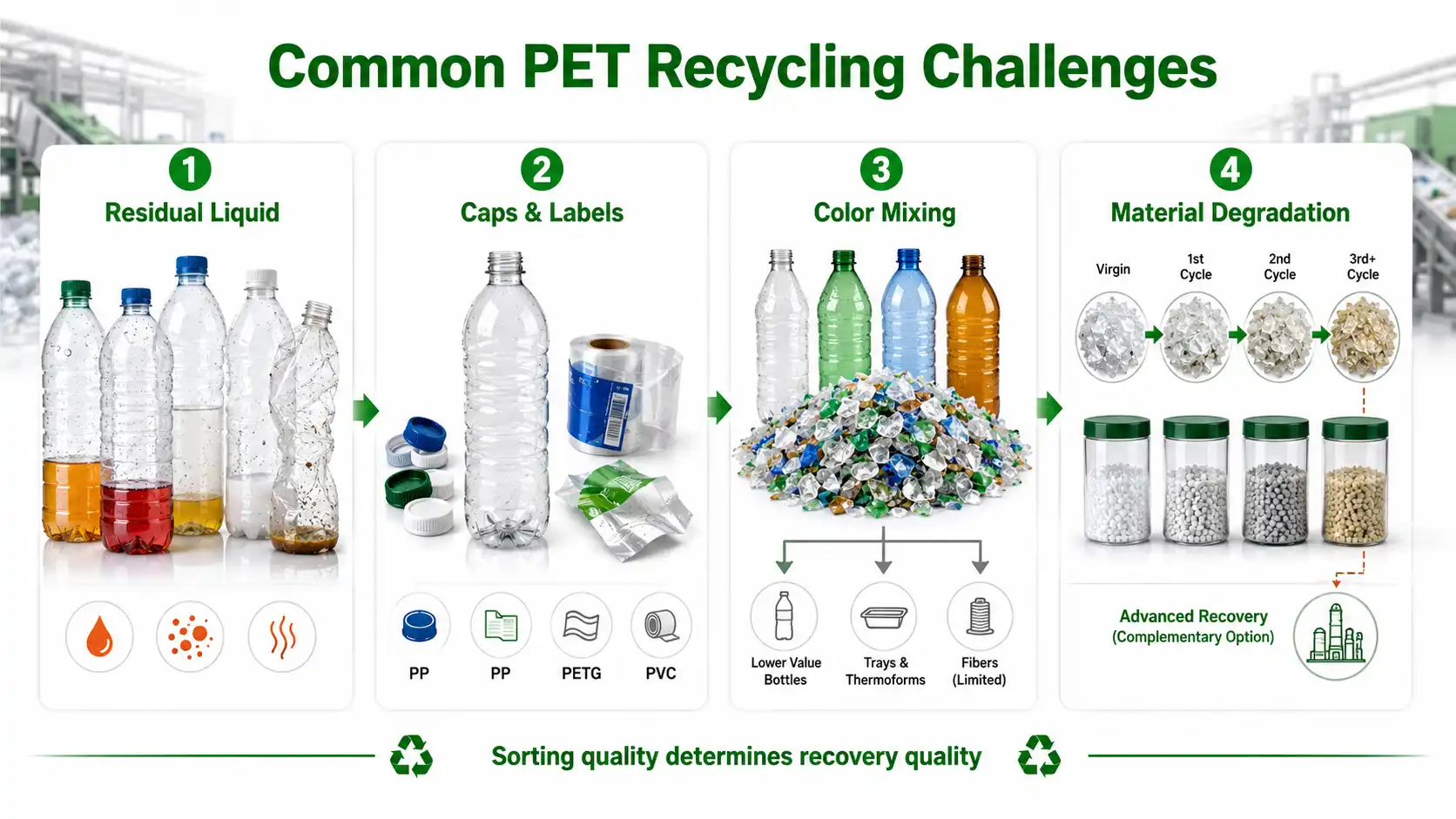
Every stage above has a failure point, and most of them show up repeatedly across commercial PET streams. These include:
1. Residual Liquid and Contamination
Leftover product inside a bottle remains one of the most common reasons a load needs extra handling before it moves through processing cleanly, the same issue raised in the still-full and off-spec scenarios above, just at a smaller scale across an otherwise recyclable batch.
2. Non-PET Caps and Labels in the Stream
Caps, labels, and shrink wrap are frequently different materials than the bottle they are attached to. Left unseparated, they contaminate what would otherwise be a clean, single-polymer PET stream and reduce what that material can become downstream.
3. Color-Mixing and End-Market Limits
Clear PET has more end-market options than color-mixed material. Inconsistent sorting by color at the front end narrows what a batch can become later, tying directly back to the collection-rate figures above: sorting quality shapes how much recovered material actually reaches a usable end market.
4. Degradation with Each Recycling Pass
As mentioned above, recycled PET plastic loses some material quality with every mechanical recycling cycle. The U.S. EPA notes that mechanical recycling can degrade certain plastics during reprocessing, part of why advanced recycling methods exist as a complement rather than a replacement for standard mechanical recovery.
Working with a PET Recycling and Destruction Partner
Not every load of PET-bottled inventory needs the same path, and figuring out which pathway applies to a specific batch is usually the hardest part of the process for a beverage brand to sort out internally.
Shapiro coordinates material evaluation, logistics, and routing for PET-bottled inventory, whether that inventory is straightforward enough for standard recycling or complicated enough to need destruction first. Our role is evaluating the material, arranging the logistics, and directing it to the right recovery or destruction pathway, backed by documentation at every step.
If your team is managing rejected, off-spec, recalled, or contaminated PET-bottled inventory and is not sure which path it should take, our beverage destruction and recycling team can help evaluate the options. Contact us to talk through your specific inventory and volume.
FAQ
1. Are PET plastic bottles recyclable?
Yes, in general. But are PET plastic bottles recyclable at every stage of their life, even when full, contaminated, or recalled? Not automatically. Empty, clean PET bottles move through standard recycling streams, while full, contaminated, or recalled inventory typically needs assessment first.
2. Is recycled PET plastic infinitely recyclable?
No. PET degrades in quality with each mechanical recycling pass, unlike glass or aluminum. Independent municipal recyclers confirm this limitation, even though some industry-affiliated sources describe PET recycling in more absolute terms.
3. What is the PET bottle recycling process?
At commercial scale, it involves sorting by condition and color, removing caps and labels, addressing residual liquid, and baling or palletizing the material for transport to a reclaimer.
4. What happens to PET-bottled inventory that can’t be recycled normally?
Rejected, off-spec, recalled, or heavily contaminated inventory typically needs an assessment step first. Some of it can still be recycled once separated and evaluated properly; some needs destruction before anything re-enters a recovery stream.
5. Can caps and labels stay on PET bottles for recycling?
No. Caps, labels, and shrink wrap are usually made from different materials than the bottle itself, and they need to be separated before the PET can be processed cleanly.
our expert

Peter W. Klaich Director, Agriculture/Animal Health
Peter Klaich is a leading expert within the agricultural recycling and animal health market arena, known for leading National Sales at Skip Shapiro Enterprises since June 2016. He focuses on advancing sustainable recycling solutions and waste management practices across the agricultural industry.