Call or Text Now
Glass is one of the most recyclable materials out there, and one of the least forgiving when something goes wrong. A cracked pallet, a mislabeled run, or a contaminated batch can turn a straightforward recovery stream into a costly disposal problem.
But that can easily be avoided. You just have to understand how the glass bottle recycling process works on a commercial scale.
This guide covers that process for beverage companies, from collection and sorting to final recovery, plus what changes once bottles can’t be sold and how beverage glass recycling differs from the household version most people picture.
Why Glass Bottle Recycling Matters for Beverage Companies
Glass ranks among the most recyclable packaging materials available, and by a wide margin compared to most alternatives. It can be melted down and remade into new containers indefinitely without losing purity or clarity.
For beverage brands, recyclable means something different at scale. Breweries, wineries, and bottlers produce beverage glass recycling volumes measured in pallets and truckloads, on a schedule that runs every week of the year.
Operating at that volume brings additional complexities to the process. For example, sustainability reporting needs to reflect real recovery numbers, not estimates. Also, treating glass like ordinary trash quietly eats into margins through disposal costs, and a mishandled load can easily become a visible brand risk.
That is also where beverage glass waste starts to overlap with your broader beverage waste management strategy, since glass rarely moves through a facility in isolation from cans, plastics, and liquid waste streams.
How Is Glass Bottle Recycling Done? Collection, Sorting & Recovery
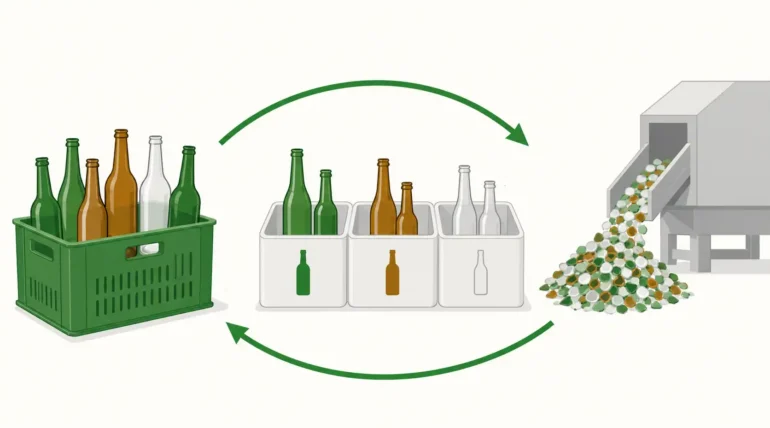
Here is how a batch of glass typically moves from collection to a usable end product:
|
Step |
What Happens? |
Why It Matters |
|
1. Collection |
Glass is picked up at pallet or truckload scale on a set schedule. |
Establishes chain of custody and keeps volume out of general waste. |
|
2. Sorting |
Non-glass materials, liquid residue, and (where needed) color are separated out (similar to the recycling aluminum beverage cans process). |
Protects downstream processing and end-market eligibility. |
|
3. Label/cap removal |
Labels, adhesive, and metal or plastic closures are pulled. |
Prevents contamination of clean cullet. |
|
4. Breaking into cullet |
Clean glass is mechanically broken into small, uniform fragments. |
Cullet melts faster and more evenly than whole bottles. |
|
5. Screening & drying |
Cullet is screened for fines, dried, and graded by size and color. |
Determines which recovery outcome the batch can reach. |
|
6. Recovery |
Graded cullet becomes new bottles, fiberglass insulation, or aggregate. |
Higher purity and color consistency mean higher-value outcomes. |
Step 1: Collection
For a consumer, collection means placing a bottle in curbside recycling or a drop-off bin. For a beverage company, it means scheduled bulk pickup, with chain-of-custody expectations.
Pickup frequency, staging, and documentation all get coordinated in advance, which is another major difference between the commercial and household recycling of glass process.
Step 2: Sorting and Contamination Removal
Once glass reaches a processing facility, sorting stations remove anything that is not container glass before the batch moves further down the line.
Mirrors, window glass, ceramics, lightbulbs, and ovenware all melt at different temperatures than bottle glass, and any of them slipping through can compromise an entire batch. Liquid residue gets pulled out at this stage too, and where the end market calls for it, optical or manual sorting separates glass by color.
Step 3: Label and Cap Removal
Labels, adhesive residue, and non-glass closures such as metal caps or plastic rings get separated out before the glass is broken down, since all of them contaminate clean cullet if left in place.
This tends to be a bigger friction point for beverage bottles than for food jars, largely because beverage labels often use stronger adhesives and metallic finishes, and it is one more reason commercial recycling of glass benefits from dedicated handling rather than a generic recycling bin.
Step 4: Breaking into Cullet
Sorted and cleaned glass is mechanically broken down into cullet (small, uniform fragments that are far easier to melt and reprocess than whole bottles). This stage of the recycling process of glass bottles relies on industrial breaking equipment at the processing facility itself.
Step 5: Screening, Drying, and Grading
Broken cullet passes through rotary screens and a drying stage that removes remaining fines and moisture, then gets graded by size and color purity. This grading step decides which recovery outcome a batch of waste glass bottles qualifies for next, and it is also where color-mixed or lower-purity cullet starts to lose options compared to a clean, single-color batch.
Step 6: Recovery Outcomes
Graded cullet becomes new glass containers when it clears the color and purity bar, true bottle-to-bottle recycling and the highest-value outcome, or it gets redirected into fiberglass insulation or construction aggregate when it does not. Color-mixed or lower-grade cullet often ends up in one of those lower-value outcomes rather than back into new bottles.
Consumer Glass Recycling vs. Commercial Glass Bottle Recycling
A single household’s recycling bin and a bottler’s glass stream look nothing alike once you get past the fact that both technically contain glass.
|
Factor |
Consumer Glass Recycling |
Commercial Glass Bottle Recycling |
|
Volume |
Small household quantities |
Pallets, truckloads, and recurring commercial pickups |
|
Product condition |
Usually empty, rinsed bottles |
Empty, full, mislabeled, contaminated, or unsaleable bottles |
|
Main concern |
Rinsing and correct bin placement |
Logistics, contamination control, documentation, and brand protection |
|
Contamination risk |
Food or liquid residue |
Liquid contents, mixed packaging, labels, adhesive residue, breakage |
|
Documentation |
Not required |
Often required for compliance, audits, and chain of custody |
|
Best fit |
Curbside or drop-off recycling |
A commercial glass bottle recycling and recovery partner |
Household bottle recycling usually involves a few empty containers placed in a curbside bin. Commercial glass bottle recycling operates at a much larger scale, often handling pallets or truckloads of damaged, expired, recalled, or still-full products.
This creates greater contamination risks and more complex logistics. Businesses may need depackaging, liquid separation, dedicated containers, scheduled collection, product destruction, and chain-of-custody documentation to manage the material efficiently and meet compliance requirements.
What Makes Glass Valuable for Recycling?
Glass holds a genuine advantage over many packaging materials:
- It can be recycled indefinitely without losing quality or clarity, unlike plastics, which degrade a little with each cycle.
- Recovered cullet reduces the energy needed to make new glass, since it melts at a lower temperature than raw materials do, and it lowers demand for virgin silica, soda ash, and limestone.
None of that is new information to most sustainability teams. What is less obvious is how much of that value depends on the sorting and grading steps, since a clean, correctly colored, undamaged bottle carries a very different recovery outcome than one that is not.
What Happens When Glass Bottles Are Full or Unsaleable?
Everything above assumes an empty bottle enters the stream. That assumption breaks down the moment a beverage company is dealing with expired stock, a recall, a labeling error, or a pallet damaged in transit.
Full or unsaleable bottles cannot go straight into a standard glass recycling stream. The liquid has to be separated first, and that removal typically needs to be documented, especially when the product involved was recalled or is otherwise restricted from reaching the market again.
That documented step is what full beverage container destruction services are built around, separating product from packaging under controlled conditions so the glass can still be recovered afterward instead of defaulting to landfill.
Once that separation happens, the glass itself rejoins the same collection-to-recovery sequence we covered earlier. A bottle does not become un-recyclable just because it was full, it simply needs one extra, carefully documented step before it gets there.
Common Challenges in Glass Bottle Recycling at Scale
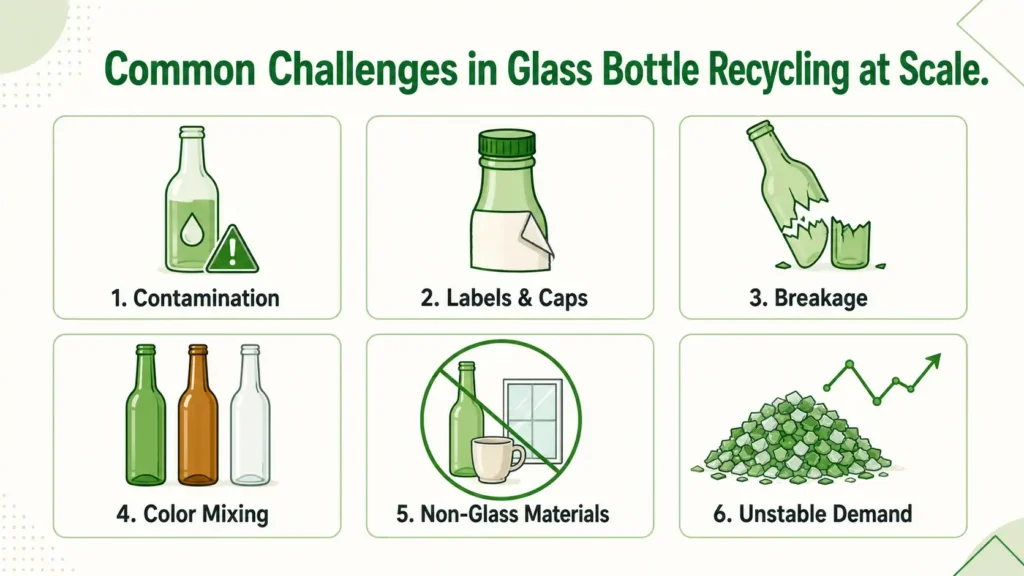
Glass recycling works well in theory, and often in practice too, but the gap between the two shows up clearly in the numbers: only about a third of glass packaging gets recycled in the U.S., compared with an EU average north of 75 percent.
That gap is not a mystery, it traces back to a specific set of obstacles beverage companies moving commercial volumes run into.
1. Contamination (Liquid Residue, Mixed Materials)
Leftover liquid and mixed-in packaging waste are the most common reasons a batch gets flagged before it ever reaches the breaking stage. Even small amounts of residue can affect sorting equipment and downstream processing quality.
2. Labels and Caps (Adhesive Residue, Non-Glass Closures)
Beverage labels often use strong adhesives, and metal or plastic closures need to be pulled before breaking. Skipping this step, or doing it inconsistently, contaminates otherwise clean cullet.
3. Breakage
Broken glass mixed in with other recyclables creates a hazard of its own, and breakage during transport or handling can damage sorting equipment further down the line. Pallet integrity and load stability matter more here than most companies expect.
4. Color Mixing
Mixed-color cullet has fewer end uses than color-sorted glass, since manufacturers need consistent color to make new containers. A load that mixes green, brown, and clear glass without separation often gets routed toward a lower-value outcome by default.
5. Non-Glass and Heat-Resistant Contaminants
Ceramics, Pyrex, and window glass all melt at different temperatures than standard container glass, and even a small amount mixed into a batch can compromise the entire load. These materials need to be identified and pulled before breaking, not after.
6. Inconsistent End-Market Demand
Cullet value moves with manufacturer demand, and even properly sorted, high-purity glass can end up downcycled or, in a weak market, landfilled anyway. Recyclable does not always mean there is a buyer ready for that particular batch in that particular week.
How Beverage Companies Can Improve Glass Recovery
None of the challenges above rule out strong glass recovery outcomes, they just mean the strategy needs to be intentional rather than assumed. Here’s a practical checklist that can help you have stronger product recovery outcomes:
- Pre-sort by color at the source whenever facility layout allows it.
- Choose label adhesives with lower processing friction where product design allows.
- Coordinate scheduled bulk pickups instead of ad hoc, inconsistent collection.
- Flag contaminated or mixed batches early rather than blending them into a clean stream.
- Track documentation for every load, not only the ones headed toward destruction.
When to Work with a Beverage Destruction and Recycling Partner
Not every beverage company needs outside help managing glass. A brewery with clean, color-sorted bottle waste and a reliable regional buyer may manage the process largely on its own.
The calculation changes once contamination, mislabeling, recalls, or full unsaleable inventory enter the picture. At that point, coordinating collection, sorting pathway, and documented recovery or destruction gets far more complex than a standard pickup schedule can handle.
Shapiro coordinates beverage destruction and recycling for brands managing exactly these situations. If your team is dealing with any of this right now, contact us to talk through what the process would look like for your specific volume and timeline.
FAQ
1. Are glass bottles recyclable?
Yes. Glass ranks among the most recyclable packaging materials available, since it can be melted and remade repeatedly without losing quality. For a broader look at how glass fits into overall packaging strategy, see our guide to sustainable beverage packaging.
2. How do you get rid of glass that can’t go in a recycling bin?
Broken, contaminated, or mixed-material glass typically needs to go through a dedicated commercial recovery pathway rather than a standard bin, since standard streams are built for clean, sorted glass. A destruction and recycling partner can coordinate pickup and proper handling for these harder-to-place loads.
3. Is glass recyclable regardless of color or condition?
Container glass itself is recyclable in nearly any color, but mixed-color or damaged loads have fewer end-market options than clean, single-color batches. Some materials that look like glass, such as ceramics, Pyrex, or window glass, are not accepted in standard glass recycling streams at all.
4. What happens to glass bottles that are broken or contaminated?
Broken or contaminated glass gets flagged during sorting and either cleaned and reprocessed, if the contamination is minor, or redirected to a lower-value recovery outcome or disposal if it cannot be safely separated. Catching this early prevents it from affecting an otherwise clean batch.
5. Can glass bottles with labels and caps still be recycled?
Yes, but labels, adhesive residue, and non-glass closures need to be removed before the glass is broken into cullet. Leaving them in place contaminates the batch and can push it toward a lower-value recovery outcome.
6. What is the difference between recycling empty bottles and full beverage container destruction?
Empty bottle recycling moves straight into the collection-to-cullet process. Full or unsaleable bottles need the liquid separated and documented first, typically through a destruction process, before the glass itself can rejoin that same recovery stream.
7. When should a beverage company work with a destruction and recycling partner instead of standard recycling?
Standard recycling works well for clean, empty, sorted glass. A destruction and recycling partner becomes the better fit once a company is dealing with recalls, contamination, mislabeling, or full pallets of unsaleable inventory that need documented handling.
8. Does commercial glass bottle recycling always turn into new bottles?
Not always. Clean, color-sorted, high-purity cullet is the material most likely to become new bottles, while mixed-color or lower-purity batches are often redirected into fiberglass insulation or construction aggregate instead.
our expert

Peter W. Klaich Director, Agriculture/Animal Health
Peter Klaich is a leading expert within the agricultural recycling and animal health market arena, known for leading National Sales at Skip Shapiro Enterprises since June 2016. He focuses on advancing sustainable recycling solutions and waste management practices across the agricultural industry.