Call or Text Now

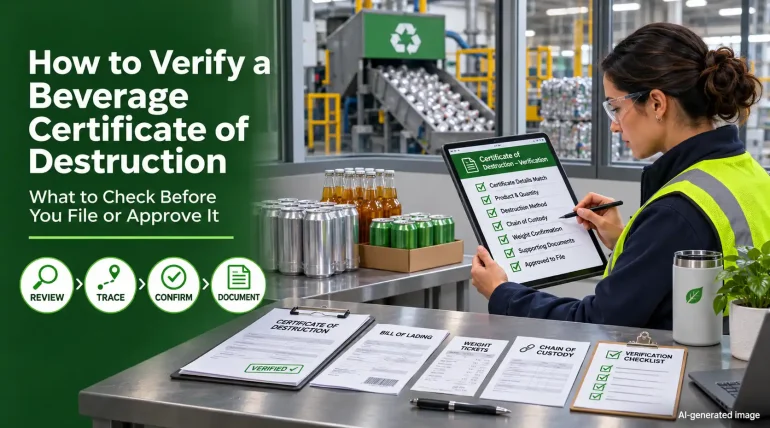
If you manage beverage destruction for your company, you know the certificate is the easy part. The hard part comes later, when an auditor or a retailer asks you to prove the product never went back on the market, and you are digging through old emails for the paperwork. Gaps like that are common, and they are painful to fix once the project is closed.
However, this doesn’t have to be the case. If the beverage certificate of destruction is complete, it should match the chain of custody records behind it and show clearly where the product finally went.
This guide gives you a 10-point verification checklist, the fields to review on the document, the records to match against it, and what to keep afterward, so you always have real proof of destruction at hand.
What Does It Mean to Verify a Beverage Certificate of Destruction?
Verifying a beverage certificate of destruction means testing the document against the records behind it. This entails confirming that every claim on that document traces back to a record you can produce.
All these records form an audit trail, and they allow the reviewer to follow the project from release to result. Within that broader audit trail, chain of custody specifically documents who held the product, and when, at each stage before destruction.
Also, reviewers rarely take a certificate at face value. For example, a retailer might ask how many cases were destroyed and on what date, while a tax team might ask where the liquid ended up. The certificate should point to easily accessible records that have answers to all these questions.
The 10-Point Checklist for Verifying a Beverage Destruction Certificate
Run this 10-point checklist the day a beverage destruction certificate arrives and work down the list in order.
- Confirm the certificate names your legal entity and the facility that performed the destruction.
- Match product names, SKUs, and lot codes to your inventory release record.
- Reconcile quantities across the certificate and supporting records, such as the release record, bill of lading, and weigh or scale tickets.
- Check that the destruction date appears separately from the issue date and that every date falls after the one before it.
- Confirm the destruction method fits the product and packaging.
- Confirm final disposition appears for each applicable output stream.
- Check that reference numbers tie the certificate to the bill of lading or work order.
- Check for a named signatory with a title and a date.
- Collect every supporting record the certificate refers to.
- File the full set under one project reference and record the retention date.

Certificate of Destruction Requirements and What to Check on the Document Itself
The exact certificate of destruction requirements depend on the project, the regulator, the contract, and the type of claim. Use the checks below as a practical verification framework, then apply any project-specific requirements.
Depending on the project, some of these details may sit in the supporting records, such as chain of custody records and weight or volume reports, rather than on the certificate itself. What matters is that each one can be found somewhere in the file.
| Field | What to confirm | What a weak entry looks like |
|---|---|---|
| Issuer and responsible party | The certificate and project documentation clearly identify the party responsible for the destruction and, where required, the processing facility. | The responsible party is unclear, or a required facility is missing. |
| Client | Your correct legal entity | A trade name or a different subsidiary |
| Product identification | SKUs, lot or batch codes and pack format, with the certificate listing the products sent and handled | “Assorted beverages” or “mixed pallets” |
| Quantity | A quantity and unit that reconcile to your records, supported by weight or volume reports where the project provides them | A unit count that cannot be matched to your records |
| Dates | Date received and date destroyed, both stated on the certificate or in supporting records | No receipt or destruction date anywhere in the file |
| Method | The actual process used for liquid and packaging | “Disposed of” or “processed” with no further detail anywhere in the file |
| Final disposition | Where each output stream went, shown on the certificate or in reporting | No mention of any end point anywhere in the file |
| References | Bill of lading, work order or project number on the certificate or in the chain of custody records | No way to tie the certificate to other records |
| Signature | Name, title and date, where the project or reviewer requires a signed certificate | Unsigned where a signature is required |
When an entry is incomplete, the gap may be resolved through a corrected or supplemented certificate and supporting records. Ask the provider what documentation is available and keep both the original and updated records in the file.
If you are still weighing beverage destruction companies, ask to see a sample certificate first, because these fields are much easier to get right before pickup than to repair afterward.
How Chain of Custody for Beverage Destruction Supports the Certificate
Chain of custody for beverage destruction shows how the product travelled from your dock to the destruction line. The certificate states the outcome, and the chain of custody records document each handoff for any reviewer who wants more substantiation.
On a full beverage container destruction project, every handoff between your dock and the processor can leave a record behind, and the ones you collect decide how much your certificate can prove.
Which Records Sit Behind the Certificate?
Not every project produces every record, so ask about each.
- The internal release or write-off record shows you authorized the product to leave.
- The bill of lading shows what the carrier accepted and when.
- Trailer seal numbers, where used, show the load stayed closed in transit.
- The receiving log shows what arrived at the facility and when.
- Weigh tickets show how much arrived by weight.
- A photo, video, or witness record shows the destruction itself, where the project includes witnessing.
How to Reconcile Quantities Across Documents
Your team probably counts in cases or pallets, the carrier counts in pallets, and the facility often records weight, so every number can be right and still look contradictory. Agree on a conversion basis before pickup, such as weight per case or per pallet. If a variance appears anyway, get a written explanation and keep it in the file.
Do the Dates Run in Order?
Line up the release, pickup, receipt, destruction, and certificate issue dates, then check that each falls after the one before it. A destruction date earlier than the receipt date will draw questions, and so will a long unexplained gap. For recalled or brand-sensitive product, that gap matters even more, because it is time the product existed outside your control.
What Should the Records Show About Final Disposition?
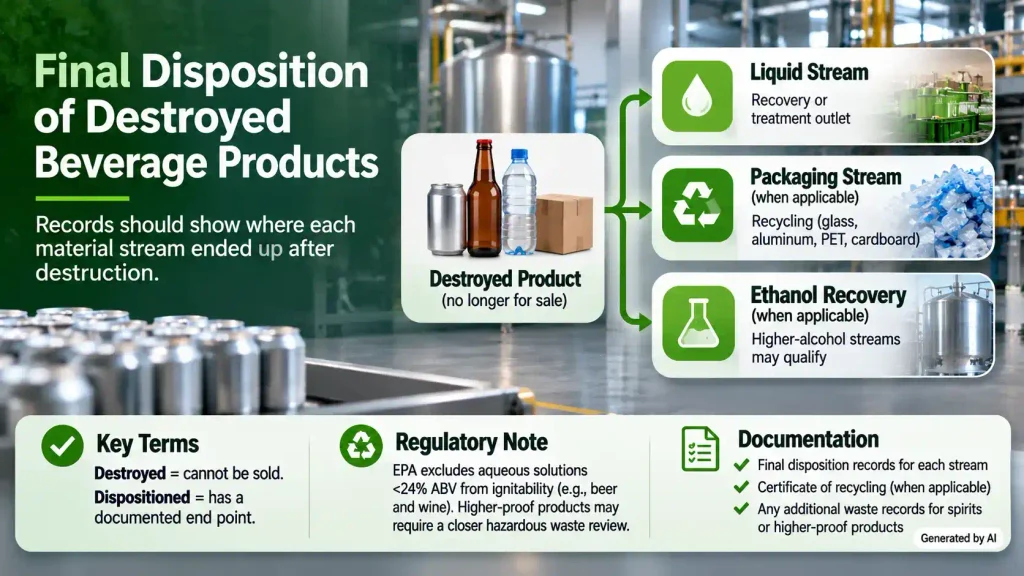
Final disposition is where the materials ended up after destruction. For packaged beverages, the records should account for each output stream, usually the liquid and the packaging. Bulk or unpackaged product may have a liquid stream only.
Depending on the product and project, liquid may be routed to an appropriate recovery or treatment outlet, while recoverable glass, aluminum, PET, and cardboard can be directed to recycling where feasible. Higher-alcohol streams may also qualify for ethanol recovery.
It also helps to separate two ideas. Destroyed means the product can no longer be sold, and dispositioned means the materials have a documented end point. Some projects add a certificate of recycling for the packaging.
Higher proof alcohol deserves a quick check. EPA excludes aqueous solutions with less than 24 percent alcohol by volume from the ignitability characteristic. Beer and wine commonly fall within that specific exclusion, while higher-proof products may require a closer hazardous waste determination based on the full waste characteristics. If spirits are in your load, ask a provider of alcohol disposal services which extra waste records apply.
Is the File Ready for the Audit You Actually Face?
That depends on who is asking. The evidence standard changes with the reviewer, so a file that satisfies a retailer can fall short for a tax claim.
What Different Reviewers Look For
Some reviewers require advance notice before destruction, and a certificate alone cannot repair a missed notice.
| Reviewer | What the file needs to show | Source |
|---|---|---|
| FDA, recall closeout | Quantity of product accounted for, and proper disposition | 21 CFR 7.53 and 7.55 |
| TTB, beer excise tax claim (example) | The file needs to show the quantity, reason, date and method of destruction. The beer provisions limit claims to 6 months and do not allow them where insurance covered the tax. Wine and spirits follow different TTB provisions. | 27 CFR 25.225 and 25.283 (beer provisions), TTB Form 5620.8 |
| CBP, duty drawback | Advance notice on CBP Form 7553 at least 7 working days before destruction, plus third party evidence if CBP does not attend | 19 CFR 190.71 |
| IRS, inventory write off | Records of how unusable goods were disposed of | 26 CFR 1.471-2(c) |
| Retailer or insurer | Whatever the agreement or policy specifies, so check before the project starts | The contract or policy itself |
What Each Team Should Confirm Before Sign Off
Compliance checks that lot codes match the recall scope and that the total quantity agrees with what was reported. Legal wants the right entity named, a signed certificate and a file showing the product never re-entered commerce.
Operations compares released quantity with received quantity and explains any variance. For finance, the destruction date has to land in the correct period and the quantity has to support the write off or claim amount.
Retailer contracts and insurance policies add their own conditions on top of the wider beverage disposal documentation rules for your product and location, so read those terms before the project starts.
What Destruction Documentation Should You Retain After the Project?
Keep the certificate, the chain of custody records, and the internal paperwork under one project reference, with one named owner and a recorded retention date. Legal or tax counsel should set the date, because the longest applicable requirement governs.
Your destruction documentation file should also hold the internal approval to destroy, the inventory adjustment entry, any regulator or retailer correspondence, and any variance explanation. Make it searchable by SKU and lot code so a newcomer can find it in minutes.
No single period fits every project. The IRS general period is three years, yet recall, excise, customs, contract, and litigation requirements can run longer. Name one function as record owner so the file survives staff changes.
Plan the Documentation Before the Truck Arrives
Verification gets easier when the documentation is agreed before pickup, including the unit of measure, the lot level detail, and the records your reviewer will need.
With more than 50 years in operation, Shapiro assesses each project, coordinates it through a network of more than 200 vetted processor facilities, and provides a certificate of destruction with chain of custody documentation. Contact us to discuss your beverage type, packaging, quantity, location, and documentation requirements, or explore our beverage destruction services.
Disclaimer: This article offers general information and does not constitute legal or tax advice.
Frequently Asked Questions
How do you verify a certificate of destruction for beverages?
Check that the certificate is complete and that it matches your release record and bill of lading. Then confirm that each claim traces to a supporting record you can produce. The 10-point checklist above covers each step in order.
Is a certificate of destruction enough on its own for an audit?
Not necessarily. The certificate summarizes the project, and reviewers often ask for the records behind it, such as the bill of lading, receiving documents, and any weigh tickets. A complete file behind the certificate answers follow-up questions quickly.
What is the difference between a certificate of destruction and chain of custody records?
The certificate confirms the outcome. Chain of custody records document each handoff from the moment product left your control until destruction, including who held it and when.
What does final disposition mean in beverage destruction?
It means where the materials ended up after destruction. For a packaged product, that usually means the liquid, which may go to ethanol recovery for energy, and the packaging, which may go to recycling. Records should name an endpoint for each stream.
What should we do if a certificate of destruction is missing information?
Request a corrected or supplemented certificate in writing, and say exactly which fields need attention. Keep the original, the corrected version, and the correspondence in the project file so the history stays clear.
Who should keep beverage destruction records inside the company?
One named function should own the file, with access for compliance, legal, operations, and finance. Compliance or quality teams usually take it on, since they already track recalls and the day-to-day side of beverage waste management around each project.
our expert

Peter W. Klaich Director, Agriculture/Animal Health
Peter Klaich is a leading expert within the agricultural recycling and animal health market arena, known for leading National Sales at Skip Shapiro Enterprises since June 2016. He focuses on advancing sustainable recycling solutions and waste management practices across the agricultural industry.