Call or Text Now
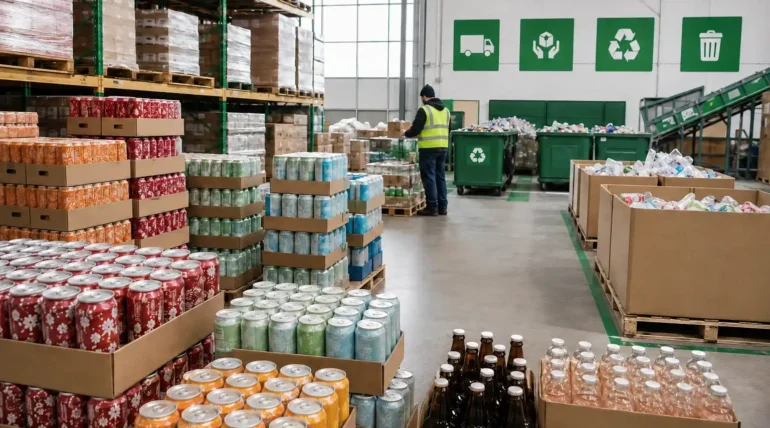
A limited-edition holiday flavor sells well for eight straight weeks. Then the calendar turns and a few hundred cases are left sitting in a warehouse with packaging that says “Winter 2025” on every can.
That kind of limited-time beverage inventory did not fail – it just ran out of time because it was built around a fixed time window. It’s a genuinely different situation from expired product or a launch that simply didn’t sell.
Below, we cover what counts as seasonal beverage overstock, why it can’t just wait for next year, what actually happens to it once a sales window ends, how promotional and co-branded beverages complicate the picture, and where brands typically turn for help.
What Counts as Seasonal Beverage Overstock?
Not every slow-moving SKU qualifies as seasonal overstock. The defining feature is a fixed sales window rather than a quality problem or a market-fit miss. A few common examples:
- Holiday flavors and packaging. Peppermint, pumpkin spice, eggnog-adjacent flavors, or standard products wrapped in holiday-specific cans and labels built to move during a single, defined season.
- Promotional tie-ins. Beverages produced around a sporting event, a movie release, or a retailer promotion, where the product’s relevance is tied to a calendar date rather than an ongoing demand curve.
- Limited-edition and collaboration runs. Co-branded flavors or partnership releases created for a set production run, with no plan (and often no ability) to reorder once it’s gone.
In each case, the product was never meant to be an evergreen SKU. It is also not expired product or a launch that missed the mark on flavor or price. It is inventory that did exactly what it was built to do, and simply has volume left when the calendar moves on.
Why Seasonal Overstock Can’t Just Roll Over to Next Year
The instinct to hold onto leftover holiday drink inventory until next season is understandable, but it rarely works out for a few practical reasons.
First, holiday-dated packaging is date-stamped in a way that can’t be sold once the season passes, regardless of what’s inside the can or bottle. A “Holiday 2025” design does not become “Holiday 2026” inventory just by sitting in a warehouse another eleven months.
Second, storage cost adds up while it sits. Pallet space, warehouse fees, and the opportunity cost of tying up space with dead inventory all accumulate the longer a decision gets delayed.
Third, many retailers reset seasonal sets on a fixed schedule and do not accept old-season product back into next year’s planogram, even if the brand wanted to bring it back. Reset timing and take-back policies vary by retailer, so this is not a universal rule, but it is common enough that most beverage brands and retailers plan around it rather than around the alternative.
Taken together, these three factors are why “just hold it until next year” is rarely a workable plan for unsold seasonal stock, and why the more realistic question becomes what to do with it now.
What Actually Happens to Seasonal Beverage Overstock
Once a brand accepts that the product isn’t coming back for a second season, the path forward generally follows the same shape:
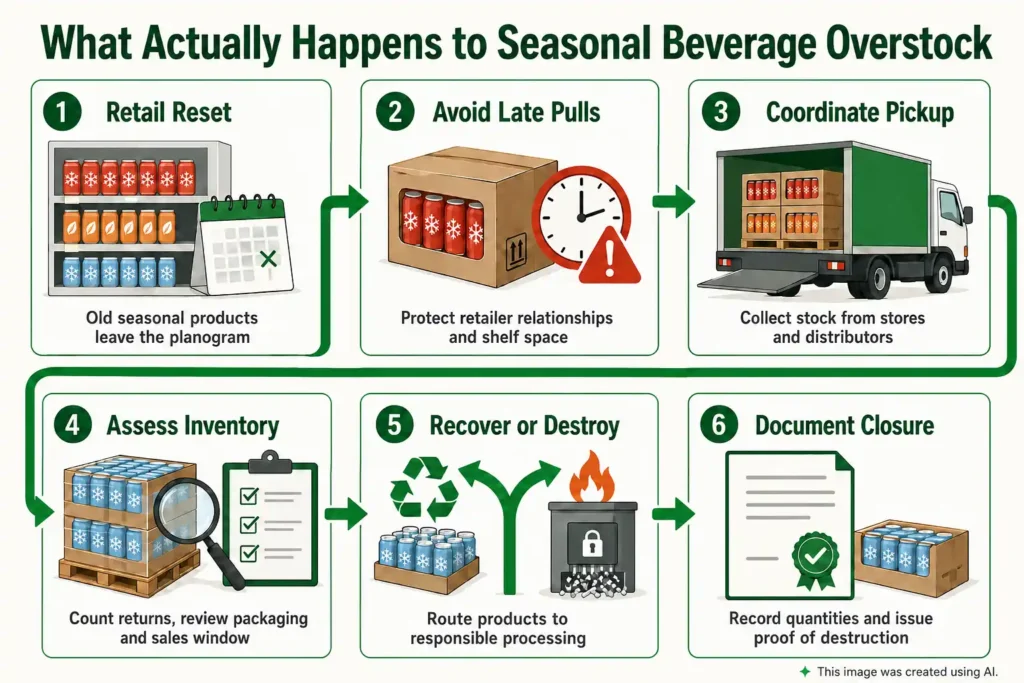
1. What a Reset Actually Means for a Retailer
A seasonal reset is when a retailer swaps out a holiday or promotional set for the next planogram, on a schedule the retailer controls rather than the brand. Many retailers run resets on a fixed date tied to their own merchandising calendar, though timing and enforcement vary by retailer and by category, so this should not be treated as a fixed industry rule.
2. Why Late Pulls Can Create Problems for a Brand
Product left on shelf past a reset date can create friction that has nothing to do with disposal. It can trigger retailer penalties, strained shelf-space relationships, or a harder conversation the next time a brand wants a seasonal placement. This is primarily a business-relationship consideration, separate from the question of what eventually happens to the physical inventory.
3. Coordinating Pickup Before the Reset Date
The practical side of a reset is getting old-season product off shelf and out of distribution before the deadline. That is what actually generates the volume that needs a destination: cases coming back from stores, distributor returns, and whatever remains in the warehouse.
This is the point where brands typically start looking into beverage destruction and recycling for overstock inventory, since coordinating pickup across multiple retail locations is its own logistics exercise before any processing even begins.
4. Assessing What’s Left When the Window Closes
What makes this assessment specific to seasonal inventory is what’s being measured:
- How much old-season stock actually came back
- How much of it carries packaging tied to a specific holiday or promotion that limits where else it could realistically go
- How much usable sales window, if any, is left before it’s not worth trying to move at all
From there, finance teams may need to assess the remaining value and appropriate write-off treatment before the physical process moves forward.
5. Routing to Destruction or Material Recovery
Written-off inventory then gets routed to responsible destruction or, where the packaging can be separated cleanly, to material recovery – the same general process that applies to any excess or discontinued beverage inventory.
6. Documentation for Retailer and Audit Requirements
For a seasonal pull, the paperwork tends to matter more than usual: records tied to the reset showing what came back, from where, and when it was processed. A certificate of destruction is often what a retail partner is really asking for, proof that last season’s promotional inventory has been closed out and won’t resurface on shelf or through another channel.
Promotional and Limited-Edition Beverages: A Special Case
Promotional and co-branded beverages add a layer that a brand’s own straightforward seasonal SKU doesn’t have to deal with. These runs often carry partnership terms that shape what can happen to unsold stock once the tie-in period ends, and this applies just as much to smaller limited-edition releases as it does to major collaborations.
1. Why Collabs and Co-Branded Runs Are Different
A licensing or partnership agreement can restrict what happens to leftover product after the partnership window closes. Contractual terms vary, so resale or donation isn’t always available once a brand partnership or license period ends, but it often requires destruction rather than allowing the product to circulate outside its intended window. That is a meaningfully different situation from a brand’s own holiday flavor, where the only real constraint is a shrinking sales window rather than a legal one.
2. What This Means for Disposal Decisions
When resale or donation isn’t an option under the partnership terms, responsible destruction becomes the practical route rather than a fallback preference.
The same logic applies to a broader category of expired promotional beverages and other unsaleable beverage inventory: once the commercial window and any contractual constraints have closed, the goal shifts from finding a buyer to closing out the inventory cleanly, with documentation to match.
Working With a Partner for Seasonal and Promotional Overstock
Seasonal and promotional overstock is a recurring part of doing business with limited-time products, not a sign that something went wrong. What matters is having a plan before the reset date arrives rather than scrambling once the display comes down.
Our team helps brands, retailers, and distributors assess remaining inventory, coordinate pickup across locations, and route product to appropriate processors for beverage destruction and recycling, with documentation that stands up to retailer and internal audit requirements.
If you’re sitting on seasonal beverage inventory that isn’t coming back for another season, contact us to talk through what’s left and what it takes to close it out.
Frequently Asked Questions
No. Seasonal overstock is inventory tied to a fixed sales window like a holiday, limited-edition run or a promotion that still has volume left once that window closes.
Expired product has passed a use-by or best-by date. The two can overlap, but seasonal overstock is fundamentally a timing issue, not a quality issue.
Sometimes, but often it isn’t practical. It depends on the retailer, the packaging, shelf-life and storage conditions. Some retailers allow old-season product back on next year’s shelf, but many reset their seasonal sets on a schedule that doesn’t accommodate it.
Holiday-dated packaging can also make a product hard to sell once the season is over even if the contents inside are perfectly fine. On top of that, storage costs often make holding such inventory the more expensive option compared with closing it out now.
Once a brand confirms the sales window has closed, the typical path is an inventory assessment, a write-off decision, and routing to responsible destruction or material recovery, with documentation produced along the way for retailer and audit purposes.
Often, yes. Partnership or licensing agreements can restrict what happens to unsold stock once a promotional period ends, and resale or donation isn’t always contractually available. Terms vary by agreement, so this should be confirmed on a case-by-case basis rather than assumed.
The underlying process, assessment, write-off, and routing to destruction or recovery, is largely the same. The difference usually comes down to whether a partnership agreement adds contractual restrictions on top of the standard timing pressure that any seasonal SKU faces.
our expert

Peter W. Klaich Director, Agriculture/Animal Health
Peter Klaich is a leading expert within the agricultural recycling and animal health market arena, known for leading National Sales at Skip Shapiro Enterprises since June 2016. He focuses on advancing sustainable recycling solutions and waste management practices across the agricultural industry.