Call or Text Now

Last updated November 20, 2026. Packaging rules change often. We review this guide every quarter.
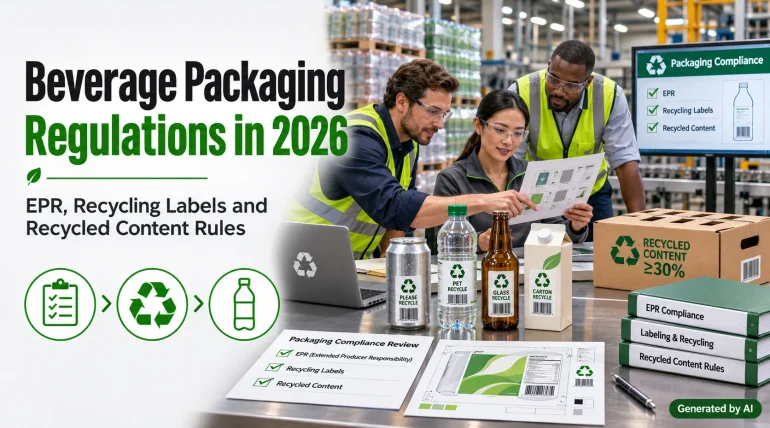
In 2026, beverage packaging regulations require brands to navigate overlapping state EPR programs, recycling-label restrictions, and recycled-content requirements.
Under extended producer responsibility (EPR) programs, brand owners pay a producer responsibility organization (PRO) to fund recycling, and Oregon, Colorado, California, Minnesota, Maryland and Washington all have obligations on the calendar. Maine’s program hasn’t started yet. California has also limited recycling claims on packaging made from October 4, 2026, and recycled content minimums for plastic bottles keep rising. If you export, the EU packaging regulation began applying on August 12, 2026.
So where does that leave you? Usually, the brand owner is the one who has to comply, and deposit containers are often treated differently. This guide sorts out packaging compliance in 2026 so you can see which rules reach you and when.
What do beverage packaging regulations cover?
When we talk about beverage packaging regulations, we refer to a handful of rule types, so let’s clarify these before we get into the dates.
- EPR comes first. Under extended producer responsibility packaging laws, the company that puts packaged product on the market pays toward collecting and recycling that packaging, usually by joining a PRO.
- A PRO is simply the organization that collects fees and files reports on behalf of its members.
- Recycling labels are the next piece, and here we mean the chasing arrows symbol and any “recyclable” claim on a can or bottle.
- Recycled content (often shortened to PCR for postconsumer recycled content) sets a minimum share of recycled material that a container has to contain.
- And then there are deposit laws, also called bottle bills, where shoppers pay a refundable deposit on a container. California’s version is known as California Redemption Value, or CRV.
This hit beverage brands harder than most because one bottle can sit inside an EPR program, carry a recycling claim and face a recycled content minimum, all in the same state.
Which states have EPR beverage packaging rules in 2026?
Six states have EPR beverage packaging rules that either apply to producers now or are scheduled to, and Maine has a law on the books without a working program yet.
The pattern is similar everywhere. You join a PRO, report what you sell into the state and pay fees, although the dates and exemptions differ quite a bit. Because these beverage packaging laws keep shifting, we’ve put the key points side by side.
| State and rule | Key dates | What producers do | Beverage containers | Source |
|---|---|---|---|---|
| Oregon, Recycling Modernization Act | PRO membership and fees from July 1, 2025 | Join the PRO (Circular Action Alliance), pay fees and give records. Exempt under $5M global revenue or under 1 metric ton sold into Oregon | Bottle Bill containers are exempt, and a Bottle Bill brand is exempt only if it is sold under 5 metric tons of other covered products. Secondary and tertiary packaging, such as six pack rings and wine boxes, usually stays covered | Oregon DEQ producer obligations summary |
| Colorado, Producer Responsibility Program for Statewide Recycling | First annual dues January 2026, with CAA plan implementation by June 9, 2026 | Join CAA (participant agreement and Colorado addendum), submit supply reports and pay annual dues | The state page doesn’t address beverage containers, and Colorado has no bottle bill. Confirm with CAA | Colorado CDPHE EPR program |
| California, SB 54 (Plastic Pollution Prevention and Packaging Producer Responsibility Act) | Final regulations effective May 1, 2026, with producer registration due June 1, 2026 | Register with CAA, register as an independent producer or apply for the small producer exemption (under $1M gross annual sales) | Containers in the CRV deposit program are excluded from covered material (Public Resources Code 42041(e)(2)(E)). The exclusion doesn’t reach other packaging around them, so confirm with CAA | CalRecycle exemptions and exclusions and Public Resources Code 42041 |
| Minnesota, Packaging Waste and Cost Reduction Act | CAA membership by July 1, 2025. Program costs covered in a phase from 2029 to 2032 (at least 90% by 2031). From 2032 packaging must be refillable, reusable, recyclable or compostable | Join CAA and later pay toward program costs | No beverage exception is listed, so beverage packaging appears covered as food packaging. | Minnesota MPCA |
| Maryland, Packaging and Paper Products Producer Responsibility (SB 901, 2025, and COMAR 26.04.14) | Regulations effective May 25, 2026. Registration with MDE by July 1, 2026 and every year after. Individual producer plans due July 1, 2028. Sales ban without an approved plan from October 29, 2028 (or a later date MDE sets) | Register with MDE through a PRO (CAA) or on your own. Exempt under 1 ton of covered material or under $2M global gross revenue in the last fiscal year | Covered. The rule’s definition of a beverage container includes bottles, cans, cartons and pouches of any material up to 5 litres, and the deposit exclusion doesn’t apply because Maryland has no bottle bill | Maryland MDE program page and COMAR 26.04.14 |
| Washington, Recycling Reform Act (SB 5284, 2025) | Producers not in the PRO can’t sell after March 2029. Program starts in 2030 | Join the PRO (CAA) and pay fees | Ecology’s page doesn’t address beverage containers, and Washington has no bottle bill. Confirm with the PRO | Washington Ecology |
| Maine, Stewardship Program for Packaging | No stewardship organization yet. DEP is reassessing the schedule (update posted October 28, 2026) | Register with the stewardship organization within 90 days of it opening registration. Exempt under $2M revenue for the first 3 years (then $5M) or under 1 ton | Bottle bill containers (33 M.R.S. 3102) are excluded |
If you only read one column in that table, make it the fourth, because deposit laws shape your obligations more than anything else. Oregon and California leave out containers already covered by their deposit laws, and Maine does the same, so a can with a deposit in Oregon may sit outside the program. The six-pack rings and wine boxes around it can still count, though. Maryland has no bottle bill, so its definition of a beverage container applies to bottles, cans, cartons, and pouches up to 5 liters.
So who counts as the producer? Generally, it’s the brand owner of the product sold in the state, and if there isn’t one, the licensee or importer may step in. Small producers may be exempt, and the table shows where each state draws that line.
Most of these programs run through Circular Action Alliance (CAA), although Maryland allows other PROs and Maine has no stewardship organization yet. Several dates have already passed, so it may be worth checking where you stand.
Do beverage recycling labels apply to cans and bottles?
The headline change for beverage recycling labels in 2026 is a limit on what you can claim, since nobody is adding a new mandatory label to every can. California’s SB 343, often called the truth in recycling law, restricts the chasing arrows symbol and “recyclable” claims on products and packaging made on or after October 4, 2026, so that they only appear on materials meeting CalRecycle’s criteria. Marking duties haven’t disappeared entirely either, because some states still require resin identification codes on plastic containers.
Here is where beverage brands get a bit of breathing room. CRV beverage containers are carved out of SB 343, since the symbol on them isn’t deemed deceptive under Business and Professions Code 17580(e)(2), as SB 343 added it. Packaging outside the CRV program doesn’t get that carve-out, which includes most wine and spirits bottles and secondary packaging such as cases. Products made before October 4, 2026 are grandfathered, so stock you manufactured earlier can generally keep its existing marks.
Now for the part that complicates things. On July 14, 2026, a federal court in the Southern District of California issued an order, in a lawsuit brought by trade groups, that bars the California Attorney General from enforcing provisions of the law while the case continues. A law firm alert from September points out that the order didn’t touch the October 4 date itself, and it doesn’t address private lawsuits under California consumer protection law. The October 4 date has now passed, so the law exists, the enforcement picture is unsettled, and the case is still moving. Depending on how it ends, the rules for your non-CRV packaging could look different next year.
If you export, the EU is heading toward its own harmonized material labels, and we cover the timing in the EU section below.
How much recycled content is required in beverage bottles?
Three states set recycled content requirements for beverage containers, and they climb on different schedules. In plain terms, a plastic bottle sold in these states needs a minimum share of postconsumer recycled material, and that share keeps rising. Here is how they compare.
| State | Covered containers | Requirement | Obligation | Source |
|---|---|---|---|---|
| California | Plastic beverage containers in the CRV program | 25% from January 1, 2025, and 50% from January 1, 2030 | Annual report by March 1. Penalty of $0.20 per pound of shortfall. Makers of 16M or fewer containers a year are exempt from the minimum but must report | CalRecycle minimum content page |
| Washington | Plastic beverage containers | 25% in 2026 and 50% in 2031 (187 ml plastic wine bottles are on a later schedule) | Register and pay fees by April 1 each year, plus an annual report | Washington Ecology recycled content minimums |
| New Jersey | Plastic beverage containers and glass containers | Plastic at 15% (2024), 20% (2027), 25% (2030), rising to 50% (2044). Glass at 35% (25% if the glass is 50% mixed color cullet) | Brand owner registers annually and files an annual compliance certification. The 2026 extension for food contact packaging doesn’t cover beverage containers | NJDEP recycled content FAQ |
Think of California as the state that shows you where the others are heading. Its plastic CRV containers have needed 25% recycled content since January 1, 2025, and that rises to 50% on January 1, 2030. You file an annual report by March 1, and a shortfall can cost $0.20 per pound. Smaller makers get some relief, since those producing 16 million containers or fewer a year are exempt from the minimum, although they still have to report.
Washington follows a similar path on a different timeline. Plastic beverage containers need 25% in 2026 and 50% in 2031, and you register and pay fees by April 1 each year.
New Jersey is the one that behaves differently, and for good reason. Its plastic schedule starts lower at 15% and climbs gradually to 50% by 2044, and it also covers glass, which is unusual. Glass containers need 35% recycled content, or 25% if the glass is at least half mixed-color cullet. You may have heard about New Jersey’s 2026 extension for food contact packaging, but it doesn’t reach beverage containers.
Aluminum isn’t covered by these state minimums, which means the pressure lands on plastic and glass. If you’re wondering what a higher percentage means for your supply, it helps to know how PET bottles are recycled, since the quality of the recovered material shapes what you can actually buy. And if you export, the EU is asking for 30% recycled content in single use plastic beverage bottles by 2030, rising to as much as 65% by 2040.
What changes for beverage brands that export to the EU?
The EU’s Packaging and Packaging Waste Regulation, known as PPWR and formally Regulation (EU) 2025/40, applies from August 12, 2026, so if you ship product into EU markets, it is already part of your picture. It entered into force on February 11, 2025, and the European Commission’s packaging page confirms both dates.
Most of the beverage-specific targets arrive later, which gives you some room to plan. Labels are the first one to watch. Under the EU PPWR, harmonized material labeling requirements apply from August 12, 2028, or 24 months after the relevant implementing acts enter into force, whichever is later, so the final date may shift. Either way, label art for EU markets may need a redesign within a couple of years.
Additionally, member states need to separately collect at least 90% of single-use plastic and metal beverage containers up to 3 liters by January 1, 2029, and in practice that tends to mean deposit systems. Single-use plastic beverage bottles need 30% recycled content by 2030, as we covered above, and beverage reuse targets for 2030 apply with exclusions for milk, wine, aromatized wine and spirits. You can see the full list of targets in the European Parliament’s summary.
One more thing that often surprises US brands. The EU importer carries obligations for imported packaging, so your importer of record may start asking you for packaging data, material details and label artwork sooner than you expect.
Which teams inside a beverage company does this affect?
Rules like these rarely stay in one department, and a single change can ripple through several teams before anyone notices. The table below shows you the breakdown.
| Team | What changes |
|---|---|
| Packaging and R&D | Material choice, PCR sourcing and label art all move at the same time |
| Regulatory and legal | State registrations and reviews of recyclability claims |
| Finance | EPR fees that differ by state and can arrive on different schedules |
| Sales and data | State by state supply reports built from shipment data |
| Procurement | Finding a dependable supply of food grade recycled material |
| Marketing | Any recyclability claim on packs, websites and ads |
| Operations and logistics | Unsaleable, obsolete and relabeled stock |
Packaging and R&D tends to carry the heaviest load, because every material and label decision now has a regulatory side. The tradeoffs between materials deserve their own discussion, and our look at sustainable beverage packaging choices covers them, so here we’ll stick to the regulatory side. Sales and data teams often get surprised too, since supply reports depend on how well your shipment records match the packaging you actually used.
What does this mean for unsaleable, recalled, or relabeled product?
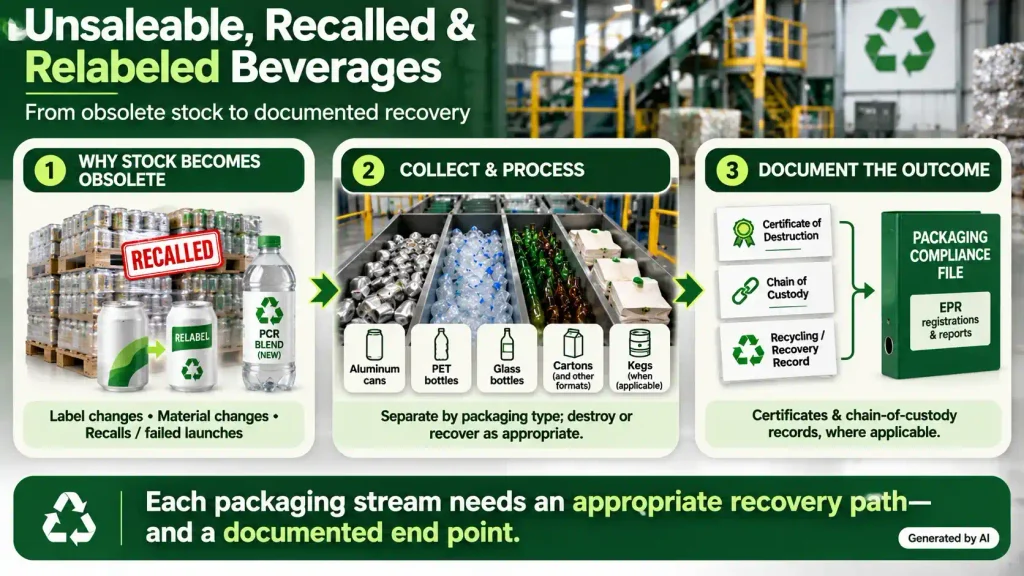
Packaging compliance 2026 doesn’t stop at the production line. When a label claim changes, a material switches or a bottle moves to a new recycled content blend, the packaged stock you already have can turn obsolete almost overnight. Recalls and failed launches leave you in the same spot, with product that still needs a documented end of life. And since EPR and recycled content laws run on records, the destruction and recycling paperwork for that stock fits best in the same compliance file as your registrations and reports.
The material matters here, because each one follows a different recovery path. If you’re holding glass, our overview of the glass bottle recycling process shows what happens after collection. For cans, we walk through recycling aluminum beverage cans in a separate guide.
So where do we fit in? We work with aluminum cans, PET and glass bottles, and we also handle cartons, kegs, and other packaging formats. Our team coordinates collection and then destruction or recovery, providing certificates of destruction and chain of custody documentation where applicable. If you’re dealing with relabeled or recalled stock, that is the kind of support our beverage destruction and recycling services are built around, and the paperwork it produces can go straight into your compliance file.
How can beverage companies keep track of changing rules?
A short routine goes a long way here, because the rules in this guide moved several times in 2026 alone. We’d suggest a few habits.
- Subscribe to updates from each state agency you sell into, using the same pages linked in the EPR table above, such as Oregon DEQ and Maine DEP.
- Watch PRO notices for fee schedules and reporting dates, which you can find through Circular Action Alliance.
- Keep a dated calendar of the deadlines in this article so nothing slips between teams.
- Review label claims before each print run, especially while the SB 343 case is still open.
- Confirm what applies to you with counsel or your PRO, since this guide describes what the rules say and can’t speak to your situation.
Rules in this guide were checked against official sources on November 20, 2026.
Frequently Asked Questions
Are beverage containers covered by state beverage packaging laws?
It depends on the state and the container. Oregon, California, and Maine exclude containers covered by their deposit laws, while states without a deposit law generally treat beverage packaging like other packaging. Secondary packaging is often covered either way.
Who counts as the producer for beverage packaging?
Usually it’s the brand owner of the product sold in the state. If there isn’t one in the state, the licensee or importer may be responsible, and small producers may be exempt under each state’s thresholds.
When do California’s recycling label rules start?
SB 343 applies to products and packaging made on or after October 4, 2026. CRV beverage containers are carved out, and a court order currently limits enforcement of provisions of the law while a lawsuit continues, so it’s worth rechecking the status before you print.
How much recycled plastic must a beverage bottle contain?
In California, it’s 25% now and 50% from 2030 for CRV plastic bottles, and in Washington it’s 25% in 2026 and 50% in 2031. New Jersey requires 20% from 2027, and the EU asks for 30% in single-use plastic beverage bottles by 2030.
our expert

Peter W. Klaich Director, Agriculture/Animal Health
Peter Klaich is a leading expert within the agricultural recycling and animal health market arena, known for leading National Sales at Skip Shapiro Enterprises since June 2016. He focuses on advancing sustainable recycling solutions and waste management practices across the agricultural industry.