Call or Text Now
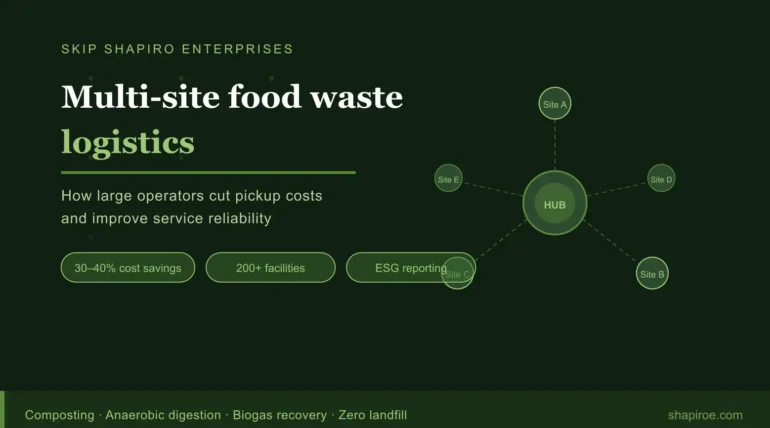
If you’re managing food waste across multiple facilities, you already know the problem.
Five vendors, twelve locations, and no two pickup schedules that match. One site is running a composting program. Another is sending everything to landfill. A third has a vendor who keeps missing pickups with no notice and no accountability. Meanwhile, your sustainability team needs diversion data for ESG reporting, and your operations budget is taking hits from cost overruns no one can explain.
This is not a food waste problem. It is a food waste logistics problem — one that gets harder to manage with every location you add.
Key Takeaways
- Managing food waste across multiple locations is a logistics coordination problem that compounds into cost overruns and compliance exposure that site-level fixes cannot solve.
- Consolidated multi-site food waste pickup programs reduce per-location costs through route efficiency, volume-based negotiating power, and the elimination of redundant vendor minimums.
- Routing organic waste correctly requires food-specific expertise: composting, anaerobic digestion, and biogas facilities each accept different stream types, and a generic broker cannot manage that routing at scale.
- Centralized waste tracking enables ESG reporting, per-site diversion documentation, and the consolidated compliance records that multi-location audits require.
Why Multi-Site Food Waste Logistics Is Different
Most large operators treat multi-site food waste like a single-site program at greater volume. That assumption is where cost control, compliance, and service reliability start to break down.
At a single facility, waste schedules, routing decisions, and vendor accountability are straightforward. Across 10, 20, or 50 locations, those variables multiply at every level. Perishability timelines shift by location, product type, and seasonal mix. Organic waste routing (whether to composting, anaerobic digestion, or biogas recovery) requires processing infrastructure within proximity to each individual site, not just a network average. And food-specific compliance documentation must be maintained per site, then consolidated cleanly.
Layer in volume swings from promotions, seasonal peaks, and SKU transitions, and you have a logistics coordination challenge that generic waste haulers are not built to absorb. The operators who manage it well treat food waste in supply chain as a function, not a facilities task.
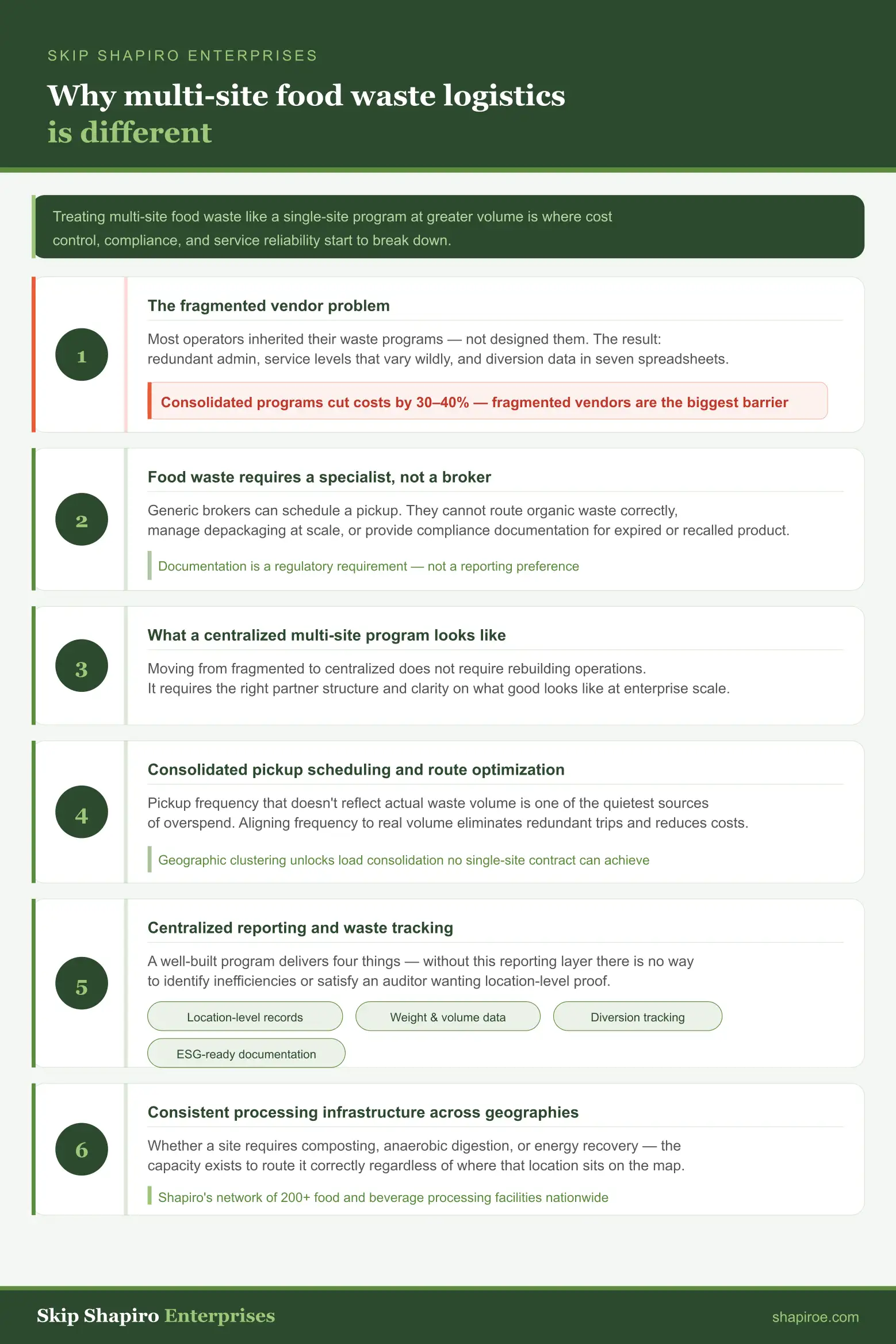
1. The Fragmented Vendor Problem
Most large operators did not design their waste programs, they inherited them.
The result: redundant admin overhead, food waste pickup service levels that vary wildly between locations, and diversion data that lives in seven different spreadsheets.
When it comes time to pull diversion data across 15 locations, it becomes a manual, error-prone exercise. By moving to consolidated waste services, multi-property operators can cut costs by 30-40%. Fragmented vendor relationships are the single biggest barrier to getting there.
2. Why Food Waste Requires a Specialist, Not a Broker
Generic waste brokers can schedule a pickup. They cannot reliably route organic food waste to dedicated food waste recycling services, manage depackaging at scale, or provide the documentation required for food product disposal compliance. That gap matters most if you’re handling expired product, recalled items, or close-dated SKUs, where documentation is a regulatory requirement, not a reporting preference.
3. What a Centralized Multi-Site Program Actually Looks Like
Moving from a fragmented setup to a centralized food waste logistics program does not require rebuilding operations from the ground up. It requires the right partner structure and a clear picture of what good actually looks like at enterprise scale. Here is what a well-designed program includes.
4. Consolidated Pickup Scheduling and Route Optimization
Pickup frequency that does not reflect actual waste volume is one of the quietest sources of overspend in multi-site programs.
A distribution center generating five tons of organic waste per week has different needs than a smaller retail location. Aligning pickup frequency to real volume eliminates redundant trips and brings per-pickup costs down. Additionally, when sites are clustered geographically, route optimization across that cluster creates load consolidation opportunities that no single-site contract can unlock.
Haulers and trucking companies serving these routes can also draw on waste disposal support to keep loads moving to the right facility.
5. Centralized Reporting and Waste Tracking
A well-built program delivers:
- Location-level pickup records
- Weight and volume data per site
- Diversion rate tracking
- Consolidated documentation ready for ESG reporting or sustainability audits
Without that reporting layer, there is no way to identify inefficiencies, track year-over-year program performance, or satisfy an auditor who wants location-level proof.
6. Consistent Processing Infrastructure Across Geographies
If you’re performing well at one facility but have no processing capacity or infrastructure in others, you’re dealing with serious inconsistencies across the board.
Shapiro’s network of 200+ food and beverage processing facilities is what makes that possible. Whether a site requires composting, anaerobic digestion, or energy recovery, the capacity exists to route it correctly regardless of where that location sits on the map.
How Large Operators Cut Pickup Costs Without Sacrificing Reliability
Three areas consistently move the needle for operators consolidating from fragmented programs.
1. Vendor Consolidation and Contract Leverage
Moving from five regional vendors to one national partner is a procurement decision as much as an operational one. Each vendor relationship carries its own service minimums, billing cycle, rate escalation clause, and administrative overhead. Multiply that across a national portfolio and the hidden cost of fragmentation goes through the roof.
Uniting all of this into a single program eliminates the redundancies, but it also changes your negotiating position. A single contract covering 20 locations carries far more leverage than 20 individual agreements, and a waste consolidation partner managing your full footprint has both the incentive and the visibility to optimize performance across it.
2. Matching Service Frequency to Actual Volume
One of the most consistent sources of overspend in multi-site waste programs is fixed pickup schedules set at contract inception and never revisited.
Volume at any given location fluctuates all the time. When pickup frequency does not track those shifts, operators pay for trips that are not needed or face overflows when volume spikes.
A data-driven program adjusts cadence based on actual waste generation per site, keeping food waste pickup aligned to what each location actually produces rather than what was estimated at contract signing.
3. On-site and Near-site Processing Options
For high-volume locations, long-haul transport is one of the largest single cost drivers in the system. The further material travels before it reaches a processing facility, the more expensive it becomes.
What works better? By separating and condensing materials at or near the point of generation, only processed outputs move downstream, which reduces transport volume, lowers per-load cost, and shortens the overall logistics chain. For the trade-offs, see our guide to on-site vs. off-site organic waste processing.
Choosing the Right Multi-Site Food Waste Partner
The difference between a food waste logistics program that works and one that creates ongoing frustration usually comes down to partner selection. For multi-site operators, the criteria matter more than the pitch. Here is what to evaluate before committing:
- Geographic processing network: A vendor with strong coverage in one area only will underperform the moment your program extends beyond it. Confirm that processing capacity exists near each of your locations, not just in your highest-volume markets.
- Food-specific routing capability: A qualified partner should be able to route each waste stream to the appropriate destination based on material type, regulatory requirements, and proximity, not just what is available.
- Consolidated reporting and documentation: All data should be accessible in one place. If your partner cannot produce consolidated documentation for ESG reporting or a regulatory audit, the program has a structural gap.
- Capacity to absorb volume surges from recalls, expirations, or seasonal peaks: Predictable programs are easy to manage. The real test of a partner is what happens when a product recall generates 10x normal volume at three locations simultaneously. Ask specifically how surge events are handled and what processing capacity backs that answer.
- A measurable diversion commitment, zero landfill or documented rates by location: Diversion claims without location-level data are not useful for sustainability reporting. Require specifics, not averages.
- A clean regulatory compliance record: For operators in regulated food environments, this is non-negotiable. A partner that has never been cited by a local, state, or federal agency is not a baseline expectation, it is a genuine differentiator worth asking about directly.
- Dedicated account management for multi-site coordination: A call center that routes tickets is not the same as a contact who knows your locations, your program, and what your next reporting deadline looks like.
Conclusion
Running a cost-efficient, reliable food waste program across multiple locations is a solvable problem. It requires the right processing network and a partner who understands the specific demands of food and beverage operations at scale.
Shapiro handles multi-site food waste logistics for some of the largest food and beverage operators. Whether you are managing 5 locations or 50, we build programs around your actual footprint: consolidated food waste pickup, certified processing, and centralized reporting.
If your current program does not work for you but against you, let’s fix that. Contact us to get a custom multi-site waste program for your operation.
FAQ
1. How does multi-site food waste logistics work for large operators?
A centralized program assigns one partner to manage pickup scheduling, routing, processing, and reporting across all locations. Instead of each site running its own vendor relationship, the entire footprint operates under a single program.
2. Can one vendor manage food waste pickups across multiple states?
Yes, but only if that vendor has confirmed processing infrastructure near each location. A partner with a deep geographic network can route organic waste to composting, anaerobic digestion, or energy recovery facilities regardless of where each site sits.
3. What is the best way to reduce food waste pickup costs across multiple locations?
The most reliable levers are vendor consolidation, which eliminates redundant minimums and improves contract leverage, and frequency alignment, which matches pickup cadence to actual waste volume per site rather than a fixed schedule. For high-volume locations, near-site processing can also remove long-haul transport cost from the equation.
4. How do you consolidate food waste management for a national restaurant chain or food manufacturer?
Start with a full audit of current vendors, contracts, service frequencies, and diversion rates by location. Then transition to a single partner capable of managing the full footprint under unified contract terms.
5. What reporting does a multi-site food waste program provide for ESG compliance?
A well-structured program delivers location-level pickup records, weight and volume data per site, diversion rates by destination, and portfolio-wide summaries ready for sustainability reporting or regulatory audits. If your current vendor cannot provide this at the location level, that is a gap worth addressing before your next ESG reporting cycle.
6. How is a food waste specialist different from a general waste broker for multi-location programs?
A general broker can schedule hauling. A food waste specialist manages the full downstream chain. For operators managing food products, that operational depth is the difference between compliance confidence and exposure.
7. Does service frequency affect food waste pickup cost per location?
Directly. Sites on fixed schedules that no longer reflect actual volume are either overpaying for unnecessary trips or underserved during peak periods. A data-driven program solves these problems by adjusting frequency per location based on real generation patterns.
8. Can multi-site organic waste programs accommodate seasonal volume spikes?
A qualified partner should be able to absorb surges from seasonal peaks, promotional campaigns, product expirations, or recalls without service disruption. Ask any prospective partner specifically how they handle sudden volume increases at multiple locations simultaneously, and expect a concrete answer.
our expert

Peter W. Klaich Director, Agriculture/Animal Health
Peter Klaich is a leading expert within the agricultural recycling and animal health market arena, known for leading National Sales at Skip Shapiro Enterprises since June 2016. He focuses on advancing sustainable recycling solutions and waste management practices across the agricultural industry.