Call or Text Now
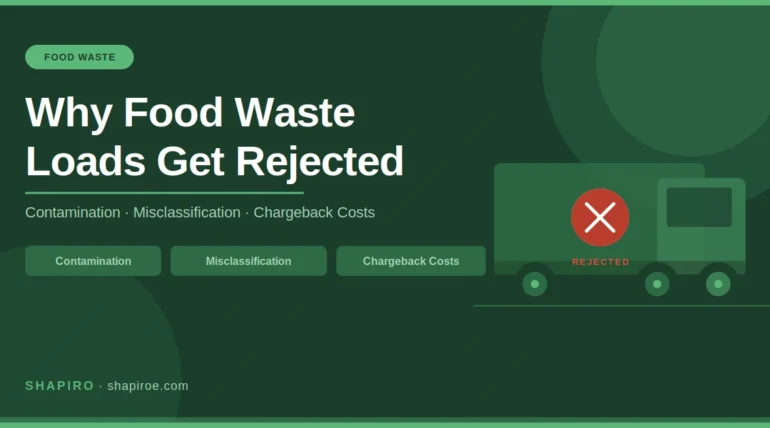
Picture this: A truck arrives at an organic waste processing facility. The tipping floor operator scans the load in under two minutes: plastic film, packaged retail goods still in clamshells, liquid pooling at the base. Rejected. The driver leaves with a full truck, a re-routing charge, and a chargeback notice hitting the shipper’s account before end of day.
Food waste load rejection is not random. It follows three predictable failure categories: contamination, misclassification, and logistics errors — and each one is identifiable before a load ever leaves a facility.
Here is what the rejection process actually looks like, and what it costs when things go wrong.
What Actually Happens When a Food Waste Load Gets Rejected
The truck is weighed at the scale house, manifests are checked, then the load moves to the tipping floor. An operator visually evaluates the material as it is dumped. The inspection is not forensic — a decision is made based on what is immediately observable.
1. Arrival and Initial Inspection
When a food waste load arrives, the first stop is the scale house, where the truck is weighed and manifests are checked.
From there, the load moves to the tipping floor, where an operator visually evaluates the material as it is dumped.
This is where most rejection decisions happen. The inspection is visual and operational, not forensic. A decision is made based on what is immediately observable.
2. What Triggers Immediate Rejection
Three conditions trigger rejection without further review:
- Visible contamination: Plastic film, packaged goods, non-organic materials, or liquid waste where none is expected
- Incorrect load type: A load documented as clean food-grade organics that arrives mixed with other waste streams, or material sent to a facility not permitted to accept it
- Documentation mismatch: A manifest that does not match what is on the truck, missing waste characterization paperwork, or loads that lack the pre-approval some facilities require.
3. What Happens After Rejection
A rejected load does not disappear. It has to go somewhere, and the options are limited: re-route to a landfill, transport to an alternative processor, or hold in the truck until another destination is arranged.
Each option carries cost.
Return transport fees, landfill tipping fees (which often run higher than organic processing rates per ton), and any penalty charges baked into the original processing contract.
Facilities that record repeated non-compliant deliveries from the same shipper can suspend agreements entirely. At that point, the cost of the rejection is not a single invoice. It is the loss of a processing partner.
When a rejected load needs a permitted destination quickly, waste disposal support for haulers and trucking companies can help.
Food Waste Contamination: The #1 Cause of Load Rejection
Contamination is the most common — and most preventable — rejection cause. The problem usually starts long before the load reaches the facility: in the collection process, on the production floor, or in the container itself, long before food waste logistics ever get involved.
1. Cross-Contamination During Collection
Cross-contamination sources include:
- Mixed collection bins where non-food materials are placed alongside organic waste
- Shared containers not cleaned between uses
Spotters identify this at the tipping floor and do not attempt to separate it. The load is rejected — or accepted at a contamination processing premium on top of standard tipping fees.
2. Chemical and Packaging Contamination
Chemical contamination in organic waste rejection cases typically involves cleaning agents, processing additives, or sanitizing residues that have entered food waste streams during production or washdown.
Packaging contamination is harder to miss: shrink wrap, foil seals, multi-layer laminates, and rigid plastics are flagged immediately on the tipping floor.
At anaerobic digestion and composting facilities, packaging contamination disrupts the biological processing environment. At wet digesters specifically, it can damage equipment and trigger repair incidents with significant downtime costs.
3. Biological Contamination Risks
Biological food waste contamination covers pathogen-loaded material and heavily degraded organic waste that poses risk to the facility’s processing environment. Operators identify it through visual inspection, odor assessment, and documentation review — and if characterization paperwork is missing or mismatched, the load is rejected.
3.1 Food Waste Contamination: Prevention Checklist
Use this checklist to reduce food waste contamination risk before loads leave your facility:
- Have clearly labeled, separate collection containers for each organic waste stream
- Remove all non-organic packaging from food waste before loading
- Audit containers for residual cleaning chemicals before using them
- Confirm processor acceptance criteria before loading recalled, spoiled, or off-spec product
- Verify waste characterization documentation matches the physical load
- Inspect containers for cross-stream contamination before final loading
- Train collection staff on contamination thresholds specific to your receiving facility
- Establish a pre-departure visual check protocol for all outgoing organic loads
For a complete overview of what facilities expect from incoming loads, Shapiro’s food waste services provide the operational framework needed to stay compliant and cost-efficient.
Misclassification Errors That Trigger Rejected Produce Loads
Contamination is visible. Misclassification is not — a load can arrive clean, on schedule, and still be rejected because it was sent to the wrong facility or incorrectly documented.
1. Waste Stream Classification Mistakes
Misclassification is one of the most common causes of rejected produce loads. The core principle is straightforward: right waste, wrong facility equals rejection.
The three main food waste types are:
- Pre-consumer waste: Trimmings, off-spec product, and manufacturing rejects that have never reached consumers
- Post-consumer waste: Products that have never been used or sold
- Processing waste: By-products from food manufacturing operations, which under FSMA’s 21 CFR Part 507 must meet specific animal feed safety requirements if intended for that pathway
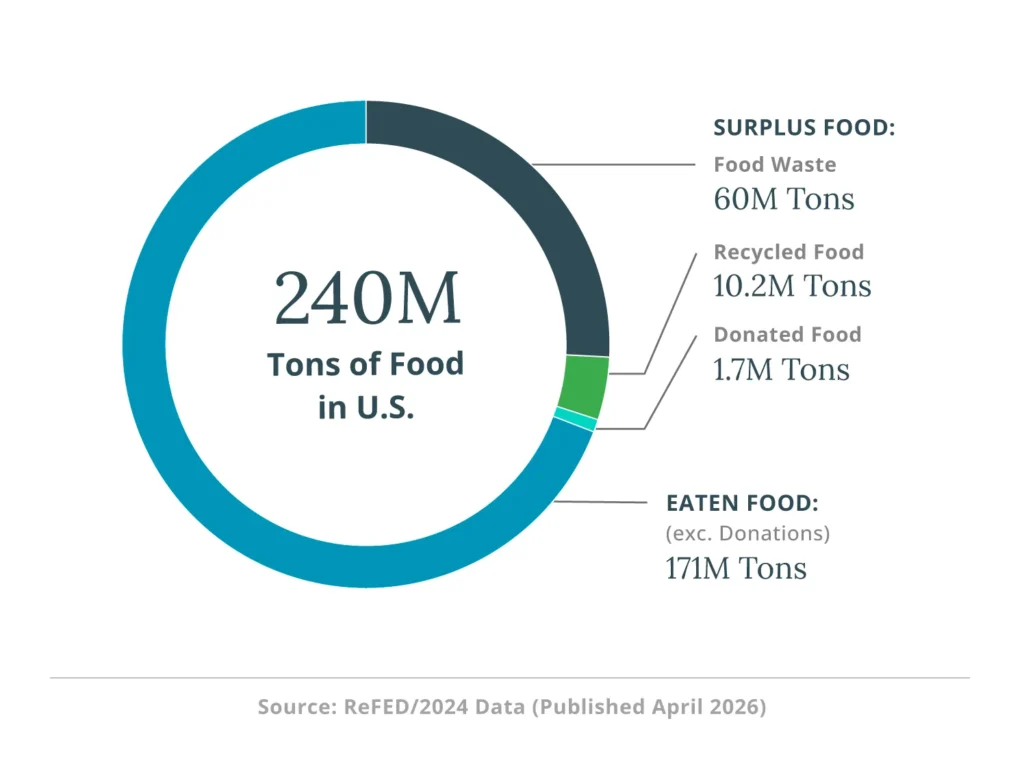
According to ReFED, buyer rejections and processing errors are significant — and preventable — causes of food loss. Understanding which tier of the food waste management hierarchy applies to your specific waste stream is the first step to routing it correctly.
2. Measurement and Documentation Errors
Errors in food waste measurement and documentation are another category of avoidable rejections.
A manifest showing 4,000 lbs that arrives at 6,200 lbs triggers a compliance review — facilities use intake weight for processing planning, billing, and regulatory reporting.
Other common measurement and documentation errors in food waste logistics include:
- Load descriptions reflecting the original product rather than the waste stream
- Missing batch or lot identifiers on recalled or off-spec product
- Transport paperwork that was not updated when load composition changed after initial manifesting
Each of these is an error food waste operation teams can audit and close before loads leave the facility.
3. Regulatory Compliance Failures
Regulatory failures are the most consequential rejection type — they can trigger state agency notifications and generator penalties.
Under RCRA, waste must be correctly identified and classified before transport.
State-level organics diversion laws add further complexity. California’s SB 1383, for example, requires large food waste generators to divert organic material through permitted organic recycling pathways.
Missing permits, expired waste codes, or absent pre-transport characterization documentation all produce an automatic rejection. To avoid this, you must verify permit status with each receiving facility before the load moves.
Transportation and Handling Failures in Food Waste Logistics
Many food waste load rejection decisions are made at the facility, but the failure that caused them happened hours earlier.
1. Temperature Control and Timing Issues
When temperature control fails, spoilage accelerates — and inspectors do not need instruments to spot it. Visible degradation, pooling liquid, and odor are enough to trigger rejection before the load reaches the tipping floor.
For food waste during transportation, prevention means verifying refrigeration unit function before loading, logging temperature throughout transit, and building in realistic timing that does not expose time-sensitive loads to ambient conditions at pick-up or drop-off.
2. Vehicle and Container Contamination
Under FSMA’s Sanitary Transportation Rule (21 CFR Part 1, Subpart O), carriers must maintain vehicles free of pest residue, mold, mildew, excess water, ice buildup, and structural damage that could compromise load integrity.
The FDA also requires carriers to disclose the previous three loads on request – a requirement that exists precisely because a dirty or incompatible prior load is an invisible rejection risk.
To prevent rejection, check interior cleanliness, prior cargo compatibility, and structural integrity before every departure. Retain cleaning records for 12 months per FSMA requirements.
3. Load Securing and Spillage Problems
Spillage and load shifting during food waste transportation introduces contamination risk while shifted loads can rupture packaging and change the waste stream’s composition in transit.
Facilities operating at high throughput will not sort through a damaged load — if material does not match the manifest, rejection follows. Use appropriate containers for the waste type, stay within capacity, and account for liquid movement in bulk organic loads.
Food Processing Waste Rejection Scenarios
Food processing plants generate multiple waste streams simultaneously, and that operational complexity is exactly where rejection risk accumulates.
1. Processing Facility Contamination
Three contamination patterns account for most food processing waste rejections:
- Mixed streams occur when organics are collected alongside packaging or cleaning materials, exceeding a processor’s contamination tolerance.
- Industrial contamination involves lubricants, sanitizing agents, or washdown chemicals entering organic waste and altering its chemical profile.
- Batch inconsistency means waste from multiple production runs with different composition, moisture, or pH arrives at a facility expecting uniform feedstock.
Prevention: Collect waste by stream type at the source. Keep washdown chemicals out of organic containers. Log production run changes and update manifests. Verify waste characterization matches facility acceptance criteria before scheduling pickup
2. Mixed Waste Stream Problems
A mixed waste stream disqualifies a load from every higher-value processing pathway before it leaves the plant. A dairy processor generating clean whey by-product, packaging waste, and floor wash water in adjacent areas — if those streams share containers — produces a combined load that falls outside acceptance criteria for composting, anaerobic digestion, and animal feed processing simultaneously.
According to EPA food waste research, plastic and packaging contamination is one of the primary barriers to organic recycling at processing scale. The downstream result is mandatory landfill disposal, loss of beneficial reuse revenue, and a chargeback.
Prevention: Install dedicated, labeled containers per waste stream. Separate wet organics, dry packaging, and chemical waste at the source. Train production staff on stream separation. Conduct regular waste audits to catch mixing before it reaches the loading dock.
The Hidden Cost Chain Behind Food Waste Load Rejection

A rejected food waste triggers a chain of secondary expenses, and each link in that chain costs more than the one before it. Let’s break down where those costs originate, and who absorbs them:
1. Direct Rejection Costs
Food waste load rejection costs stack up immediately:
- Return transport fees
- Emergency re-routing at worse per-ton rates than the original agreement
- Higher landfill tipping fees
- Administrative time spent re-documenting and managing chargebacks
These four costs hit before any secondary consequences are counted.
2. Operational Disruption Costs
Beyond the invoice, food waste load rejection creates costs that do not appear on any single line item. A rejected load occupies driver time, vehicle capacity, and collection scheduling planned for other pickups.
Repeated rejections erode the processing relationship — and finding a new processor takes weeks, typically at less favorable pricing than the agreement that was lost.
3. Prevention Investment ROI
The ROI case for rejection prevention is straightforward. Staff training on load preparation and stream separation takes hours. A pre-departure checklist costs nothing to implement. A waste characterization review before a new facility relationship takes one conversation.
Measured against the recurring cost of food waste load rejection events, prevention protocols pay back on the first incident avoided.
4. Who Pays for a Rejected Load
Liability follows the contract. Most contracts assign liability to whichever party was responsible for load preparation and documentation. If the load left the client’s facility with a contamination issue or an incorrect manifest, the chargeback will be enforced. Reviewing contract liability language before a rejection occurs is significantly less expensive than disputing it after.
5. Double Handling and Re-Routing Costs
A rejected load requiring a second transport leg adds cost at every step: additional transport fees, time, and degradation risk. Organic waste held in a vehicle continues decomposing — and may arrive at the secondary destination in worse condition than when it was first rejected.
6. Why Rejection Costs More Than Disposal
When a load goes to planned disposal, costs are predictable. When it gets rejected, those disposal costs do not disappear — they become the starting point for additional costs that compound with every handling step. Rejection does not replace disposal. It adds costs on top of it.
Where Most Companies Get It Wrong
Most food waste logistics failures do not start with bad intent. They start with assumptions that went unverified and systems that were never built.
1. Treating All Waste as a Single Stream
The most common waste handling error is treating food waste, liquid waste, and packaged goods as one category because they come from the same facility. A composting facility cannot accept sealed retail packaging. An anaerobic digester has specific moisture thresholds. An animal feed processor requires clean organics.
Collapsing distinct streams into a single container does not simplify logistics — it guarantees waste misclassification and the rejection that follows.
2. Lack of Pre-Load Verification
Rejection happens at the facility. The decision to ship without verifying load composition, documentation, and facility acceptance criteria happens hours earlier.
Most rejection events trace back to the same gap: no internal check between waste generation and loading.
Operations that rely on assumption — the load matches the manifest, the facility will accept it, what was true last month still applies — create rejection conditions on every shipment.
3. Disconnect Between Operations, Logistics, and Disposal
When the team generating waste, the team scheduling pickup, and the team managing the disposal contract operate in silos, wrong information travels with the load.
Each gap is a food waste logistics failure waiting to happen. The load gets rejected not because the waste was unsuitable, but because no one connected the information that would have made it acceptable.
How to Prevent Food Waste Load Rejections
Prevention requires a food waste handling process built around three things:
1. Pre-Load Audit Checklist
Before any load leaves your facility, the following should be confirmed and documented:
- Waste type confirmed: Stream matches the receiving facility’s permitted acceptance categories
- Contamination checked: Load visually inspected for packaging, chemical residue, or cross-stream contamination
- Packaging separated: All non-compostable materials removed before loading
- Weight verified: Container weight matches manifest; tare weight recorded
- Documentation verified: Manifest complete, waste characterization accurate, pre-approval in place
- Facility acceptance confirmed: Receiving facility confirmed to accept this load type on this date
- Vehicle inspected: Checked for prior load contamination and cleanliness
For a comprehensive food waste recycling program, Shapiro works with clients to establish intake requirements and documentation standards upfront.
2. Aligning Waste with the Right Facility
Not every organic waste processor accepts every type of organic waste. That’s why sending the right waste to the wrong facility produces the same outcome as sending the wrong waste: rejection. A waste classification system that maps each stream to its correct processing pathway eliminates this failure mode before it occurs — a different challenge from beverage waste management, which carries its own facility and permitting constraints.
3. Standardizing Internal Waste Handling Processes
Repeatable systems outperform individual judgment. Standardization means documented SOPs for stream separation at the source, a waste classification system updated when production or facility agreements change, clear accountability for pre-departure load compliance, and staff training that covers not just what to do but why getting it wrong is costly.
Why Load Rejection Is a System Failure, Not a One-Time Issue
A single rejected load is an incident. Two from the same cause is a pattern. Food waste process gaps compound over time rather than self-correct.
1. Why Rejections Repeat Across Loads
Recurring rejections share a common structure: the root cause was never addressed after the first event. A contamination issue resolved by re-routing rather than by fixing the source will produce another rejection on the next load.
Waste management system failure at this level looks like a recurring chargeback line item absorbed as a cost of doing business, or a processing relationship that quietly deteriorates until the facility stops accepting loads entirely.
2. The Gap Between Waste Generation and Waste Processing
Companies think in terms of disposal. Facilities operate on processing constraints. When those two perspectives are not aligned, rejection is the mechanism that enforces the difference. The companies that avoid waste rejection causes consistently are the ones that understand the facility’s constraints as well as their own waste streams.
3. What Efficient Waste Operations Do Differently
Operations with low rejection rates share three characteristics. They
- Verify facility acceptance requirements before establishing a processing relationship and re-verify when criteria change
- Build pre-load validation into standard operating procedures rather than treating it as optional
- Treat rejected loads as diagnostic data, tracing each failure to its source before the next shipment moves.
The result is fewer surprises, lower logistics costs, and stable processing relationships.
Conclusion
Food waste load rejection is predictable — and preventable. The facilities that avoid it consistently have built systems that match the right waste to the right facility with the right documentation.
For the organic waste that remains after your programs do their work, Shapiro’s 30-year track record and national processor network provide the downstream infrastructure to keep material out of landfills and costs under control. Explore our food waste recycling services or contact us today.
1. What percentage of food waste loads get rejected?
No single published rejection rate exists across the industry — facilities do not report uniformly and thresholds vary by processor type. However, 78% of composting facilities in the US cite contamination from packaging and plastics as their leading reason for declining loads.
2. Why would a food waste load be rejected even if it looks acceptable?
Visual appearance is not the only trigger. Loads are rejected for documentation mismatch, waste stream misclassification, prior vehicle contamination, weight discrepancy, or missing pre-approval. Many rejections happen not because the waste is unusable, but because the load does not meet intake requirements as submitted.
3. Who is responsible for rejected waste loads?
Liability follows the contract. The facility rejects the load, the hauler absorbs return and re-routing costs, and the hauler passes the chargeback to the client if the rejection stemmed from load preparation or documentation failures on the generator’s side.
4. What contamination level causes rejection?
There is no universal threshold — each facility sets its own tolerance based on processing type and equipment. In practice, visible contamination on the tipping floor is often enough to trigger rejection without formal measurement.
5. Can a rejected load be reprocessed or reused?
Potentially, but each option adds cost: re-sort and re-tender to an alternative facility, re-route to a landfill at higher per-ton fees, or re-characterize for a different processor. All of these add on top of the original rejection cost.
6. How do facilities inspect waste loads?
The truck is weighed at the scale house and the manifest is checked. The load is then dumped on the tipping floor where a spotter conducts a visual inspection, scanning for contaminants. Most rejection decisions are made within minutes.
7. How much does a rejected food waste load cost?
Direct costs typically hundreds to thousands of dollars per truckload, covering return transport, emergency re-routing, higher secondary tipping fees, and administrative time. A load requiring a second transport leg can reach two to three times the original shipping cost.
8. Can contaminated food waste loads be fixed after rejection?
In limited circumstances, yes. If the contamination is physical and separable (packaging, non-organic material), the load can be sorted and the acceptable organic fraction re-tendered. However, this makes post-rejection remediation the most expensive version of a problem that was preventable.
9. What documentation prevents food waste load rejection?
A completed waste manifest, a waste characterization document confirming load composition meets facility acceptance criteria, any required pre-approval or permit, and vehicle cleaning records. Retain records for 12 months per FSMA Sanitary Transportation requirements.
our expert

Peter W. Klaich Director, Agriculture/Animal Health
Peter Klaich is a leading expert within the agricultural recycling and animal health market arena, known for leading National Sales at Skip Shapiro Enterprises since June 2016. He focuses on advancing sustainable recycling solutions and waste management practices across the agricultural industry.