Call or Text Now

Restaurant food safety guidelines are legally enforceable rules that govern how food is handled and disposed of in any restaurant.
All food-service establishments, from fast food to full-service dining, should strictly apply these rules to avoid health risks, hefty fines, or in some cases even shutdowns.
For example, foodborne illness hospitalizations more than doubled in 2024 (from 230 to 487) and deaths rose from 8 to 19. The biggest threats: Listeria, Salmonella, and E. coli. Regulatory scrutiny is intensifying — and the cost of a violation has never been higher.
This guide covers everything you need to know: the current food safety practices in restaurants, who enforces them, common violations, penalties, and a practical checklist you can use today.
Key Takeaways
- Proper hygiene, handwashing, and preventing cross-contamination between raw and cooked foods are essential food safety guidelines for restaurants.
- Organize and label foods with the First-In First-Out (FIFO) method to use older products first and utilize them before their expiration date.
- Maintain a consistent cleaning schedule for all kitchen surfaces and equipment and ensure proper waste disposal and pest control to avoid contamination risks.
- Follow food safety guidelines about correct storage and temperature control to prevent violations.
What is Restaurant Food Safety?
Food safety in restaurants covers a set of procedures you should follow to keep customers safe and prevent any foodborne diseases. It covers everything from the moment your ingredients are delivered to the second the meal is served.
These guidelines also ensure that every step of the process is handled with care and protect your business from potential fines, closures, and bad reviews. Whether it’s properly storing ingredients at the right temperatures, avoiding cross-contamination, or keeping the kitchen spotless, each detail matters.
The result?
Safe food handling practices contribute to better operational efficiency, reduced waste, and, ultimately, happier, healthier customers.
Who Regulates Restaurant Food Safety?
Who regulates restaurant food safety in the United States? There are three government agencies responsible for food safety — each with distinct authority.
| Agency | What They Regulate | Key Tool |
|---|---|---|
| FDA (Food & Drug Administration) | Non-meat food products, food handling, sanitation, retail food service | FDA Food Code (updated every 4 yrs) |
| USDA / FSIS | Meat, poultry, and egg products | HACCP requirements, on-site inspection |
| Local Health Departments | All food service at state/municipal level | Routine inspections, operating permits |
1. FDA (Food and Drug Administration)
The FDA oversees food safety procedures in restaurants, for all non-meat products. Its FDA Food Code — a model framework now updated every four years — sets the national baseline for food safety standards for restaurants, including temperature control, hygiene, and sanitation. State and local agencies adopt and enforce it.
2. USDA (United States Department of Agriculture)
The USDA regulates meat, poultry, and egg products, which are crucial to many restaurant menus. Their Food Safety and Inspection Service (FSIS) ensures that these products are properly inspected, stored, and prepared to prevent foodborne illnesses.
For restaurants serving these foods, USDA guidelines help ensure compliance with safe handling and cooking practices.
3. Local Health Departments
Local health departments play a critical role in enforcing food safety at the state and municipal levels. They conduct routine health inspections, ensuring compliance with local restaurant food safety laws, which can vary by location. These inspections cover everything from employee hygiene to proper food storage and kitchen cleanliness.
Note: You should stay updated on your local regulations and be prepared for routine health inspections to avoid violations and penalties.
Restaurant Food Safety Guidelines: 5 Core Practices
Here are the five pillars of food safety in restaurants — practices that address the most common sources of violation and illness.
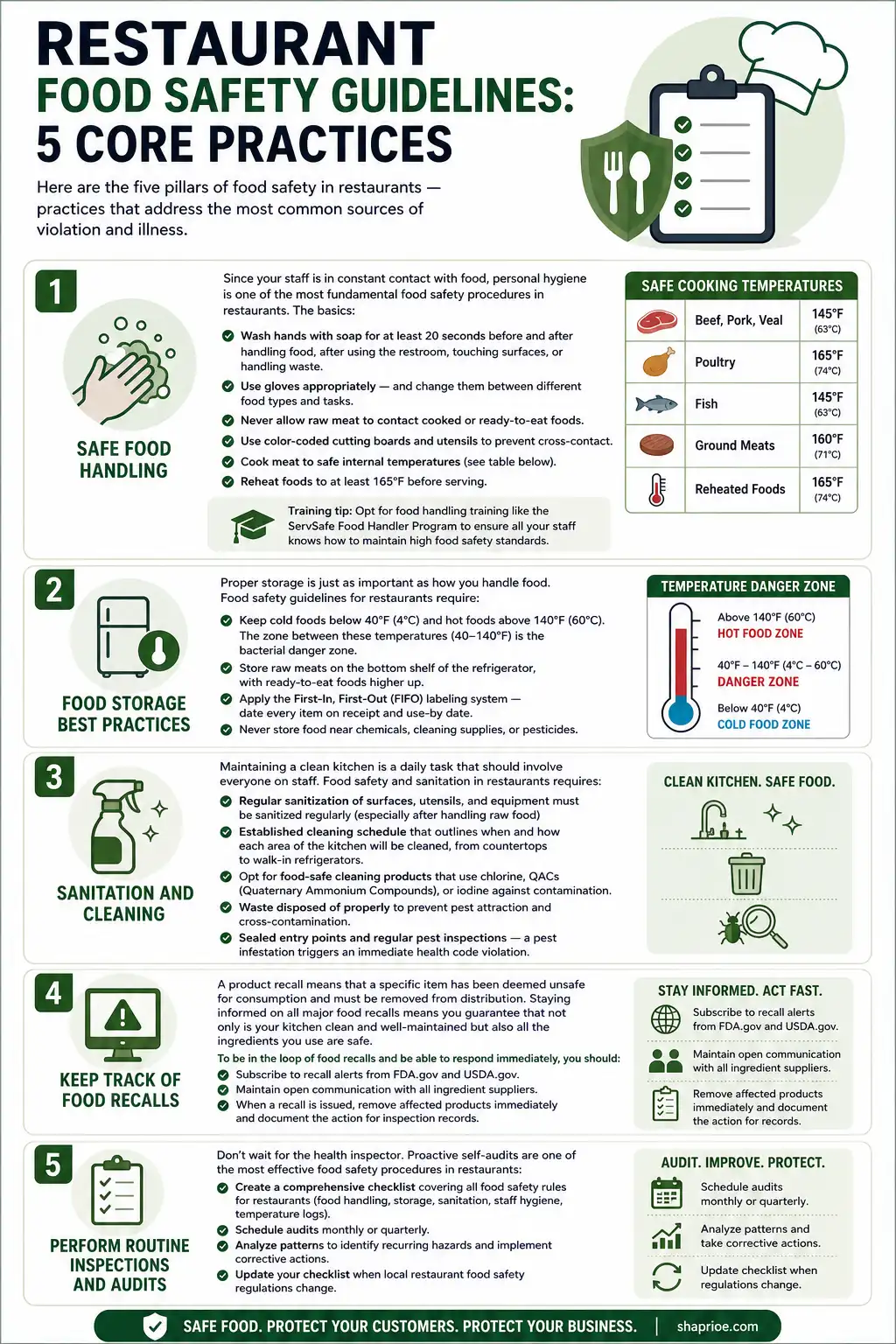
1. Safe Food Handling
Since your staff is in constant contact with food, personal hygiene is one of the most fundamental food safety procedures in restaurants. The basics:
- Wash hands with soap for at least 20 seconds before and after handling food, after using the restroom, touching surfaces, or handling waste.
- Use gloves appropriately — and change them between different food types and tasks.
- Never allow raw meat to contact cooked or ready-to-eat foods.
- Use color-coded cutting boards and utensils to prevent cross-contact.
- Cook meat to safe internal temperatures (see table below).
- Reheat foods to at least 165°F before serving.
Training tip: Opt for food handling training like the ServSafe Food Handler Program to ensure all your staff knows how to maintain high food safety standards.
2. Food Storage Best Practices
Proper storage is just as important as how you handle food. Food safety guidelines for restaurants require:
- Keep cold foods below 40°F (4°C) and hot foods above 140°F (60°C). The zone between these temperatures (40–140°F) is the bacterial danger zone.
- Store raw meats on the bottom shelf of the refrigerator, with ready-to-eat foods higher up.
- Apply the First-In, First-Out (FIFO) labeling system — date every item on receipt and use-by date.
- Never store food near chemicals, cleaning supplies, or pesticides.
3. Sanitation and Cleaning
Maintaining a clean kitchen is a daily task that should involve everyone on staff. Food safety and sanitation in restaurants requires:
- Regular sanitization of surfaces, utensils, and equipment must be sanitized regularly (especially after handling raw food)
- Established cleaning schedule that outlines when and how each area of the kitchen will be cleaned, from countertops to walk-in refrigerators.
- Opt for food-safe cleaning products that use chlorine, QACs (Quaternary Ammonium Compounds), or iodine against contamination.
- Waste disposed of properly to prevent pest attraction and cross-contamination.
- Sealed entry points and regular pest inspections — a pest infestation triggers an immediate health code violation.
4. Keep Track of Food Recalls
A product recall means that a specific item has been deemed unsafe for consumption and must be removed from distribution. Staying informed on all major food recalls means you guarantee that not only is your kitchen clean and well-maintained but also all the ingredients you use are safe.
To be in the loop of food recalls and be able to respond immediately, you should:
- Subscribe to recall alerts from FDA.gov and USDA.gov.
- Maintain open communication with all ingredient suppliers.
- When a recall is issued, remove affected products immediately and document the action for inspection records.
5. Perform Routine Inspections and Audits
Don’t wait for the health inspector. Proactive self-audits are one of the most effective food safety procedures in restaurants:
- Create a comprehensive checklist covering all food safety rules for restaurants (food handling, storage, sanitation, staff hygiene, temperature logs).
- Schedule audits monthly or quarterly.
- Analyze patterns to identify recurring hazards and implement corrective actions.
- Update your checklist when local restaurant food safety regulations change.
Food Safety Violations in Restaurants: What They Are, Penalties & Exceptions
Food safety violations are pretty common. According to research, there’s at least one food worker action in every restaurant that leads to cross-contamination.
Here are some of the main food safety issues in restaurants you should avoid at all costs:
Common violations
| Violation | Risk Level | Typical Penalty |
|---|---|---|
| Improper food storage temperatures | Critical | Warning → Fines → Closure |
| Cross-contamination (raw/cooked foods) | Critical | Warning → Fines |
| Poor staff hygiene / no handwashing | Critical | Warning → Fines |
| Storing / serving expired food | Critical | Immediate product disposal; Fines |
| Missing required signage (handwashing posters etc.) | Non-critical | Warning; Re-inspection |
| Improper storage of cleaning chemicals | Non-critical | Warning → Fines |
| Damaged or unclean serviceware | Non-critical | Warning |
1. Penalties for Food Safety Violations
Restaurant food safety laws allow health departments to impose a range of penalties, including:
- Written warnings for minor, first-time violations
- Fines ranging from hundreds to thousands of dollars per violation, per day
- Mandatory re-inspection fees
- Temporary closure for critical violations (e.g., active pest infestation, no hot water)
- Permanent revocation of operating permit for repeat or severe violations
- Criminal liability in cases where negligence causes serious public illness
2. Exceptions and Variances
Some jurisdictions allow variances (formal exceptions) for specific practices — such as serving raw or undercooked eggs or meat — if operators can demonstrate they have implemented alternative safety controls (e.g., consumer advisory notices, modified HACCP plans). These are not automatic; they require documented approval from your local health authority.
Food Safety Standards for Restaurants by Type
Food safety requirements for restaurants vary based on the type of outlet you operate.
1. Fast-Food Restaurants
Speed creates risk. In fast-food environments, safety rules for fast food restaurants focus on:
- Holding temperatures: Improper holding is one of the most cited violations in quick-service environments. In this case, using proper equipment (like heat lamps and refrigeration units) is essential to avoid major food safety hazards.
- Glove and utensil discipline: The fast pace of operations often means food is handled frequently, increasing the risk of cross-contamination. Staff should use gloves and utensils correctly to prevent bacteria from spreading.
- FIFO storage: Since inventory moves quickly, it’s vital to stay on top of food storage. Organize your storage areas to ensure that raw and cooked foods are kept separate and use the FIFO system to prevent spoilage.
2. Full-Service Restaurants
Complexity is the risk factor here. Longer prep times and multi-ingredient dishes demand:
- Temperature control: Dishes that take longer to prepare must be checked regularly to ensure they stay out of the danger zone. Use food thermometers to monitor internal temperatures, especially for meats and poultry, which need to reach safe cooking temperatures.
- Cross-contamination control: The complexity of full-service menus often means multiple ingredients are being prepared simultaneously. Prevent cross-contamination by using separate cutting boards and utensils for raw and cooked foods, and ensure all surfaces are sanitized between uses.
- Pre-prep labeling: All items prepped ahead of service must be labeled with preparation date and use-by date.
3. Catering Services
Off-site service adds transport variables. Food safety procedures in restaurants for caterers must also cover:
- Temperature maintenance during transport: Use insulated containers or portable refrigeration. Document temperatures at load-out and arrival.
- Buffet contamination control: Cover food when not actively serving; use serving utensils to minimize guest contact.
- Mobile hygiene infrastructure: Bring portable handwashing stations and sanitizer to every event.
What Happens During a Restaurant Food Safety Audit?
A restaurant food safety audit is a structured inspection by a health authority (or an internal reviewer) assessing compliance with applicable restaurant food safety regulations.
Here’s what to expect and how to prepare.
1. What Inspectors Check
Inspectors focus on several key areas to determine whether you’re following all the needed restaurant food safety regulations. Some of the main things they’ll inspect include:
- Food storage: Temperatures, labeling, organization, refrigerator/freezer placement
- Sanitation: Prep areas, dishwashing stations, walk-in coolers, floors
- Employee hygiene: Handwashing compliance, glove use, uniform cleanliness
- Temperature control: Cooking, holding, cooling, and reheating logs
- Pest control: Signs of infestation, entry-point sealing, inspection records
- Signage compliance: Required posters (handwashing, allergen notices) in visible locations
2. How to Prepare
Here are some practical steps you can take to make sure your restaurant is ready when the inspector arrives:
- Conduct internal self-audits on the same checklist inspectors use — monthly minimum.
- Keep detailed temperature logs, cleaning schedules, and staff training records.
- Label every food item with preparation date and use-by date.
- Hold refresher training sessions whenever restaurant food safety standards are updated locally.
Most Common Audit Violations
Even well-run restaurants can slip up occasionally, but being aware of common violations can help you avoid them. These include:
- Food stored at wrong temperature or in wrong location
- Unclean kitchen surfaces or equipment
- Missing or incorrect date labels on food items
- Staff observed not washing hands
- Cleaning chemicals stored near food
Why is Food Safety Important in Restaurants?
Complying with food safety guidelines reduces the risk of foodborne illnesses and legal consequences. Beyond compliance, ensuring food safety builds customer trust, leading to repeat business and positive reviews.
Food safety also plays a key role in minimizing food waste. When food is stored and handled correctly, it lasts longer, reducing the chances of spoilage. Techniques like labeling, proper storage, and the FIFO method ensure that older stock is used before newer items. This not only improves operational efficiency but also saves money and reduces your environmental footprint.
Restaurant Food Safety Checklist
This food safety checklist for restaurants can help you maintain high standards and keep both your customers and business protected.
| Area | Daily Check | Weekly Check | Monthly Check |
|---|---|---|---|
| Food Handling | Handwashing logs reviewed; gloves in use | Cross-contamination audit | ServSafe refresher training |
| Food Storage | Fridge/freezer temps logged (below 40°F / above 140°F) | FIFO rotation check; discard expired stock | Full storage area deep-clean |
| Sanitation | Prep surfaces sanitized after each use | Cleaning chemical inventory checked | Pest inspection + entry point seal check |
| Temperature Control | Cooking temps recorded for all meats | Thermometer calibration check | Review temp logs for anomalies |
| Staff Hygiene | Uniform and handwashing compliance observed | Hygiene policy review with staff | Training documentation updated |
| Recalls & Compliance | Check FDA/USDA recall alerts | Supplier communication on recent recalls | Full compliance audit vs. local regs |
Food Cooking Temperatures Guidelines
Ensuring that food is cooked to the right internal temperature is critical to killing harmful bacteria and preventing foodborne illnesses. Below is a table of safe minimum internal temperatures based on guidelines from the USDA.
| Food Type | Safe Minimum Internal Temperature |
|---|---|
| Poultry (whole, parts, ground) | 165°F (74°C) |
| Ground meat (beef, pork, veal, lamb) | 160°F (71°C) |
| Beef, pork, veal, lamb (steaks, roasts, chops) | 145°F (63°C) with a 3-minute rest |
| Fish and shellfish | 145°F (63°C) |
| Egg dishes | 160°F (71°C) |
| Leftovers and casseroles | 165°F (74°C) |
| Ham (fully cooked, reheated) | 140°F (60°C) |
For more detailed guidance, visit the USDA Food Safety and Inspection Service.
Storage Chart
Here’s how you should store your products based on their type:
1. Meat and Poultry Storage Chart
| Food Type | Refrigerator (≤ 40°F) | Freezer (≤ 0°F) |
|---|---|---|
| Poultry (whole or pieces) | 1–2 days | Up to 1 year |
| Ground meats | 1–2 days | 3–4 months |
| Beef, pork, veal, lamb | 3–5 days | 4–12 months |
2. Seafood Storage Chart
| Food Type | Refrigerator (≤ 40°F) | Freezer (≤ 0°F) |
|---|---|---|
| Fish (fatty) | 1–2 days | 2–3 months |
| Fish (lean) | 1–2 days | 6–8 months |
| Shellfish (raw) | 1–2 days | 3–6 months |
3. Dairy and Egg Storage Chart
| Food Type | Refrigerator (≤ 40°F) | Freezer (≤ 0°F) |
|---|---|---|
| Milk | 1 week | Do not freeze |
| Cheese (soft) | 1 week | 1–2 months |
| Eggs (raw, in shell) | 3–5 weeks | Do not freeze |
4. Dairy and Egg Storage Chart
| Food Type | Refrigerator (≤ 40°F) | Freezer (≤ 0°F) |
|---|---|---|
| Leftovers (meat, poultry) | 3–4 days | 2–6 months |
| Soups, stews | 3–4 days | 2–3 months |
5. Fruits and Vegetables Storage Chart
| Food Type | Refrigerator (≤ 40°F) | Freezer (≤ 0°F) |
|---|---|---|
| Fresh fruits | 1–2 weeks | 8–12 months |
| Vegetables (raw) | 3–7 days | 8–12 months |
The Bottom Line
Maintaining proper food safety practices is essential for the success of any restaurant. By implementing the right guidelines, you can ensure compliance, reduce food waste, and improve overall kitchen efficiency.
Partnering with a food waste management company like Shapiro can further help you streamline operations and reduce waste. Contact us today to learn how we can assist your restaurant in managing food waste while staying compliant with food safety standards.
Frequently Asked Questions About Restaurant Food Safety
1. Who is responsible for food safety in a restaurant?
Responsibility is shared: restaurant owners and managers are legally accountable for compliance with all applicable restaurant food safety laws. Day-to-day, every staff member who handles food shares operational responsibility. Externally, the FDA, USDA, and local health departments enforce and inspect compliance.
2. What are the penalties for food safety violations?
Penalties escalate with severity and frequency: written warnings for minor violations, fines (often $100–$2,000+ per violation), mandatory re-inspection, temporary closure for critical violations, and permanent permit revocation for repeat offenders. Criminal charges are possible when negligence causes serious public harm.
3. Are there exceptions to restaurant food safety regulations?
Yes — with documented approval. Health authorities may grant variances for specific practices (e.g., serving undercooked eggs) if operators implement alternative controls and submit formal documentation. Exceptions are never assumed; they must be applied for and approved in writing by your local authority.
4. How often are restaurant food safety inspections conducted?
Frequency varies by jurisdiction. Most municipalities conduct 1–4 inspections per year, with higher-risk establishments (those with previous violations, high volume, or vulnerable-population customers) inspected more often. Inspections can be announced or unannounced.
5. Does food safety apply to beverages as well as food?
Yes. Restaurant food safety policy covers all consumables — including beverages. Expired, recalled, or off-spec beverages must be removed from service immediately and disposed of in a compliant, documented manner. For businesses managing large volumes of expired beverage inventory, beverage destruction services from companies like Shapiro provide certified, chain-of-custody disposal that satisfies regulatory requirements.
6. What is the ‘danger zone’ in restaurant food safety?
The temperature danger zone is 40°F to 140°F (4°C to 60°C) — the range in which most harmful bacteria multiply rapidly. Food should never remain in this zone for more than 2 hours total (1 hour if ambient temperature exceeds 90°F). This principle is central to all food safety guidelines for restaurants.
our expert

Peter W. Klaich Director, Agriculture/Animal Health
Peter Klaich is a leading expert within the agricultural recycling and animal health market arena, known for leading National Sales at Skip Shapiro Enterprises since June 2016. He focuses on advancing sustainable recycling solutions and waste management practices across the agricultural industry.