Call or Text Now

Brewery waste isn’t only difficult to manage, but it can also be a significant expense for companies due to storage, transportation, and disposal costs.
Beyond direct costs, breweries must also navigate operational risks, strict and location-specific compliance requirements, and complex logistics infrastructure. That’s exactly why we’re not here to tell you that there’s a one-size-fits-all waste management solution for every commercial brewery.
In fact, that’s far from the truth. Brewery waste recycling requires a tailored plan, considering factors like waste type, business requirements, and sustainability goals.
This guide is for operations managers, sustainability leaders, and anyone else interested in exploring different waste types, why brewery waste management often fails, and the various beverage destruction pathways available.
Key Takeaways
- Brewery waste disposal requires tailored operational planning based on waste type, volume stability, infrastructure access, and regulatory requirements.
- High-BOD wastewater, contamination rates, and recall events are major risk drivers that can significantly increase costs and compliance exposure.
- Brewery waste recycling, energy recovery, and direct disposal each have practical trade-offs that must be evaluated using economic, logistical, and regulatory criteria.
- Structured documentation, chain-of-custody controls, and experienced waste management partnerships are critical to maintaining compliance and reducing operational disruption.
Brewery Waste Categories: What Commercial Operations Are Actually Managing
Before choosing a disposal or management pathway, it helps to understand exactly what brewery waste looks like at scale. Commercial breweries don’t generate a single type of waste — they manage several distinct streams simultaneously, each with different handling requirements, disposal options, and compliance considerations.
Here are the primary brewery waste categories:
1. High-BOD Liquid Streams
The higher the BOD, the more polluted the water is with organic waste. In brewery waste, the sugar, alcohol, spent yeast, grains, hops, and trub all contribute to BOD. The New Hampshire Department of Environmental Services explains this, stating that, “Beer and brewery wastewater has VERY high BOD on the order of 60,000 mg/l compared to domestic sewage from a house which is ~300 mg/l.”
With seasonal batch variability common in this industry, production fluctuations can significantly impact downstream treatment capacity. These elevated and fluctuating BOD levels can strain municipal wastewater systems, increase treatment costs, and raise the risk of non-compliance without proper equalization or pre-treatment strategies.
2. Expired, Recalled, or Off-Spec Packaged Product
Another source of brewery waste comes in the form of recalled, off-spec or expired beer. This type of brewery waste disposal requires alcohol destruction compliance and documented palletized inventory destruction, particularly for large batches or damaged retail returns. Proper SKU-level tracking is also essential to maintain traceability and meet regulatory requirements.
When packaged product reaches this stage, it enters the domain of beverage destruction services. Breweries that don’t have a pre-established destruction protocol in place often face delays, compliance exposure, and elevated costs when recalls or spoilage events occur.
3. Sludge, Biosolids, and Pre-Treatment Residuals
Breweries generate sludge and other residual solids through wastewater solids capture processes and on-site pre-treatment systems, including dissolved air flotation (DAF) units. DAF systems remove suspended solids, fats, oils, grease, and organic material, producing a concentrated sludge stream that must be properly managed.
Breweries must then evaluate disposal options based on sludge composition, regulatory requirements, and local infrastructure.
Where Brewery Waste Management & Disposal Break Down (and How to Fix It)
From brewery wastewater treatment to de-packaging and beverage destruction, gaps in brewery waste disposal planning can quickly escalate into compliance risks, storage overflows, and costly disruptions.
Below are the three most common failure points—along with the operational pathways breweries must implement to stay compliant and efficient.
1. Contamination, De-Packaging & Material Recovery Gaps
Contamination is a major challenge in commercial breweries, especially when handling returned or unsellable packaged products. Glass breakage, aluminum separation, and mixed loads complicate de-packaging and material recovery.
Best practices: Implement integrated de-packaging systems and partner with certified beverage destruction providers to ensure compliant separation, liquid destruction, and maximum material recovery.
2. Recall Logistics Without Chain-of-Custody Controls
Recall events expose a major weakness: lack of documented chain-of-custody. Without full traceability—from production through final beverage destruction—breweries face regulatory exposure, failed audits, and financial penalties.
Best practices: Implement integrated documentation systems, including certificates of destruction, audit-ready tracking, appropriate spent grain brewery disposal strategy, and aligned waste disposal workflows.
3. Wastewater Surges, Disposal Bottlenecks & Emergency Response Gaps
Production spikes, spoilage events, or recalls can rapidly convert liquid inventory into regulated waste, overwhelming on-site systems. Without predefined disposal pathways, breweries risk shutdowns and emergency costs.
Best practices:
- On-site brewery wastewater treatment systems (DAF, biological processes) to stabilize baseline flows
- Bulk tanker hauling and off-site beverage destruction to handle overflow, high-alcohol waste, or emergency volumes
The right balance depends on volume thresholds, infrastructure, and compliance requirements—but relying on a single pathway creates risk.
The Takeaway: Integrating Brewery Waste Management + Disposal
The most resilient breweries don’t treat waste management and disposal as separate decisions—they build integrated systems that combine on-site treatment, off-site hauling, and certified beverage destruction.
Without this alignment, even well-run operations face preventable compliance gaps, rising costs, and operational instability. With the right partner, breweries gain a scalable, audit-ready solution that adapts to both daily operations and unexpected events.
De-Packaging & Material Separation — The Hidden Cost Center
De-packaging and material separation are essential components of brewery waste recycling, yet many companies overlook the hidden costs involved when developing their strategy.
1. Mechanical Separation Systems
Mechanical separation systems are used to recover liquid product and separate packaging materials such as glass, aluminum, and plastic. However, real-world throughput often falls short of specifications, especially when damaged packaging or mixed loads are involved.
Throughput limitations and contamination tolerance directly impact recovery rates, residual waste volume, and overall processing costs, making de-packaging a frequently underestimated cost center.
2. Recyclable Material Recovery (Aluminum, Glass, PET)
Recovering aluminum, glass, and PET from de-packaged brewery waste can create revenue offsets, but returns depend heavily on material quality and contamination levels. Commodity market variability, transportation costs, and regional demand all influence resale value, making recovery economics less predictable than many operators expect.
3. When De-Packaging Becomes Economically Inefficient
De-packaging is often the first step in recovering materials, supporting circular economy goals and, in some cases, generating financial returns. However, low volumes, mixed-material complexity, contamination, and long transportation distances can quickly chip away at those benefits.
Without reliable partners and a structured process in place, the operational costs of separation, hauling, and residual disposal can outweigh the value of recovered materials.
Cost Drivers in Brewery Waste Management Systems
Multiple variables influence the total cost of a brewery waste disposal strategy. Below, we break down the key factors that directly drive pricing so you can make a more informed operational and financial decision.
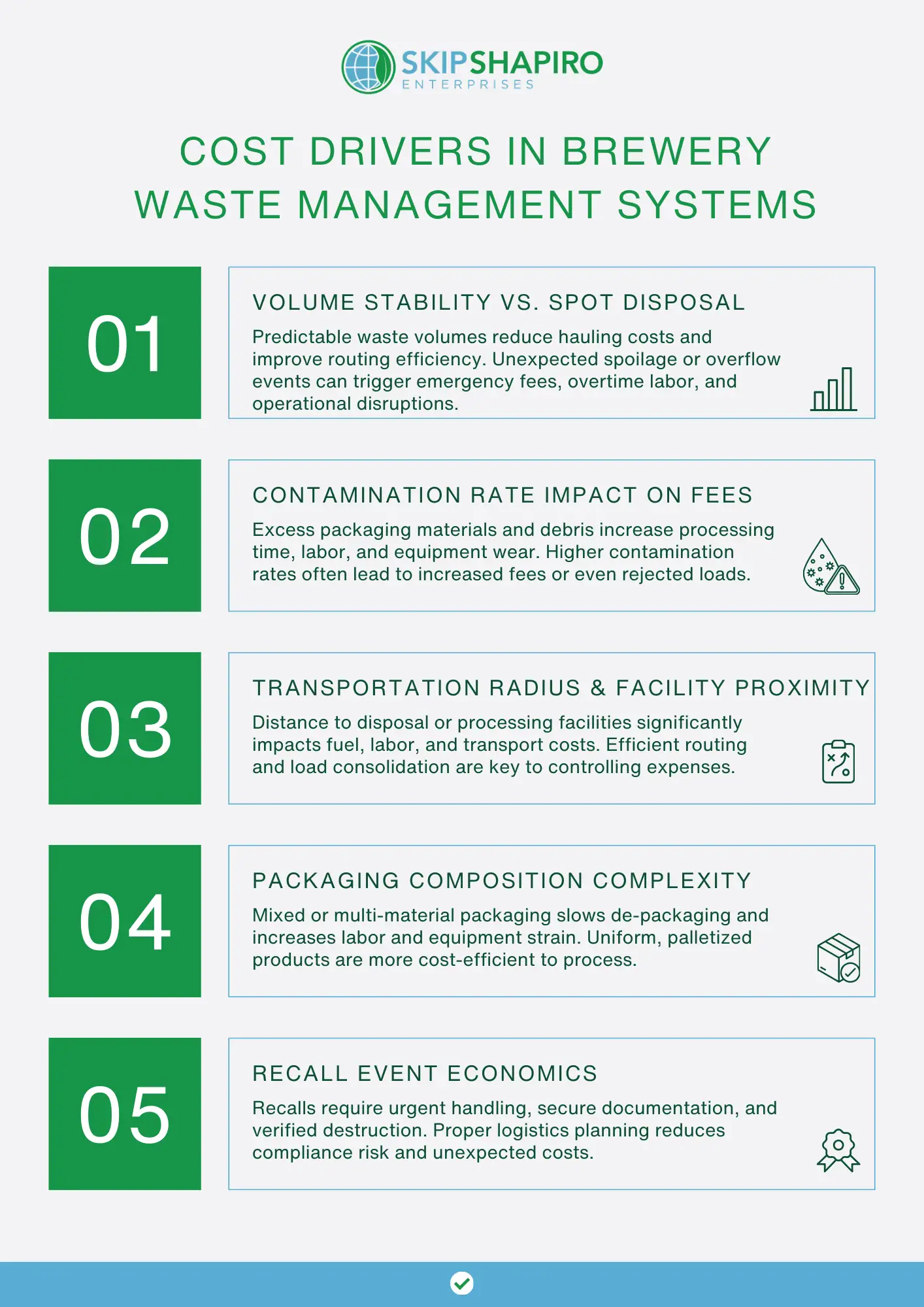
1. Volume Stability vs. Spot Disposal
Pricing and operational efficiency depend heavily on volume predictability. Stable output lowers per-unit hauling costs, while scheduled pickups improve routing efficiency and reduce the risk of expensive emergency transportation.
On the other hand, unexpected overflows, spoilage events, or tank failures can trigger rapid response charges, overtime labor, premium transport fees, and potential storage constraints that disrupt production.
2. Contamination Rate Impact on Fees
Mixed packaging materials, excess shrink wrap, broken glass, and other non-organic debris are common contaminants in brewery waste streams. Without a clear contamination management plan, these materials can affect facility acceptance, increase de-packaging labor, accelerate equipment wear, and raise downtime risk.
Higher contamination rates typically result in more manual processing, slower throughput, increased processing fees, and, in some cases, load rejection.
3. Transportation Radius and Facility Proximity
Logistics is one of the largest cost drivers in beverage waste management. Fuel, driver labor, and regulatory transport classifications all influence pricing, while the distance required to move brewery spent grain and other waste to de-packaging or anaerobic digestion facilities directly impacts total cost.
Multi-state transport requirements, weight limits, and payload optimization further affect per-load economics, making consolidation and route efficiency critical to cost control.
4. Packaging Composition Complexity
Packaging type directly impacts de-packaging efficiency. Aluminum cans, glass bottles, PET containers, and mixed-format loads require different handling processes, with multi-material packaging increasing separation time, equipment wear, and contamination risk.
Uniform, palletized SKUs allow for more efficient destruction, while loose, mixed, or damaged retail returns slow throughput and reduce recovery rates. Secondary packaging such as cardboard and shrink film adds further separation steps, increasing labor and processing costs.
5. Recall Event Economics
Product recalls are not routine waste removal. They require rapid collection, segregated storage, verified destruction, and complete documentation to maintain regulatory defensibility.
Cost drivers often include urgency, sudden volume surges, strict chain-of-custody controls, and SKU-level tracking requirements. Prepared logistics partnerships significantly reduce recall-related risk exposure and operational disruption.
Decision Framework — Disposal, Recycling, or Energy Recovery?
Choosing the right beverage waste disposal pathway isn’t about ideology; it’s about operational fit. The comparison below outlines the practical trade-offs, regulatory considerations, and logistical constraints that plant managers must evaluate when determining the most effective option.
1. When Energy Recovery Is Operationally
Justified Energy recovery is not automatically the superior disposal pathway. It makes sense only when feedstock quality, infrastructure access, and energy demand align.
High-moisture, organic-rich liquid waste with stable, predictable volumes and low contamination rates is best suited for anaerobic digestion and biogas from organic waste production. Inconsistent loads or fluctuating product mix can reduce digester efficiency and increase operational risk.
Access to nearby waste-to-energy infrastructure and a viable end use is also essential. Energy recovery is justified when operational stability and infrastructure support it, not simply because it appears sustainable.
2. When Direct Recycling Is Preferable
Recycling is often the most efficient option when packaging materials remain clean and segregated. Aluminum cans, glass bottles, cardboard, and secondary packaging separated upstream and free of liquid contamination are more likely to generate recovery value.
Low organic contamination, such as empty packaging or production scrap, supports stronger recycling outcomes, while liquids mixed with packaging reduce efficiency and increase processing costs. Commodity pricing volatility and regional incentives also influence returns, but recycling generally carries a lower regulatory burden than destruction or digestion.
When material integrity is preserved, recycling aligns more closely with practical organic waste management strategies and avoids unnecessary processing complexity.
3. When Disposal Remains the Only Viable Option
Not all waste streams are recoverable under all conditions. The circular brewery approach may become impractical when contamination exceeds processing thresholds, mixed materials cannot be economically separated, or energy recovery facilities reject the stream.
Additional constraints, such as limited digestate markets, regulatory restrictions on land application, lack of infrastructure access, or volumes too low to justify specialized processing, can further limit feasibility.
In these cases, decision-making must weigh economics, infrastructure availability, regulatory exposure, and operational urgency rather than assuming recovery is always viable.
4. Indicators of Operational Maturity
Operationally mature waste management programs are defined by dedicated beverage industry expertise, transparent reporting practices, and clearly established rapid response protocols. These capabilities reduce compliance exposure, improve cost predictability, and strengthen decision-making across disposal pathways.
If your company is evaluating its current approach, contact Shapiro to see how we can help optimize performance while maintaining regulatory compliance.
Selecting a Brewery Waste Management Partner
Looking for a brewery waste management partner?
The following framework can help evaluate whether a provider aligns with your compliance, infrastructure, and logistics requirements.
1. Industry-Specific Experience
- Do they understand beverage-specific waste streams?
- Can they handle packaged liquids and mixed material loads?
- Are they familiar with alcohol destruction compliance requirements?
2. Infrastructure Access
- Do they operate or have access to de-packaging systems?
- Do they maintain partnerships with anaerobic digestion or energy recovery facilities?
- Can they manage multiple waste streams across disposal pathways?
3. Compliance & Documentation Capabilities
- Do they issue certificates of destruction?
- Can they support recall audits and regulatory reviews?
- Do they maintain clear chain-of-custody reporting?
4. Logistics Capacity
- Are they prepared for emergency response events?
- Can they coordinate across multiple locations or states?
- Do they support scalable volume fluctuations?
Transparency & Reporting
- Do they provide diversion metrics?
- Can they break down material recovery outcomes?
- Are reporting outputs aligned with ESG and compliance needs?
A structured, well-documented waste program is not just an operational safeguard; it’s a strategic advantage. If you’re evaluating brewery waste management partners, connect with our team to see how we can help strengthen compliance, improve efficiency, and support scalable operations. m is not just an operational safeguard; it’s a strategic advantage.
FAQs about Brewery Waste Disposal
Expired packaged beer must be destroyed in accordance with federal Alcohol and Tobacco Tax and Trade Bureau (TTB) regulations and applicable state laws. Destruction typically requires documented procedures, verified volume reporting, and maintained records to demonstrate regulatory compliance.
Alcohol recalls generally require chain-of-custody records, verified destruction documentation (such as certificates of destruction), volume reconciliation, and audit-ready reporting to satisfy federal, state, and tax compliance requirements.
Higher contamination rates increase manual separation, reduce recovery efficiency, raise processing and labor costs, and may result in load rejection or premium disposal fees.
Higher contamination rates increase manual separation, reduce recovery efficiency, raise processing and labor costs, and may result in load rejection or premium disposal fees.
High-BOD wastewater increases oxygen demand in treatment systems, which can strain municipal capacity, trigger permit exceedances, and raise surcharges or compliance risks if not properly managed.
Removal timelines depend on volume, location, storage capacity, and facility availability, but rapid-response logistics can often mobilize within days when pre-established transportation and processing agreements are in place.
our expert

Peter W. Klaich Director, Agriculture/Animal Health
Peter Klaich is a leading expert within the agricultural recycling and animal health market arena, known for leading National Sales at Skip Shapiro Enterprises since June 2016. He focuses on advancing sustainable recycling solutions and waste management practices across the agricultural industry.